By the Education Magazine | March 12, 2026
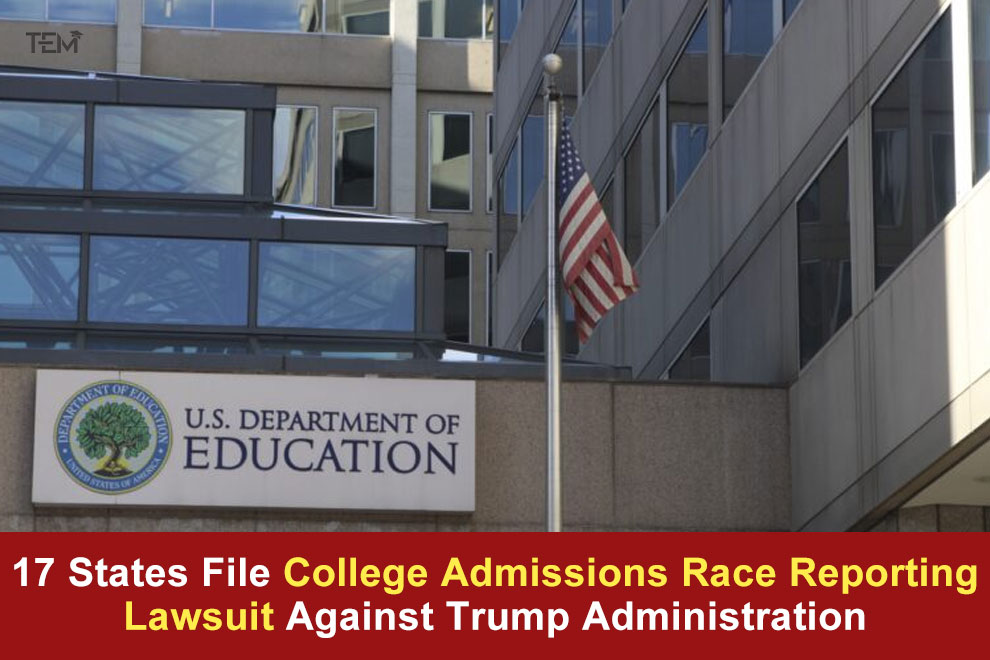
BOSTON, March 11, 2026. A coalition of 17 Democratic state attorneys general filed a college admissions race reporting lawsuit.
On Wednesday, in federal court in Boston, challenging a Trump administration policy that requires higher education institutions to submit detailed racial and demographic admissions data to prove they are not considering race in their admissions processes.
The case is the latest legal confrontation over higher education policy since the Supreme Court’s 2023 ruling in Students for Fair Admissions v. Harvard, which banned race-based affirmative action in admissions but preserved the right of applicants to discuss how race has personally shaped their lives in their essays.
What the Federal Government Is Requiring
The new mandate expands the existing Integrated Postsecondary Education Data System (IPEDS), the federal government’s existing higher education data tool, expanded to track post-ruling admissions compliance.
Under the requirements finalized on December 18, 2025, the National Center for Education Statistics will collect race- and sex-disaggregated data on applicants, admitted students, and enrolled students.
Education Secretary Linda McMahon has directed colleges to submit this data by March 18, retroactively covering the past seven years.
Institutions that fail to provide timely, complete, and accurate data face severe financial penalties under Title IV of the Higher Education Act of 1965, with each violation potentially carrying a fine exceeding $71,000, part of a broader set of federal compliance obligations for universities that have expanded significantly under the current administration.
President Trump ordered the policy in August, citing concerns that colleges were using personal statements and other indirect means to factor race into admissions, conduct he views as illegal discrimination under the Supreme Court’s ruling.
The policy mirrors elements of settlement agreements the federal government negotiated with Brown University and Columbia University to restore their federal research funding, under which both schools agreed to submit race-disaggregated admissions records.
The administration has also sued Harvard University after the school missed deadlines to report its information, a sign of how aggressively the federal government is now policing the post-ruling Ivy League admissions process.
Why States Are Suing
The 17 attorneys general representing California, Massachusetts, Maryland, New York, and 13 other states argue this college admissions race reporting lawsuit is necessary to block IPEDS requirements they call rushed, vague, and unlawful.
Maryland Attorney General Anthony G. Brown said the mandate leaves institutions with no good options:
“This mandate puts Maryland’s colleges and universities in an impossible position: face the threat of federal penalties, or comply with vague, rushed rules, and risk exposing sensitive student data to a federal government that has already shown it will weaponize that information.”
The coalition’s core legal argument is that the Department of Education failed to provide clear definitions for the terms colleges must report on, leaving institutions guessing what information is required while facing steep financial penalties if they guess wrong.
Massachusetts AG Andrea Joy Campbell added that the compressed timeline makes accurate compliance practically impossible, while the department has simultaneously cut the staff responsible for guiding universities on reporting.
California Attorney General Rob Bonta framed the data demand as politically motivated, pointing to the administration’s dismantling of the Department of Education’s Office of Civil Rights, which left thousands of civil rights complaints unresolved as evidence that the government cannot be trusted as a neutral arbiter of this data.
The plaintiffs also argue that the depth of granular, individual-level data the new IPEDS component demands jeopardizes student privacy, placing it in conflict with existing data protection obligations universities hold toward their students.
The Administration’s Defense
The Education Department pushed back directly. Spokesperson Ellen Keast argued that American taxpayers invest over $100 billion into higher education each year and deserve transparency on how those funds are being used, adding: “What exactly are State AGs trying to shield universities from?”
A New Front in the Post-Affirmative Action Debate
The college admissions race reporting lawsuit reflects a fundamental shift in higher education legal battles. With race-conscious admissions now banned, the dispute has moved to whether the federal government can use sweeping data mandates to police compliance and whether the speed and scope of those mandates are themselves unlawful.
If granted an injunction, universities may continue under existing IPEDS practices pending trial. If not, institutions face the March 18 deadline with no clear compliance roadmap, adding to the federal funding pressures already reshaping universities across the country.
FAQs
- Can colleges still mention race in admissions essays after the Supreme Court ruling?
Yes. The Supreme Court’s 2023 decision in Students for Fair Admissions v. Harvard banned using race as a categorical factor in admissions but explicitly preserved applicants’ right to discuss how race has personally shaped their lives in their essays. The new federal data mandate is partly aimed at monitoring whether colleges are using those essays as a back channel to factor race into decisions.
- What happens to colleges that miss the March 18 data deadline?
Under Title IV of the Higher Education Act, Education Secretary Linda McMahon can take action against non-compliant institutions, including penalties that could affect their eligibility for federal student financial aid and fines exceeding $71,000 per violation.