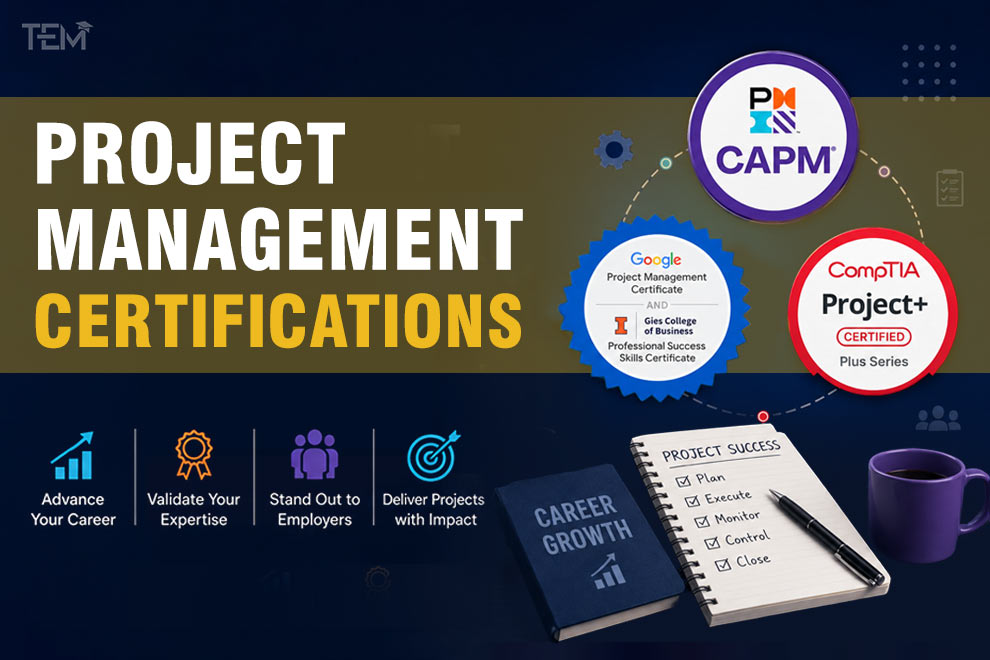
A project management certification validates your ability to plan, execute, and deliver complex initiatives on time and within budget. In 2026, if you’ve been searching for the right project management certification, you’ve probably noticed there isn’t a single “best” option. A certification that’s perfect for an experienced project manager may not be the right choice for a recent graduate or someone switching careers.
That’s why this guide compares the top project management certifications based on cost, eligibility, salary potential, and career goals so you can choose the one that fits your situation rather than following a one-size-fits-all recommendation.
This comprehensive guide compares the top 15 credentials across costs, eligibility requirements, salary potential, exam difficulty, and career outcomes to help you select the exact path for your goals.
At a Glance Summary Box
Match your professional profile with the best industry standard certification below.
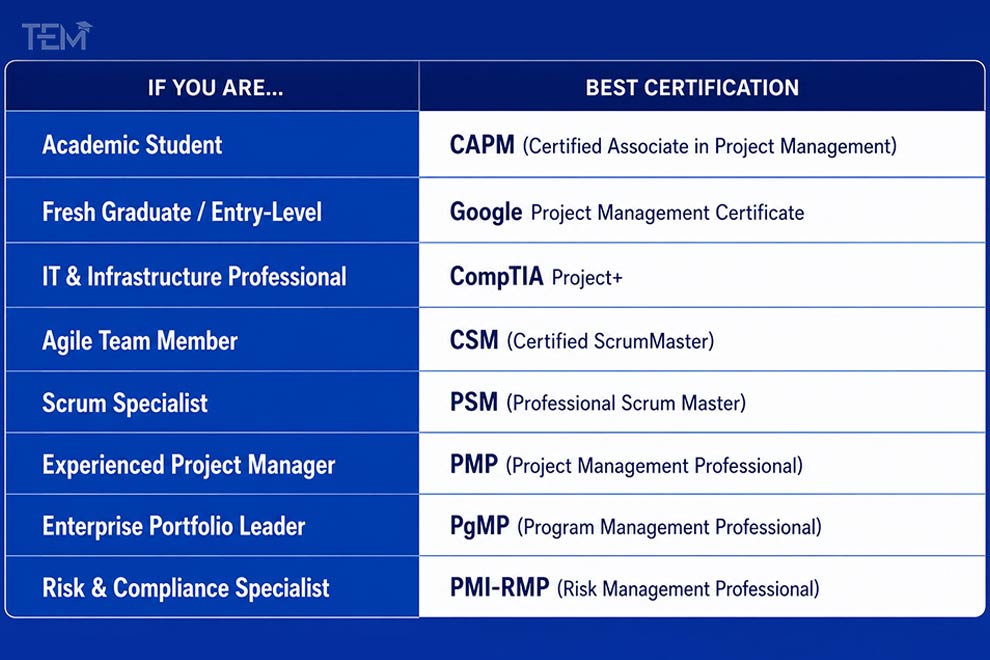
Table of contents
- At a Glance Summary Box
- What Is a Project Management Certification?
- Why Should You Get a Project Management Certification?
- How We Selected These Certifications
- Which Project Management Certification Is Right for You?
- 15 Best Project Management Certifications
- 1. PMP (Project Management Professional)
- 2. CAPM (Certified Associate in Project Management)
- 3. PRINCE2 Foundation (Projects in Controlled Environments)
- 4. PRINCE2 Practitioner
- 5. PMI-ACP (PMI Agile Certified Practitioner)
- 6. CSM (Certified ScrumMaster)
- 7. PSM I (Professional Scrum Master I)
- 8. SAFe Agilist (Scaled Agile Framework)
- 9. CompTIA Project+
- 10. PgMP (Program Management Professional)
- 11. PMI-RMP (Risk Management Professional)
- 12. Google Project Management Professional Certificate
- 13. ITIL 4 Foundation (Information Technology Infrastructure Library)
- 14. Lean Six Sigma Green Belt
- 15. Certified Project Director (CPD)
- Certification Comparison Table
- Which Certification Fits Your Situation?
- Best Project Management Certifications by Career Stage & Industry
- Project Management Certification Cost Comparison
- Highest Paying Project Management Certifications
- Certification Difficulty Comparison
- Scannable Goal Comparison Chart
- Certification Roadmap
- Common Mistakes When Choosing a Certification
- Which Project Management Certification Should You Choose?
- FAQ
What Is a Project Management Certification?
A project management certification is a formal, globally recognized credential awarded by leading professional bodies (like PMI, PeopleCert, or Scrum Alliance) that validates an individual’s knowledge, skills, and competence in leading and managing projects.
Employers demand these credentials because they offer independent validation of standard methodologies like Waterfall and Agile. Achieving a certification demonstrates mastery of practical skills, including risk management, budget management, stakeholder management, and project scheduling, which translates to fewer failed projects, higher efficiency, and immediate baseline credibility in any corporate leadership environment.
Many hiring managers don’t expect entry-level candidates to hold a senior-level credential. Instead, they often value candidates who understand project management fundamentals and can demonstrate practical experience through internships, academic projects, or entry-level certifications. Keep in mind that certifications alone don’t guarantee a promotion. Employers usually look for a combination of practical experience, communication skills, and leadership ability.
Why Should You Get a Project Management Certification?
Earning a professional credential in 2026 provides a distinct competitive edge across multiple areas:
- Career Progression: Earning a formal certification standardizes your knowledge, signaling to leadership that you are ready to move from tactical implementation to strategic planning.
- More Interviews: Many ATS algorithms and HR teams screen out resumes that lack baseline credentials like the PMP, PRINCE2, or CSM.
- Leadership Roles: Credentials validate your readiness to manage enterprise-level corporate budgets, resources, and cross-functional teams.
- Global Recognition: Leading certifications use standardized frameworks, meaning your credentials carry weight in the US, Europe, Asia, and the Middle East.
- Better Project Delivery: Structured frameworks lead to a higher success rate for timelines, cost metrics, and quality constraints.
- AI-Era Project Management Skills: Modern certifications now include frameworks for utilizing generative AI in project planning, predictive data modeling, and automated resource allocation.
- Career Switching: Certification bridges the gap for professionals migrating into corporate leadership from purely technical, educational, or creative roles.
How We Selected These Certifications
- Employer Recognition: We analyzed hiring trends, job board requirements, and active global recruiter search queries.
- Global Acceptance: We filtered for frameworks recognized across multiple geographic regions and industries.
- Skill Development: Evaluated the modern utility of the syllabus, checking for practical governance, methodology, and AI integration.
- Exam Difficulty & Pass Rates: Evaluated study hours, prerequisite demands, and cognitive complexity of the evaluations.
- Renewal Requirements: Ensured the ongoing professional development units (PDUs) match continuous industry education standards.
- Total Cost Investment: Factored in membership, exam vouchers, mandatory training hours, and hidden fees.
Which Project Management Certification Is Right for You?
| If Your Priority Is… | Best Certification | Why It’s Recommended |
| First project management job | CAPM | Ideal for beginners with little or no experience. |
| Career change | Google Project Management Certificate | Self-paced, beginner-friendly, and no experience required. |
| Global recognition | PMP | Widely accepted across industries and countries. |
| Agile project management | PMI-ACP or CSM | Best for Agile and Scrum-based teams. |
| IT project management | CompTIA Project+ | Focuses on technology-driven project environments. |
| Government or public sector | PRINCE2 Practitioner | Commonly used in government and enterprise projects. |
| Senior leadership roles | PgMP | Designed for managing multiple strategic programs. |
| Budget-friendly certification | PSM I | Lower exam cost with strong industry recognition. |
15 Best Project Management Certifications
1. PMP (Project Management Professional)
- Overview: One of the most respected project management certifications worldwide, administered by the Project Management Institute (PMI).
- Eligibility: Four-year degree, 36 months of leading projects, and 35 hours of project management education; OR high school diploma, 60 months of leading projects, and 35 hours of training.
- Skills Learned: Predictive Waterfall methodology, Agile methodology, hybrid lifecycle execution, stakeholder management, budget management, and team leadership.
- Pros: Highly respected by Fortune 500 companies; covers diverse project methodologies.
- Cons: Expensive; strict eligibility requirements; difficult exam with high stakes.
- Career Opportunities: Senior Project Manager, PMO Director, Delivery Manager, Operations Lead.
- Difficulty Level: Hard.
- Official Website: pmi.org
- Real-World Example: A senior software project manager leading enterprise cloud migration projects can significantly strengthen their profile with PMP because many multinational employers list it as a preferred qualification.
2. CAPM (Certified Associate in Project Management)
- Overview: PMI’s introductory credential is designed to validate core terminology and fundamental knowledge of project processes.
- Eligibility: Secondary degree (high school diploma or global equivalent) and 23 hours of formal project management education.
- Skills Learned: Project lifecycle phases, predictive business analysis, agile project delivery basics, and issue management frameworks.
- Pros: No practical leadership experience required; excellent stepping stone toward the PMP.
- Cons: Limited weight for executive-level or highly competitive roles.
- Career Opportunities: Project Coordinator, Associate Project Manager, Junior Business Analyst.
- Difficulty Level: Easy to Moderate.
- Official Website: pmi.org
- Who Should Skip CAPM? If you already have several years of project management experience, it may be better to prepare directly for PMP instead of investing time in CAPM.
3. PRINCE2 Foundation (Projects in Controlled Environments)
- Overview: A methodology-focused certification owned by PeopleCert that emphasizes process-driven control and governance.
- Eligibility: None (no prerequisites).
- Skills Learned: Structured business case validation, definition of organizational roles, product-based planning, and change control.
- Pros: Highly structured, widely required across international governments; simple entry requirements.
- Cons: Very rigid; lacks a deep emphasis on team leadership soft skills compared to PMI frameworks.
- Career Opportunities: Project Analyst, Project Administrator, Junior Project Manager.
- Difficulty Level: Easy to Moderate.
- Official Website: peoplecert.org
- Regional Nuance: While North American markets favor standard PMI paths, UK-based agencies or public institutions often list PRINCE2 Foundation as a fundamental prerequisite for administrative compliance.
4. PRINCE2 Practitioner
- Overview: The advanced layer of the PRINCE2 methodology that tests a professional’s ability to apply the framework to real-world corporate scenarios.
- Eligibility: Must pass PRINCE2 Foundation (or hold a valid PMP/CAPM).
- Skills Learned: Customizing PRINCE2 themes, managing product deliveries, scaling processes for risk profiles, and business case tracking.
- Pros: Highly respected in corporate governance; solid confirmation of practical application skills.
- Cons: Less prioritized in the US tech market, where pure Agile or PMP dominates.
- Career Opportunities: Senior Project Manager, Technical Project Lead, PMO Consultant.
- Difficulty Level: Hard.
- Official Website: peoplecert.org
- Prerequisite Fast Track: Many professionals overlook that holding an active PMP or CAPM completely bypasses the PRINCE2 Foundation exam requirement, letting you skip directly to this Practitioner credential.
5. PMI-ACP (PMI Agile Certified Practitioner)
- Overview: PMI’s rapid-growth certification covering various agile approaches, including Scrum, Kanban, Lean, and Extreme Programming (XP).
- Eligibility: 2,000 hours of general project experience, 1,500 hours working on agile project teams, and 21 contact hours in agile practices.
- Skills Learned: Value-driven delivery, collaborative stakeholder engagement, adaptive planning, continuous improvement models, and agile metrics.
- Pros: Broad approach covering multiple agile frameworks instead of focusing strictly on Scrum.
- Cons: Extensive dual eligibility requirements for both traditional and agile hours.
- Career Opportunities: Agile Project Manager, Product Owner, Scrum Master.
- Difficulty Level: Moderate to Hard.
- Official Website: pmi.org
- Methodology Versatility: Unlike single-framework credentials, the PMI-ACP exposes you to mixed Agile ecosystems, which is highly valuable for modern companies that use hybrid frameworks.
6. CSM (Certified ScrumMaster)
- Overview: The most visible entry-level Scrum certification globally, administered by the Scrum Alliance.
- Eligibility: Mandatory attendance of a live 2-day interactive training course led by a Certified Scrum Trainer (CST).
- Skills Learned: Scrum framework mechanics, sprint planning execution, daily stand-up curation, backlog grooming, and servant leadership.
- Pros: High pass rate; globally standardized; immediate recognition across software sectors.
- Cons: Requires a recurring course fee every 2 years to maintain; basic technical depth.
- Career Opportunities: Scrum Master, Team Lead, Agile Coach.
- Difficulty Level: Easy.
- Official Website: scrumalliance.org
- Interactive Classroom Value: The mandatory live course requirement ensures you learn conflict resolution mechanics through real-time group simulation workshops rather than isolated electronic text review.
7. PSM I (Professional Scrum Master I)
- Overview: Scrum.org’s rigorous, test-first certification assessing structural adherence to official Scrum guides.
- Eligibility: None (course attendance is optional; you can purchase the exam directly).
- Skills Learned: Core Scrum theory, product delivery accountability, team cross-functional optimization, and sprint goals.
- Pros: Affordable; credentials never expire (no renewal fees); highly respected for its strict passing score (85%).
- Cons: No room for error on the exam; lacks the live network benefits of the CSM track.
- Career Opportunities: Agile Team Lead, Delivery Specialist, Scrum Master.
- Difficulty Level: Moderate to Hard.
- Official Website: scrum.org
- The Lifetime Advantage: Because the PSM I requires no ongoing maintenance fees or professional credit filings, it is a highly popular option for developers wanting a baseline agile credential.
8. SAFe Agilist (Scaled Agile Framework)
- Overview: A leading enterprise scaling framework credential certifying the ability to run Agile across massive corporate portfolios.
- Eligibility: Attendance of a mandatory 2-day Leading SAFe training course.
- Skills Learned: Lean-Agile budgeting, Agile Product Delivery (APD), Program Increment (PI) Planning, and DevOps enterprise alignment.
- Pros: Highly paid; critical for massive digital transformations across banking, insurance, and aviation.
- Cons: Limited value outside of massive enterprise settings; complex terminology.
- Career Opportunities: Release Train Engineer (RTE), Agile Transformation Consultant, Enterprise Program Manager.
- Difficulty Level: Moderate.
- Official Website: scaledagile.com
- Corporate Scale Insight: SAFe is specifically geared toward corporate portfolios where multiple Scrum teams must be systematically synchronized to maintain enterprise quality benchmarks.
9. CompTIA Project+
- Overview: An IT-centric, entry-level project management certification that tests fundamentals of the technology development lifecycle.
- Eligibility: Recommended 1 year of managing small-scale technical projects.
- Skills Learned: Business continuity basics, resource allocation matrices, IT infrastructure deployment scheduling, and change management tools.
- Pros: Focuses on distinct technology requirements; no complex renewal requirements.
- Cons: Rarely sought after outside of core IT or tech infrastructure setups.
- Career Opportunities: IT Project Coordinator, Tech Operations Analyst, Systems Lead.
- Difficulty Level: Easy to Moderate.
- Official Website: comptia.org
- Tech Sector Niche: While generic certifications focus on broad human interactions, Project+ teaches IT-specific situations, such as managing system downtime and software patches.
10. PgMP (Program Management Professional)
- Overview: An elite, senior-level PMI credential validating your ability to coordinate multiple, complex parallel projects aligned to strategic business objectives.
- Eligibility: 4-year degree, 48 months of project management experience, and 48 months of program management experience; OR high school diploma with 48 months of project experience and 84 months of program experience.
- Skills Learned: Program lifecycle management, benefit realization modeling, stakeholder governance, and portfolio resource orchestration.
- Pros: Exceptionally high earning tier; sets you apart from baseline PMP holders.
- Cons: Extremely demanding, multi-step application review board panel step; expensive.
- Career Opportunities: Program Manager, PMO Director, Vice President of Delivery.
- Difficulty Level: Very Hard.
- Official Website: pmi.org
- Strategic Level Impact: Earning a PgMP marks a transition from tactical delivery to senior organizational governance, focusing on program benefits realization rather than individual project tasks.
11. PMI-RMP (Risk Management Professional)
- Overview: A specialized PMI certification tracking ability to identify, analyze, mitigate, and control potential project hazards.
- Eligibility: 4-year degree plus 24 months of specialized project risk experience and 30 hours of education; OR high school diploma with 36 months of risk management and 40 hours of education.
- Skills Learned: Quantitative risk analysis, contingency reserve budgeting, stakeholder risk appetite profiling, and threat mitigation strategies.
- Pros: Highly valued in unstable economic environments or volatile engineering industries.
- Cons: Highly niche; less value for standard, everyday operations managers.
- Career Opportunities: Project Risk Analyst, Strategic Consultant, Senior Project Director.
- Difficulty Level: Hard.
- Official Website: pmi.org
- Crisis Management Focus: This specialization is highly regarded in sectors like volatile oil exploration and infrastructure development, where mathematical risk modeling directly impacts bottom-line performance.
12. Google Project Management Professional Certificate
- Overview: A popular online course series created by Google to provide foundational skills via interactive online modules.
- Eligibility: None (open enrollment).
- Skills Learned: Project initiation, tracking schedules, budget creation templates, introduction to Agile methodology, and leveraging generative AI project planning tools.
- Pros: Cheap; hands-on portfolio case studies; includes direct access to an employer consortium.
- Cons: Not a strict formal examination; carries lower technical authority than PMP.
- Career Opportunities: Junior Project Manager, Project Assistant, Operations Coordinator.
- Difficulty Level: Low to Moderate.
- Official Website: coursera.org/professional-certificates/google-project-management
- What You’ll Actually Build: Throughout the program, learners complete practical exercises such as project plans, schedules, stakeholder communication templates, and risk registers that can be showcased in a portfolio.
13. ITIL 4 Foundation (Information Technology Infrastructure Library)
- Overview: The premier global framework for managing digital services and aligning tech operations to business strategic value.
- Eligibility: None.
- Skills Learned: IT service value chains, continuous service improvement, incident management lifecycles, and cloud resource coordination.
- Pros: Essential baseline requirement across global IT operations and enterprise tech consulting firms.
- Cons: Highly theoretical text structures; limited focus on physical or non-tech deliverables.
- Career Opportunities: Service Delivery Manager, Technical Project Manager, PMO Analyst.
- Difficulty Level: Easy to Moderate.
- Official Website: peoplecert.org
- Service Ecosystem Value: ITIL 4 complements project management credentials by teaching you how to smoothly transition a completed project into live, sustainable tech support environments.
14. Lean Six Sigma Green Belt
- Overview: A process-optimization credential focusing on reducing waste, removing operational defects, and driving continuous quality improvement.
- Eligibility: Varies by board (typically requires completion of a real-world quality improvement project case study).
- Skills Learned: DMAIC framework (Define, Measure, Analyze, Improve, Control), root cause analysis, statistical process monitoring, and waste reduction.
- Pros: Highly valued for its emphasis on technical quality and cost savings.
- Cons: Not a pure project management methodology; heavily quantitative.
- Career Opportunities: Continuous Improvement Manager, Operations Project Leader, Process Engineer.
- Difficulty Level: Moderate to Hard.
- Official Website: iassc.org / asq.org
- Operational Optimization Focus: Green Belts don’t just launch new products; they meticulously analyze and fix broken workflow dependencies to extract hidden profitability from existing assets.
15. Certified Project Director (CPD)
- Overview: An executive-level certification issued by the Global Academy of Finance and Management (GAFM) for senior leadership architecture.
- Eligibility: Degree plus 5+ years of senior executive management experience.
- Skills Learned: Enterprise risk governance, corporate asset allocation, high-level negotiation, and multi-million-dollar budget tracking.
- Pros: Skips standard entry test models if you possess deep real-world executive history.
- Cons: Low brand recognition compared to the premium Record-Driven PMI PgMP standard.
- Career Opportunities: Chief Operating Officer (COO), Vice President of Operations, Head of PMO.
- Difficulty Level: Hard (due to strict professional screening).
- Official Website: gafm.com
- Executive Shortcut: For seasoned leaders with over a decade of real-world history, the CPD bypasses traditional textbook tests to focus on verifying your corporate track record.
Certification Comparison Table
| Certification | Beginner Friendly? | Total Cost (Est.) | Duration | Renewal Required? | Salary Potential | Best For |
| PMP | No | $700 – $1,500 | 2–4 Months | Yes (Every 3 Yrs) | High ($115K+) | Experienced Managers |
| CAPM | Yes | $300 – $500 | 1–2 Months | Yes (Every 3 Yrs) | Mid ($70K+) | Aspiring PMs without experience |
| PRINCE2 Found. | Yes | $400 – $750 | 1–2 Weeks | Yes (Every 3 Yrs) | Mid ($80K+) | UK, Europe, & Public Sector |
| PMI-ACP | No | $500 – $800 | 1–2 Months | Yes (Every 3 Yrs) | High ($110K+) | Agile/Scrum cross-methodologies |
| CSM | Yes | $400 – $1,000 | 2 Days | Yes (Every 2 Yrs) | High ($95K+) | Software & Tech Scrum Teams |
| PSM I | Yes | $150 | 1–2 Weeks | No (Lifetime) | High ($100K+) | Budget-focused Scrum Master path |
| Google PM | Yes | $150 – $300 | 3–6 Months | No | Entry ($65K+) | Complete Beginners & Freshers |
| PgMP | No | $1,000+ | 3–6 Months | Yes (Every 3 Yrs) | Highest ($140K+) | Enterprise Multi-Project Leaders |
Which Certification Fits Your Situation?
1. I’m a College Student
Your primary operational barrier is a lack of professional corporate experience. For this scenario, an introductory terminology test builds the prerequisite industry vocabulary and project lifecycle knowledge required to successfully target highly competitive post-graduate internships and junior corporate coordinator tracks.
2. I’m Switching Careers
When migrating from non-corporate fields (such as education, retail management, or healthcare administration), you need more than simple text comprehension, you need practical artifacts. A portfolio-driven online certificate enables you to walk into interviews with realistic project plans, communication trackers, and risk logs to demonstrate active readiness to hiring managers.
3. I Work in Software Development
The tech sector operates on continuous, rapid iterations rather than long, rigid planning cycles. For this scenario, validating your ability to coordinate rapid team stand-ups, protect developer workflows, eliminate operational blocks, and manage product delivery backlogs is your most direct path to leadership roles within engineering environments.
4. I Manage Construction Projects
Physical job sites require strict cost controls, risk mitigation plans, and supply chain tracking. A framework that combines traditional process governance with continuous improvement and statistical waste reduction ensures you can accurately manage complex vendor delivery timelines, establish proper contingency reserves, and prevent expensive rework.
5. I Want to Work Abroad
If you are planning an international relocation, your credentials must match the regulatory preferences of your target region. A widely recognized, globally applicable framework serves as the standard in North America, the Middle East, and major corporate hubs across Asia. However, if your destination is the UK, continental Europe, or public sector agencies, process-driven governance compliance is often a mandatory administrative prerequisite.
6. I Already Have Five Years of Experience
If you possess a proven track record of leading projects, skip the introductory certificates completely. Preparing directly for a milestone corporate framework is your most efficient move. It automatically clears automated resume screens for senior management openings and signals to executives your readiness to manage enterprise-level budgets, resources, and cross-functional teams.
Best Project Management Certifications by Career Stage & Industry
Progression Advice by Career Stage
- Foundational Layer (Freshers & Graduates): Focus on introductory frameworks that establish clear industry vocabulary and baseline methodologies without requiring historical log hours. This demonstrates ambition and structure early on.
- Transition Layer (Career Changers): Prioritize learning tracks that emphasize hands-on project artifact construction (such as charts, schedules, and dashboards) over pure test memorization. This provides tangible proof of your transferable skills.
- Mastery Layer (Experienced Managers): Focus completely on advanced credentials that serve as critical vetting filters for senior corporate leadership vacancies. These prove your ability to navigate governance, complex team dynamics, and business strategy.
Progression Advice by Target Industry
- Tech & Software Engineering: Prioritize rapid scrum mastery and team-level iteration frameworks to sync smoothly with agile product deployment backlogs and short sprint schedules.
- Information Technology Infrastructure: Focus on service design frameworks and tech-centric coordination tracks that align with digital rollouts, database migrations, and live support level agreements.
- Healthcare & Life Sciences: Choose broad, traditional governance frameworks to successfully navigate multi-layered regulatory compliance shifts, complex health informatics tracking, and strict administrative auditing.
- Heavy Industry & Construction: Pair traditional lifecycle scheduling with data-driven process optimization tools to maintain strict bottom-line cost controls and extract hidden margin efficiency from supply chain dependencies.
- Finance, Banking & Enterprise Portfolios: Lean heavily toward enterprise-scale scaling frameworks to learn how to coordinate hundreds of parallel development pipelines under consumer compliance rules.
- Public Sector & Defense Contracting: Prioritize process-driven governance paths, which are often legally or contractually mandated across public sector contracts throughout Europe and the Commonwealth.
Project Management Certification Cost Comparison
| Certification | Training Cost (Est.) | Exam Cost | Renewal Fee (3-Yr) | Total Initial Investment |
| PMP | $200 – $600 | $425 (Member) | $60 Member / $150 Non-Member | $700 – $1,200 |
| CAPM | $50 – $200 | $225 (Member) | $60 Member / $150 Non-Member | $300 – $500 |
| PRINCE2 Found. | Included in bundle | $400 – $750 | ~$50/year equivalent | $400 – $850 |
| CSM | Included in the course | Included in the course | $100 (Every 2 Years) | $400 – $1,000 |
| PSM I | Optional ($0 – $300) | $150 | $0 (Lifetime) | $150 – $450 |
| Google PM | Included ($49/mo) | Included | $0 (Lifetime) | $150 – $300 |
Highest Paying Project Management Certifications
| Certification | Industry Demand Driver | Top Global Countries | Primary Focus Areas | Demand Level |
| PgMP | Enterprise Strategy Oversight | US, UK, UAE, India | Multi-Project Portfolio Syncing | Very High (Niche) |
| SAFe Agilist | Digital Transformation Scale | US, Germany, India | Synchronizing Large Tech Teams | High |
| PMP | Core Recruiter Target Checklist | Worldwide | General Cross-Lifecycle Governance | Maximum |
| PMI-ACP | Mixed Methodology Delivery | US, Canada, Australia | Hybrid Agile/Waterfall Frameworks | High |
| CSM | Scrum Team Efficiency | US, India, UK | Servant Leadership & Sprints | High |
Certification Difficulty Comparison
1. Easy
- Google Project Management Certificate: Low barrier to entry. Entirely self-paced multiple-choice module quizzes with open retakes. Requires roughly 30–50 hours of total study; 0 years of experience needed.
- CSM: 16 hours of mandatory live attendance. High pass rate (95%+). Requires 0 years of experience.
2. Moderate
- CAPM: Focuses on pure memorization of project terminology frameworks. Requires 60–80 hours of study time; 0 years of experience needed.
- PSM I: Requires an 85% passing grade on a rapid 60-minute test window. Requires 20–40 hours of focused study; 0 years of experience needed.
3. Hard
- PMP: Highly complex, scenario-based 180-question test framework. Requires 100–150 hours of deep preparation, a typical 60%-70% pass rate, and 3 to 5 years of verified leadership experience.
- PRINCE2 Practitioner: Complex application matching across dry, objective situational booklets. Requires 40–60 hours of study time and passing the core foundation layer.
4. Very Hard
- PgMP: Demands an intense double-gated system: a detailed independent steering panel application review followed by a difficult scenario evaluation. Requires 200+ hours of study time and 4 to 7+ years of program management experience.
Scannable Goal Comparison Chart
| Career Goal | Target Focus Area | Recommended Credential Level |
| Secure First Job / Internship | Fundamental Terminology & Processes | Introductory Associate Track |
| Pivoting Careers / Build Portfolio | Hands-On Tool Templates & Artifacts | Practical Self-Paced Certificate |
| Optimize Core Tech Projects | Infrastructure & Systems Lifecycle | IT-Centric Foundation Track |
| Lead Fast Tech/Software Teams | Sprints, Backlogs & Team Scrum | Entry-Level Scrum Master Baseline |
| Clear Corporate Senior Filters | Comprehensive Predictive & Agile Governance | Premium Professional Milestone |
| Direct Multi-Project Portfolios | High-Level Enterprise Business Strategy | Senior Program / Director Board |
Certification Roadmap
[Student / Fresh Graduate] ──► Google PM Certificate or CAPM
│
▼
[3+ Years Field Experience] ──► PMP (Core Framework Mastery)
│
▼
[Specialized Tech Path] ──► CSM / PSM I ──► PMI-ACP ──► SAFe Agilist
│
▼
[Executive Leadership] ──► PgMP or Certified Project Director
Common Mistakes When Choosing a Certification
- Choosing only based on salary metrics: Opting for a complex enterprise scaling tool (like SAFe) when your actual career environment is a small marketing agency will yield limited practical utility.
- Ignoring strict eligibility prerequisites: Submitting applications for the PMP without meeting the mandatory 36 months of documented project history results in audit failure or rejection.
- Skipping ongoing renewal requirements: Forgetting that options like the PMP or CSM require consistent professional development units (PDUs) or fees to avoid expiring.
- Not checking active employer demand: Pursuing regional or niche frameworks when your target job listings exclusively specify PMP or ScrumMaster requirements.
- Ignoring regional industry preferences: Studying PRINCE2 for a role in a small US tech startup, where agile methodologies or standard PMI certifications are preferred.
If you already meet the necessary eligibility rules, prioritize the PMP. It offers an excellent return on investment and holds lasting credibility across industries. If you are brand new to the field, start with the Google Project Management Certificate or CAPM to build baseline knowledge before investing in advanced credentials.
Which Project Management Certification Should You Choose?
The best project management certification isn’t necessarily the most famous—it is the one that perfectly balances your existing experience, career trajectory, and chosen industry constraints.
To determine your immediate next steps, leverage this quick diagnostic framework:
- Entry-Level Focus: If you have zero field hours and need to learn the basics, choose a foundational portfolio-builder or an introductory associate track to validate your intent.
- Corporate Advancement Focus: If you meet the 3-year leadership prerequisite, focus entirely on clearing a premium milestone standard to pass automated HR filters.
- Technical Iteration Focus: If your goal lies strictly in software deployment, select a team-level or enterprise agile scaling model over traditional waterfall systems.
- Regional Compliance Focus: If you are operating under public contracts or European corporate structures, choose process-driven governance compliance tracks.
Actionable Next Step: Document your exact leadership hours, determine your target geographic or industry sector, and secure your preparatory course or exam voucher bundle to systematically upgrade your professional profile.
Note: No single certification is the “best” for everyone. The right choice depends on your experience, career goals, preferred project management methodology, and the industries you plan to work in.
FAQ
- What is the best project management certification?
The PMP (Project Management Professional) is widely considered the best project management certification for experienced professionals.
- Which project management certification has the highest salary?
The PgMP (Program Management Professional) typically offers the highest earning potential, with experienced professionals often earning $145,000+ USD annually.
- Which project management certification is the easiest to earn?
The Google Project Management Certificate is one of the easiest certifications for beginners because it is self-paced, requires no prior experience, and has no formal eligibility requirements.