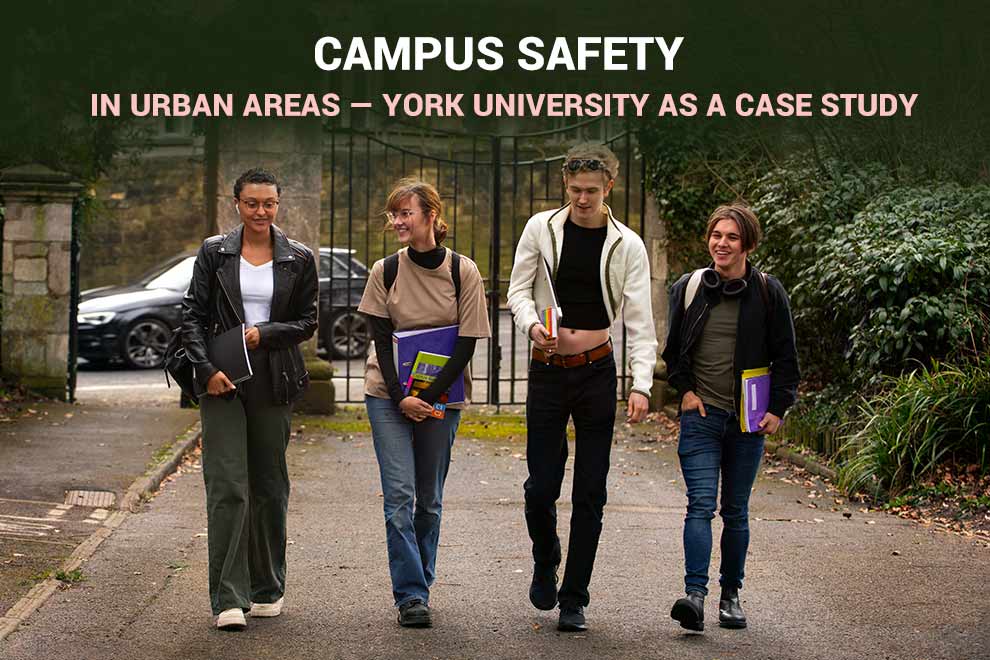
In large urban university settings, safety is foundational to student well-being, retention, and institutional reputation. As campuses stretch across dense city zones, universities must strike a balance between openness and vigilance.
Toronto’s York University, with its sprawling Keele, Glendon, and Markham campuses, offers a real-world example of how a major institution in an urban context is applying and adapting its security infrastructure and policies.
Students flock to urban universities for the unparalleled opportunities they offer for networking, internships, and exciting lifestyles. York is no exception. At York, campus safety is handled through a multi-layered system of policies, services, and protocols overseen by the Community Safety and Security Services units. Key features include:
- Security Control Centre & CCTV: The central hub monitors alarms, video feeds, and dispatches security teams across campuses around the clock.
- goSAFE Escort Service: Students can request staff escorts across campus after dark, wait for buses or taxis, or be accompanied between buildings. This service is free and can be summoned via Blue Light phones or safety phones.
- Policy Frameworks: York maintains formal safety policies — including protocols for missing persons, access control, surveillance guidelines, and active threat responses.
- Incident Reporting & Transparency: The university publishes monthly logs and annual statistics on service calls and security incidents.
- Review & Reform: In 2024, York advanced the rollout of recommendations from an internal review of Security Services, aiming to transition toward a “community-centric” safety model that stresses equity, bias-awareness, transparency, and collaboration.
Residents in York’s on-campus housing are also integrated into safety culture via the Residence Life handbook, which spells out safety measures, staff responsibilities, and standards of conduct. York encourages students to adopt basic precautions: be alert, report suspicious behaviour, use goSAFE, and avoid walking alone through dim or isolated areas.
Institutions in Toronto and other major cities increasingly publish annual safety reports or public dashboards, submit to external audits, or publish response protocols. Such transparency is becoming expected in public higher education. In smaller or rural universities, such as those in Atlantic Canada or parts of the Prairies, safety often relies heavily on campus perimeter, limited external exposure, and closer community norms. But York operates in a dense urban zone, adjacent to busy transit corridors and major roadways. The existence of the York University subway station, for instance, shows how interwoven the campus is with the city’s transport grid.
York’s investment in camera networks, centralized monitoring, coordinated staff, and transparent reporting reflects an understanding of urban risks. The push toward a community-centric model aims to temper heavy security with accountability and trust.
York University’s safety infrastructure illustrates what a large, urban university must do to balance openness and protection. Through escorts, CCTV, reporting, policy frameworks, and internal reform, York is building a layered model of campus safety that acknowledges the complexity of its metropolitan context. But the student experience remains the ultimate test of whether those systems truly work. For urban campuses in Canada and beyond, York’s efforts offer a useful reference point, as well as a reminder that vigilance, adaptability, and community engagement will always be at the heart of campus safety.
Also Read: The University of Liverpool to Launch Bengaluru Campus in 2026