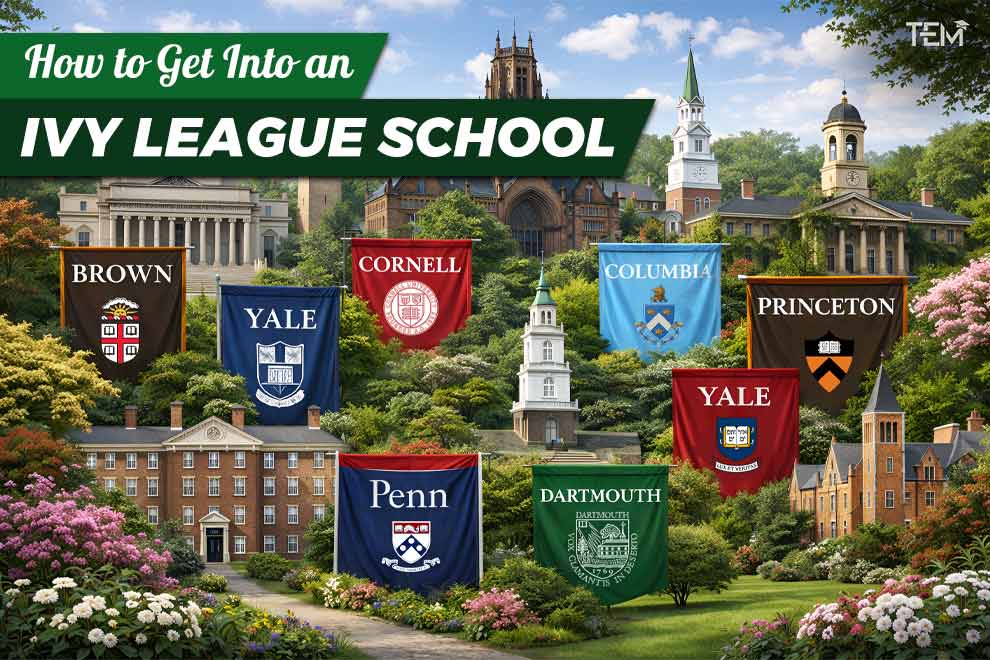
Understanding how to get into an Ivy League school in 2026 is no longer about following generic advice or chasing perfection. With acceptance rates falling below 4%, standardized testing making a return, and artificial intelligence now playing a role in application screening, Ivy League admissions have entered a new era.
Students and parents today aren’t confused about what these elite universities expect. They already know grades, test scores, and extracurriculars matter. The real challenge is learning how successful applicants position themselves in a system designed to turn away the vast majority of candidates.
This guide is built for that reality.
Drawing from official university data, admissions trend reports, and expert analysis from the latest 2025–2026 cycle, this article explains how Ivy League admissions actually work today. You’ll see why academic “spikes” now outperform well-rounded profiles, how Early Decision creates a real statistical edge, what AI looks for in essays, and where many strong applicants quietly lose ground.
This isn’t inspiration.
It’s a strategic blueprint.
How to Get Into an Ivy League School in 2026: Quick Takeaways
If you’re searching for how to get into an Ivy League School, here’s the reality of the 2026 admissions cycle: competition is fierce, acceptance rates are at historic lows, and strategy matters more than ever.
Before you read the full guide, here’s what actually moves the needle:
- Academic Rigor Beats Perfect GPA: Ivy League admissions value course difficulty over inflated grades.
- The “Spike” Strategy Wins: Depth in one academic area matters more than being well-rounded.
- Testing Is Back: Most Ivies now require SAT/ACT scores again, and high percentiles are critical.
- AI Screens Applications First: Essays must sound human, consistent, and authentic.
- Early Decision Is the Only Real Advantage: ED applicants often see 2–3× higher acceptance rates.
Now, let’s break down exactly how top applicants do this, step by step.
The Ivy League Landscape in 2026
The Ivy League has always been competitive, but the 2026 admissions cycle marks a turning point.
Across all eight Ivy League schools, the number of applicants continues to rise while class sizes remain largely unchanged. As a result, Regular Decision acceptance rates at several schools have dropped below 4%, making them statistically more selective than ever before.
At the same time, many Ivies have reversed their pandemic-era testing flexibility. Schools such as Harvard, Yale, Brown, and Dartmouth have reinstated mandatory standardized testing for the 2025–2026 cycle. This signals a clear shift: admissions offices want more standardized data points to evaluate applicants efficiently at scale.
Another defining change is operational. Admissions teams now rely on AI-assisted tools to summarize transcripts, scan recommendation letters, and flag inconsistencies, long before a human reader reviews an application. While final decisions are still made by people, the first level of screening is increasingly automated.
In short, Ivy League admissions in 2026 are more data-driven, more selective, and less forgiving of unfocused applications.
How Ivy League Admissions Really Work
Despite popular belief, Ivy League schools do not rank applicants in a simple order based on GPA or test scores. Instead, they use what’s called a holistic review, but that term is often misunderstood.
A holistic review does not mean “everyone has an equal chance.” It means each application is evaluated in context. Understanding the core factors of Ivy League admissions, from institutional priorities to intellectual direction, is essential for students who want to move beyond generic ‘well-rounded’ profiles
Admissions officers are not asking, “Is this student impressive?”
They are asking, “Does this student belong here, and why?”
This is where many applicants fail. They try to be excellent in every area, spreading themselves thin. Ivy League schools, however, increasingly favor students who demonstrate depth over breadth, those who show sustained focus, curiosity, and impact in a specific academic or intellectual direction.
Understanding this internal logic is critical. Once you see how decisions are made, the rest of the strategy becomes clearer.
Pillar 1: Academic Rigor Beyond the 4.0 GPA
When students ask how to get into an Ivy League school, the conversation often starts and ends with GPA. But in 2026, a perfect or near-perfect GPA is no longer a differentiator. It’s a baseline.
Ivy League admissions officers are not impressed by grades in isolation. What they evaluate instead is academic rigor, how challenging your course load was, how consistently you pushed yourself, and how your academic choices align with your intellectual direction.
A 3.85 GPA earned through the most demanding curriculum available often carries more weight than a 4.0 achieved through safer course selections.
What “Academic Rigor” Really Means
Academic rigor is judged in context. Admissions teams look at:
- The hardest courses offered at your school
- Whether you choose them
- How has your performance evolved over time
Advanced Placement (AP), International Baccalaureate (IB), A-Levels, and honors courses signal willingness to handle college-level work early. Programs like the IB Diploma or AP Capstone are especially valued because they demonstrate sustained intensity rather than isolated difficulty.
Equally important is the trajectory. A student who improves year over year, moving from strong to exceptional, often sends a more compelling signal than one who plateaus early.
Course Load Optimization (A Hidden Advantage)
One mistake many applicants make is loading up on advanced courses without direction. Ivy League schools don’t reward difficulty for its own sake. They reward intentional difficulty.
For example:
- A future engineering applicant should show depth in math, physics, and related problem-solving courses.
- A humanities-focused student should demonstrate advanced reading, writing, and analytical coursework.
This alignment between academics and interests helps admissions officers quickly understand who you are as a learner, a critical factor in a high-volume review process.
Pillar 2: The “Spike” Strategy, Why Well-Rounded Is Outdated
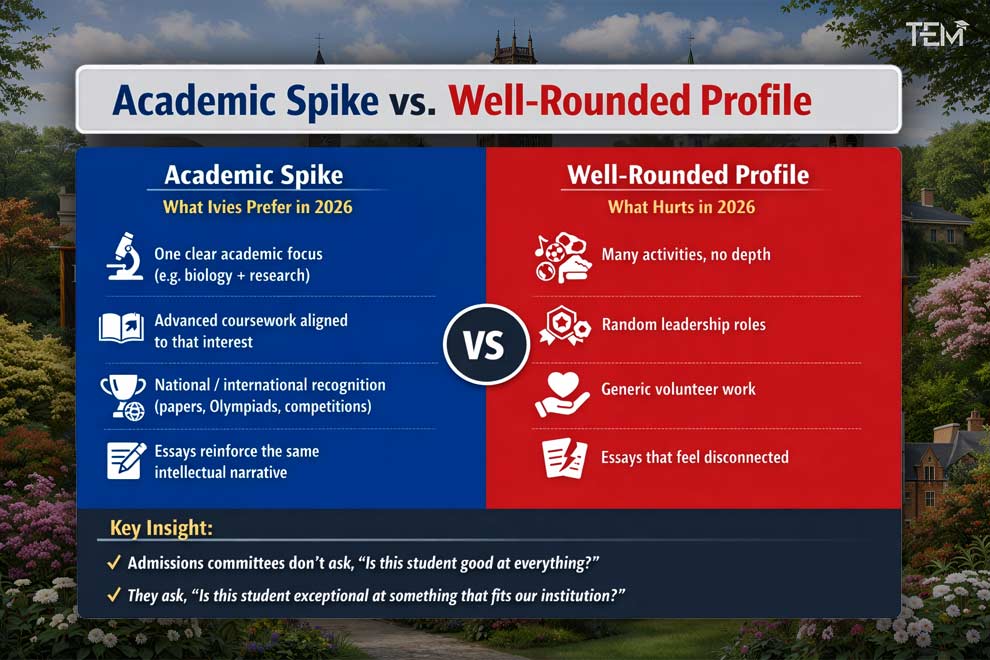
For years, students were told to be “well-rounded.” In 2026, that advice quietly hurts more than it helps.
Ivy League schools now prioritize institutional fit, and that means looking for students with a clear academic or intellectual spike in a focused area of excellence supported by sustained effort.
A spike is not a single achievement. It’s a pattern.
What a Real Academic Spike Looks Like
A strong spike usually includes:
- Advanced coursework in a specific subject area
- Meaningful extracurricular engagement tied to that interest
- Evidence of depth (research, competitions, publications, original projects)
For example:
- A biology-focused applicant conducting independent research over multiple years
- A history student producing long-form research or archival work
- A computer science applicant building tools, not just joining clubs
This depth makes applications easier to evaluate and easier to remember.
Why Spikes Win in Admissions Committees
Admissions officers are not building a class of identical overachievers. They are assembling a cohort with distinct academic identities. A focused applicant answers an unspoken question clearly: What will this student contribute intellectually once they arrive?
Well-rounded applicants often blur together. Spiked applicants stand out.
That distinction matters more than ever in an era where applications are reviewed quickly and, increasingly, with AI-assisted triage tools.
Pillar 3: Testing in the 2026 Cycle, What Scores Actually Matter
For students trying to understand how to get into an Ivy League school in 2026, standardized testing is no longer an optional strategy; it’s a decision point that can strengthen or weaken an otherwise strong application.
After several test-optional years, the Ivy League has shifted again. Schools such as Harvard, Yale, Brown, and Dartmouth have officially reinstated mandatory standardized testing for the 2025–2026 admissions cycle. Others strongly recommend scores, even if they don’t explicitly require them.
The message from admissions offices is clear: test scores are back as a trusted comparison tool in an increasingly crowded applicant pool. This shift is backed by research from Dartmouth faculty, which suggests that standardized test scores, when viewed in context, are the most reliable predictor of academic success for students from all backgrounds.
Test-Required vs Test-Optional: What This Really Means
“Test-optional” does not mean test-irrelevant.
In practice:
- Applicants with strong scores gain an advantage
- Applicants without scores are evaluated, but with fewer standardized data points
- In highly competitive pools, missing data often works against the applicant
Admissions teams use scores to confirm academic readiness, especially when reviewing applicants from different school systems across the world.
What Is a Competitive SAT or ACT Score in 2026?
While no Ivy League school publishes a “cutoff,” competitive applicants typically fall within the middle 50% range, which for most Ivies sits between:
- SAT: 1480–1580
- ACT: 33–35
Scores below this range don’t automatically disqualify an applicant, but they must be offset by exceptional strength elsewhere, such as a rare academic spike or extraordinary context.
Digital SAT, Superscoring, and Context
The Digital SAT has made testing more accessible, but also more standardized. Ivy League schools continue to superscore, meaning they consider the highest section scores across multiple test dates.
What matters most is not perfection, but alignment:
- Strong math scores for STEM-focused applicants
- Strong verbal scores for humanities-focused students
Admissions officers read scores in context, but competitive scores reduce doubt, and doubt is costly in a 4% acceptance environment.
When Not Submitting Scores Makes Sense
There are limited cases where withholding scores is strategic:
- Significant personal or educational disruption
- Strong academic record from a highly rigorous curriculum
- International contexts where testing access was constrained
Even then, the rest of the application must be exceptionally clear and coherent.
Testing won’t get a student into an Ivy League school by itself, but in 2026, it often decides who moves forward and who doesn’t.
Pillar 4: Essays, AI Screening, and Authenticity
For many applicants, essays feel like the most personal part of the Ivy League application. In 2026, they are also one of the most scrutinized.
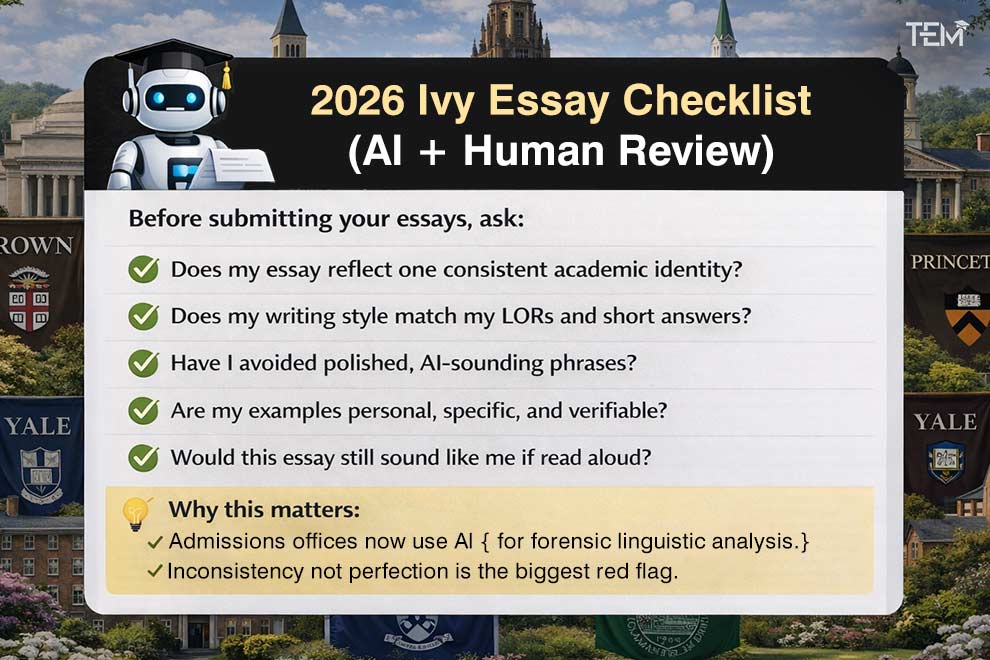
As more students turn to generative tools for writing support, admissions offices have quietly adapted. While final decisions are still made by people, AI-assisted systems are now used early in the review process to flag patterns, especially essays that feel overly polished, inconsistent, or disconnected from the rest of an application.
Understanding this shift is essential for anyone serious about learning how to get into an Ivy League school today.
How Admissions Offices Use AI in Essay Review
Admissions teams do not rely on AI to decide who gets in. Instead, AI helps them manage volume by:
- Highlighting linguistic patterns that don’t match a student’s academic record
- Flagging essays that appear formulaic or externally written
- Summarizing key themes across multiple application components
Essays that raise questions don’t get rejected automatically, but they invite deeper scrutiny in a process where time is limited.
What Triggers Concern in Essays
The most common red flags are not grammar mistakes or simple language. They include:
- Writing that sounds professional but emotionally hollow
- Vocabulary that doesn’t align with a student’s coursework or recommendations
- Sudden shifts in tone across essays
- Generic narratives that could belong to any applicant
Ironically, essays that try too hard to impress often feel the least authentic. In an era where ethical AI for students focuses on using technology for brainstorming and structure rather than content generation, the most successful applicants are those who use digital tools to refine, rather than replace, their own voice.
How to Write Essays That Pass Both AI and Human Review
Strong Ivy League essays in 2026 share three qualities:
- Consistency: Your essays should match your academic interests, activities, and recommendations. When everything points in the same direction, authenticity becomes obvious.
- Specificity: Concrete details, real moments, precise challenges, and honest reflections are difficult to fake and easy to trust.
- Voice: Clear, simple language almost always outperforms dramatic or overly complex writing. Admissions officers want to hear you, not a polished template.
Editing is expected. Outsourcing your voice is not.
In an era of AI screening, originality isn’t about avoiding tools; it’s about owning your story.
Early Decision vs Regular Decision: Where Strategy Changes Outcomes
For students researching how to get into an Ivy League school, application timing is one of the few areas where strategy can meaningfully influence outcomes.
While Ivy League schools insist that all applicants are held to the same standards, acceptance rate data tells a more nuanced story. Navigating the rigid early decision deadlines remains a critical strategic lever, as ED applicants often see 2–3× higher acceptance rates compared to the massive Regular Decision pools.
This doesn’t mean ED makes weaker applicants competitive. It means ED favors students who are already strong and signals commitment.
Why Early Decision Offers a Statistical Edge
Early Decision benefits schools in several ways:
- It increases enrollment predictability
- It improves yield rates
- It allows admissions offices to secure strong applicants early
As a result, ED pools are smaller, more focused, and reviewed with clearer institutional priorities in mind. For competitive applicants, this often translates into higher odds.
Who Should Consider Early Decision
Early Decision works best for students who:
- Have a clear first-choice Ivy League school
- Meet or exceed that school’s academic benchmarks
- Are comfortable committing before comparing offers
- Have discussed financial aid expectations carefully with family
For these students, ED is not a gamble; it’s a calculated move.
When Early Decision Can Backfire
ED is binding, which makes it risky in certain situations:
- If financial aid uncertainty is high
- If academic or testing improvements are still in progress
- If the student is unsure about institutional fit
Applying ED without readiness can remove flexibility without increasing chances.
Regular Decision: The Reality Check
Regular Decision pools are massive and unforgiving. Acceptance rates below 4% mean that even outstanding applicants are often denied simply due to volume.
RD should be approached with realism, strong alternatives, and a diversified college list.
Early Decision doesn’t guarantee admission, but in a system defined by narrow margins, it remains the most meaningful strategic lever available.
Ivy League by the Numbers: Acceptance Rates, Costs, and Aid
| Ivy League School | Overall Acceptance Rate | Early Decision Rate | Middle 50% SAT (2026) | Total Cost (USD) | Full Aid Threshold |
| Harvard | ~3.4% | ~7.8% | 1480–1580 | ~$94,000 | <$100,000 income |
| Yale | ~3.7% | ~9.2% | 1470–1580 | ~$93,000 | <$100,000 income |
| Princeton | ~4.0% | ~10.5% | 1470–1580 | ~$91,000 | <$100,000 income |
| UPenn | ~4.1% | ~14.6% | 1450–1570 | ~$96,000 | <$75,000 income |
| Columbia | ~3.9% | ED only | 1450–1560 | ~$95,000 | <$85,000 income |
| Brown | ~5.0% | ~13.0% | 1440–1570 | ~$92,000 | <$125,000 income |
| Dartmouth | ~5.3% | ~19.0% | 1440–1560 | ~$91,000 | <$125,000 income |
| Cornell | ~7.2% | ~16.0% | 1420–1550 | ~$94,000 | <$75,000 income |
Common Ivy League Myths That Cost Applicants Offers
Many applicants who miss out on Ivy League admission are not underqualified. They are misinformed.
In 2026, misinformation is one of the biggest obstacles to understanding how to get into an Ivy League school. Outdated advice, oversimplified social media tips, and recycled myths continue to shape applications in ways that quietly hurt otherwise strong candidates.
Myth 1: Perfect Scores Guarantee Admission
A 4.0 GPA and top test scores are impressive, but they are not decisive.
Every Ivy League school rejects thousands of applicants each year with near-perfect academics. Scores establish readiness, not distinction. Without a clear academic direction or intellectual identity, even flawless numbers blend into the crowd.
Myth 2: More Activities Make a Stronger Application
Admissions officers are not counting how busy you are. They are assessing impact.
Ten shallow activities rarely outperform two or three commitments pursued deeply over time. Leadership titles matter less than sustained involvement, growth, and contribution.
Depth is easier to trust than breadth.
Myth 3: Leadership Titles Matter More Than Substance
Being a “president” or “founder” means little without context.
Admissions readers are trained to spot inflated roles. They look for evidence of influence, initiative, and real outcomes, not labels. Quiet leadership, when genuine, often carries more weight than formal positions.
Myth 4: Essays Should Sound Impressive
Highly polished essays filled with abstract language often raise concern, not admiration.
In 2026, clarity beats complexity. Admissions officers want insight into how you think, not how many advanced words you can use. Essays that sound human are easier to believe.
Myth 5: Ivy League Admissions Are Random
Admissions are not random, but they are selective beyond intuition.
Rejections often reflect institutional priorities, timing, or class composition rather than applicant weakness. Understanding this helps students apply strategically rather than emotionally.
Avoiding these myths doesn’t guarantee admission, but believing them almost guarantees disappointment.
Final Ivy League Application Checklist
At this stage, understanding how to get into an Ivy League school is no longer about collecting advice; it’s about execution.
While every successful applicant’s path looks different, competitive profiles in the 2026 cycle consistently share a few defining traits.
What Strong Ivy League Applicants Do Differently
- They choose rigor intentionally: Their course selections challenge them and align with their academic direction.
- They build depth, not noise: Activities reinforce a clear intellectual interest rather than scatter attention.
- They test strategically: Scores are used to confirm readiness, not chase perfection.
- They apply with narrative clarity: Essays, activities, and recommendations tell one coherent story.
- They respect timing: Early Decision is used when it strengthens, not restricts, their position.
- They understand fit: School choices are driven by alignment, not prestige alone.
None of this requires perfection. It requires focus.
How to Get Into an Ivy League School in 2026: Final Clarity
Your Ivy League Strategy Starts With Clarity
Ivy League admissions in 2026 reward students who understand the system they’re entering. Not because it’s fair, but because it’s precise.
Strong applicants are rejected every year, not for lack of ability, but for lack of strategy. When you understand what admissions offices are actually evaluating, and why, you stop guessing and start positioning yourself with intent.
Whether you’re a student planning your next academic move or a parent trying to separate signal from noise, clarity is the most valuable advantage you can have.
If this guide helped you see Ivy League admissions more clearly, share it with someone who’s preparing for the same journey. Clarity compounds when it’s shared.
FAQs
- Is the Ivy League test-optional in 2026?
Most Ivy League schools have reinstated mandatory standardized testing for the 2025–2026 cycle, including Harvard, Yale, Brown, and Dartmouth. Test scores are a key data point in admissions decisions, though some schools may still allow optional submission under specific circumstances.
- How to get into an Ivy League school using Early Decision?
Yes. Early Decision (ED) acceptance rates are often 2–3x higher than Regular Decision rates. ED signals commitment and aligns with schools’ enrollment goals, but it only helps applicants who already meet or exceed the academic benchmarks.
- What is an “academic spike” and why does it matter?
An academic spike is a focused area of excellence, supported by coursework, extracurriculars, or research. To understand how to get into an Ivy League school, you must realize admissions now prioritize depth over being “well-rounded,” meaning students with a clear spike stand out.
- How does AI affect Ivy League essays in 2026?
Admissions offices use AI tools to flag essays that appear ghostwritten, overly polished, or inconsistent with a student’s academic profile. Essays must be authentic, consistent, and specific to pass both AI screening and human review.