Reported by The Education Magazine | 9 February 2026
Two major immigration policy announcements from the United States and Canada this week are redefining global mobility choices for international students and professionals planning their careers in 2026 and beyond.
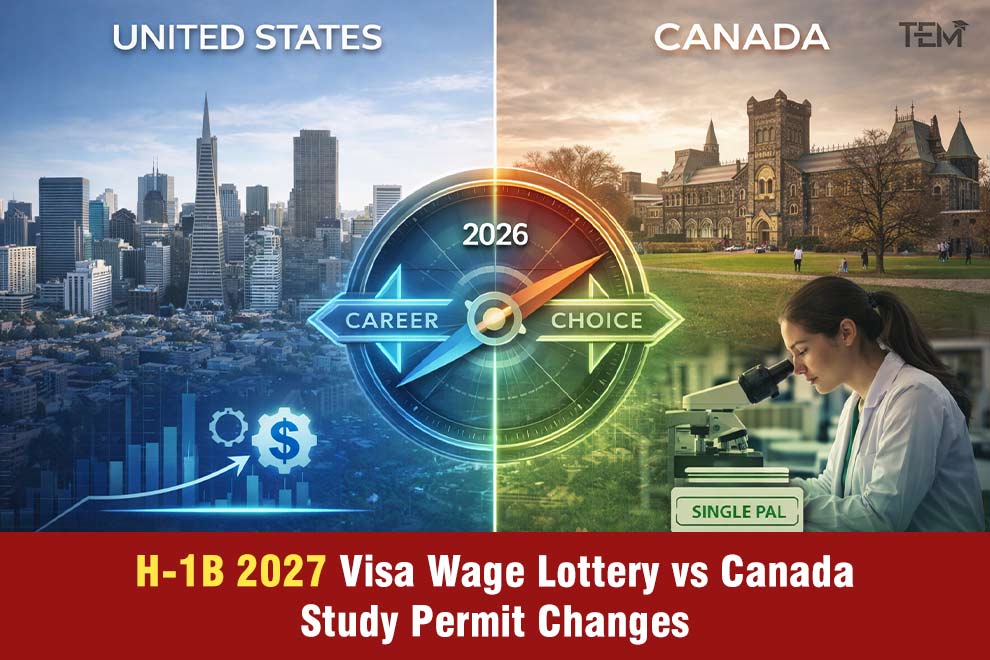
While the United States has confirmed a wage-weighted H-1B visa selection system for FY 2027, Canada has simultaneously eased study permit requirements for international students enrolled in joint degree programs. Together, the updates signal a strategic divergence in how North America is competing for global talent.
US Introduces Wage-Weighted H-1B Selection for FY 2027
The U.S. Citizenship and Immigration Services (USCIS) has confirmed that the FY 2027 H-1B registration window will open from March 4 to March 19, 2026, introducing a wage-based selection model in place of the traditional random lottery.
Under the revised framework, registrations linked to higher salary offers will receive increased selection priority, marking a decisive shift toward a “salary-over-luck” approach.
Officials said the change aims to better align the H-1B program with labor market demand and reduce misuse of the lottery system.
Key objectives of the wage-weighted model include:
- Prioritizing higher-paid and highly skilled roles
- Discouraging bulk low-wage filings
- Improving transparency and employer accountability
- Aligning visa selection with economic value
Immigration analysts say the update significantly reduces the odds for entry-level international graduates while favoring experienced professionals and high-paying job offers.
Canada Relaxes Study Permit Rules for Joint Degree Programs
As the US tightens employment-based immigration, Canada’s Immigration, Refugees and Citizenship Canada (IRCC) has announced relaxed requirements for international students enrolled in joint degree programs.
Under the updated rules, students pursuing degrees jointly offered by institutions in different provinces now require only one Provincial Attestation Letter (PAL) instead of multiple approvals.
The government also reiterated that master’s and PhD students at public universities remain exempt from international student intake caps, reinforcing Canada’s push to attract academic and research-focused talent.
Education experts say the move significantly reduces processing delays and administrative hurdles for international students considering Canada for 2026 intakes.
| Policy Area | United States (2027) | Canada (2026) |
| Visa System Change | Wage-weighted H-1B selection | Simplified PAL requirement |
| Primary Focus | High-salary employment visas | Academic and research mobility |
| Impact on Graduates | Harder for entry-level applicants | Easier processing for joint-degree students |
| Graduate Student Policy | Competitive salary-based selection | Master’s/PhD exemptions continue |
| Selection Model | Wage-priority ranking | Administrative simplification |
What This Means for Indian Students
For Indian students graduating in 2026–2027, the policy divergence significantly affects planning decisions:
- US applicants may need higher-salary job offers to improve H-1B selection chances
- Canada offers more predictable study-to-work pathways through simplified permit processing
- Students targeting research, PhD, or academic careers may find Canada’s pathway comparatively stable, while high-earning tech professionals may still benefit from the US route
Impact on International Students and Global Talent
The contrasting policy approaches are expected to directly influence destination choices for students and professionals from India, China, Nigeria, and Southeast Asia.
For prospective applicants, the changes may mean:
- United States: Higher risk for fresh graduates without premium salary offers
- Canada: Greater predictability and faster pathways for academic and research-focused students
- Increased importance of salary negotiations, specialization, and long-term residency planning
Analysts note that while the US is prioritizing economic return through wages, Canada is positioning itself as a stable hub for higher education and research collaboration.
Why This Policy Shift Matters
The timing of the announcements highlights an intensifying competition for global talent across North America. As international graduates face growing uncertainty in US employment-based pathways, Canada’s streamlined academic visa framework offers a clearer alternative.
Education consultants say the developments will likely influence enrollment patterns, post-study work decisions, and long-term migration strategies for students graduating in 2026 and 2027.
What Happens Next
USCIS is expected to release additional guidance on wage ranking methodology and employer filing requirements ahead of the March 4 registration opening.
Meanwhile, Canadian institutions are advising joint-degree applicants to review updated PAL requirements as study permit applications for upcoming intakes begin.
FAQs
- How is the US H-1B system changing for 2027?
The lottery will prioritize applications linked to higher salary offers instead of relying solely on random selection.
- What has Canada changed for international students?
Students enrolled in joint degree programs now need only one Provincial Attestation Letter, reducing paperwork and delays.