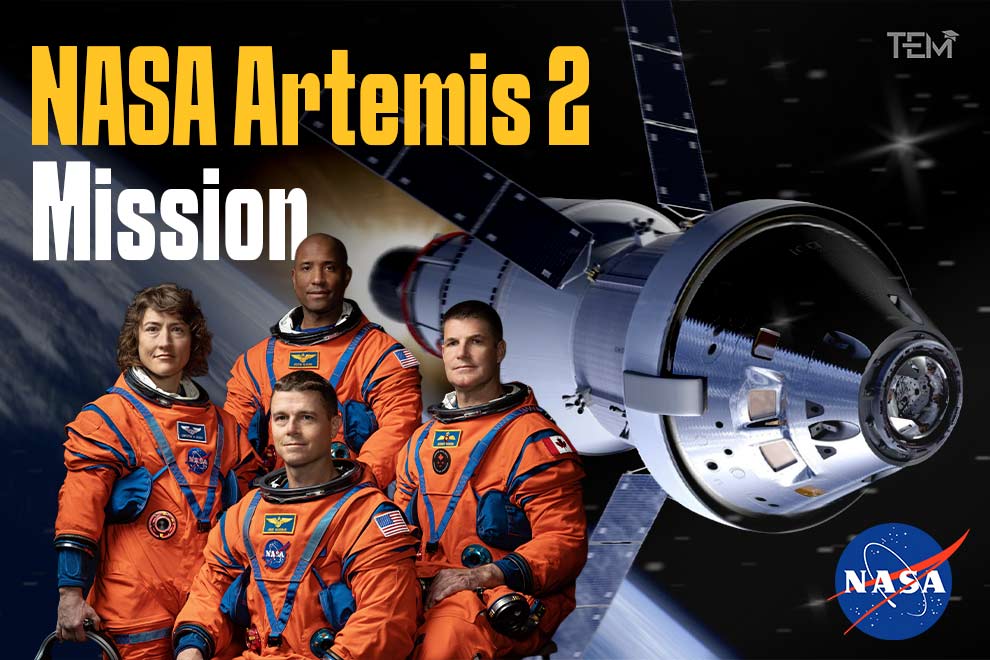
On April 10, 2026, the NASA Artemis 2 mission successfully concluded with the splashdown of the Orion spacecraft in the Pacific Ocean, marking the first time humans had traveled to the lunar vicinity in over 50 years.
The 10-day flight carried a diverse crew of four: Reid Wiseman, Victor Glover, Christina Koch, and Jeremy Hansen, who completed a high-altitude flyby of the Moon to test deep-space life support systems.
This mission serves as the final bridge to landing the first woman and first person of color on the lunar surface.
As we look toward the future of space exploration, the Artemis 2 mission provides a rich, real-world curriculum for students to explore the intersection of technology, biology, and global cooperation.
NASA Artemis 2 Mission Overview
| Feature | Details |
| Launch Date | April 1, 2026 |
| Splashdown Date | April 10, 2026 |
| Spacecraft | Orion Capsule (Integrity) |
| Rocket | Space Launch System (SLS) |
| Crew Members | Reid Wiseman (Commander, NASA), Victor Glover (Pilot, NASA), Christina Koch (Mission Specialist, NASA), Jeremy Hansen (Mission Specialist, CSA) |
| Distance Traveled | 252,756 miles from Earth (Record Breaking) |
| Primary Goal | Test crewed life support and deep-space navigation |
Here is what students can learn from the NASA Artemis 2 Mission:
1. The Power of “Marginal Gains” (Engineering & Math)
In high-stakes engineering, the solution isn’t always a “bigger engine.” Students can learn how NASA engineers used the Engineering Design Process to solve the Artemis 1 heat shield “spalling” (chipping) issue.
- The Lesson: Rather than spending years developing a new material, mathematicians and engineers used Monte Carlo simulations to test thousands of variables. They discovered that a steeper reentry angle would change the thermal load just enough to keep the existing shield intact.
- Student Activity: Use an “iterative testing” model, building a simple paper plane or water bottle rocket, changing only one variable at a time (like fin shape or weight) to see how small, calculated tweaks lead to massive performance gains.
2. Biology in Extreme Environments
Artemis 2 is the first time since 1972 that humans have left the protection of Earth’s magnetic field, exposing them to high-energy cosmic radiation.
- The Lesson: Students can study AVATAR (A Virtual Astronaut Tissue Analog Response). This project used “organ-on-a-chip” technology, living human bone marrow cells on a microchip, to monitor how deep-space radiation affects human DNA in real-time.
- Takeaway: This introduces students to the future of Personalized Space Medicine. By understanding a specific astronaut’s biological response, doctors can tailor “medical kits” to their unique genetic needs for a future Mars mission.
3. STEAM: The Fusion of Art and Science
The mission proved that success in space requires more than just equations; it requires the ability to inspire and communicate.
- The Lesson: NASA integrated the arts through the “Rise” Moon Mascot and high-definition storytelling. This showed that visual design is essential for everything from user-friendly cockpit interfaces to explaining complex mission phases to the public.
- Takeaway: This teaches students that creativity is a “future-proof” skill. While AI can calculate orbits, the human touch of art and communication is what builds the global support and “Moon Joy” necessary for long-term exploration.
4. Digital Literacy & Navigation
How do you send a 4K video from 250,000 miles away? Artemis 2 replaced “old-school” radio with “new-age” lasers.
- The Lesson: The mission successfully tested the O2O (Orion Artemis 2 Optical Communications) system. By using infrared lasers instead of radio waves, NASA achieved a data rate of 260 Mbps, which is fast enough to stream live 4K “Earthrise” video.
- Takeaway: Students can learn the physics of the Electromagnetic Spectrum. This demonstrates how “bandwidth” works and why moving to higher frequencies (like lasers) is the key to connecting our future “lunar economy” to Earth.
5. Environmental Awareness (The “Overview Effect”)
Seeing Earth from the lunar far side provides a perspective known as the Overview Effect, which is a cognitive shift in how we see our planet.
- The Lesson: Students can compare the high-resolution images of the “Earthset” (Earth rising over the lunar horizon) to the barren, cratered lunar surface.
- Takeaway: This fosters Space Sustainability. It encourages students to think about Earth as a “closed-loop system” (like the Orion capsule) where resources are limited and must be managed. It also raises questions about space debris and how to explore other worlds without leaving a “human footprint” of pollution behind.
Expert Takeaways: From Mission Milestones to Student Skills
| The Big Lesson | What Happened? | What Does It Mean for You? |
| 1. The “Safety First” Rule | NASA didn’t land on the Moon yet; they did a “flyby” first to check the brakes, oxygen, and heaters. | Practice makes perfect. Before you do something big (like a final exam), you should always do a practice run first. |
| 2. Everyone is Invited | The crew included the first woman, the first Person of Color, and the first Canadian to head to the Moon. | Teamwork needs everyone. Great things happen when people from different backgrounds work together on one goal. |
| 3. High-Tech “Texting” | Instead of old radios, NASA used “Laser Beam” light to send videos back to Earth much faster. | Stay curious about tech. Finding new ways to share information (like using light instead of wires) changes the world. |
| 4. The Space “Recycle” | Astronauts had to recycle their air and water inside a tiny capsule for 10 days. | Waste not, want not. Learning to live with only what you have is the best way to protect our own planet, Earth. |
| 5. The Giant Slingshot | NASA used the Moon’s gravity to “pull” the ship back to Earth, saving fuel. | Work smarter, not harder. Sometimes you can use the world around you to help you reach your goals more easily. |
End Note
The success of the NASA Artemis 2 Mission is more than just a technical achievement; it is an invitation for the “Artemis Generation” to see themselves in the stars. By studying these five pillars, students can understand that the journey to the Moon is fueled as much by human curiosity and teamwork as it is by rocket propellant.
The Artemis 2 mission shows us that you don’t need to be a ‘rocket scientist’ to understand the most important part of space travel: preparation. Whether you are building a Lego tower or a lunar rocket, the ‘Artemis Mindset’ is about checking your gear, trusting your team, and always having a backup plan.
FAQ
1: What was the main goal of the Artemis 2 mission?
The primary goal was to test how humans interact with the Orion spacecraft and its deep-space life-support systems. By completing a 10-day flyby of the Moon, NASA checked that everything from oxygen to heaters worked perfectly before future crews attempt an actual landing.
2: Who were the astronauts on this mission?
The mission carried a diverse crew of four: Reid Wiseman (Commander), Victor Glover (Pilot), Christina Koch (Mission Specialist), and Jeremy Hansen (Mission Specialist from the Canadian Space Agency). This crew represents the “Artemis Generation,” which focuses on including everyone in space exploration.
3: How did NASA send high-quality videos from the Moon?
Instead of using traditional radio waves, NASA tested a new “Laser Beam” technology called O2O (Optical Communications). Using infrared lasers allowed data to travel at 260 Mbps, which is fast enough to stream live 4K video back to Earth.
4: What is Personalized Space Medicine?
It is a way to create custom medical kits based on an astronaut’s unique DNA. By using “organ-on-a-chip” technology to see how radiation affects human cells in real-time, doctors can better understand how to keep individual astronauts healthy on long trips to Mars.
5: What can students learn about problem-solving from this mission?
Students can learn the power of “Marginal Gains.” Instead of rebuilding everything from scratch when a problem occurs, engineers use simulations to find small, calculated tweaks—like changing a reentry angle—to make massive improvements in safety and performance.