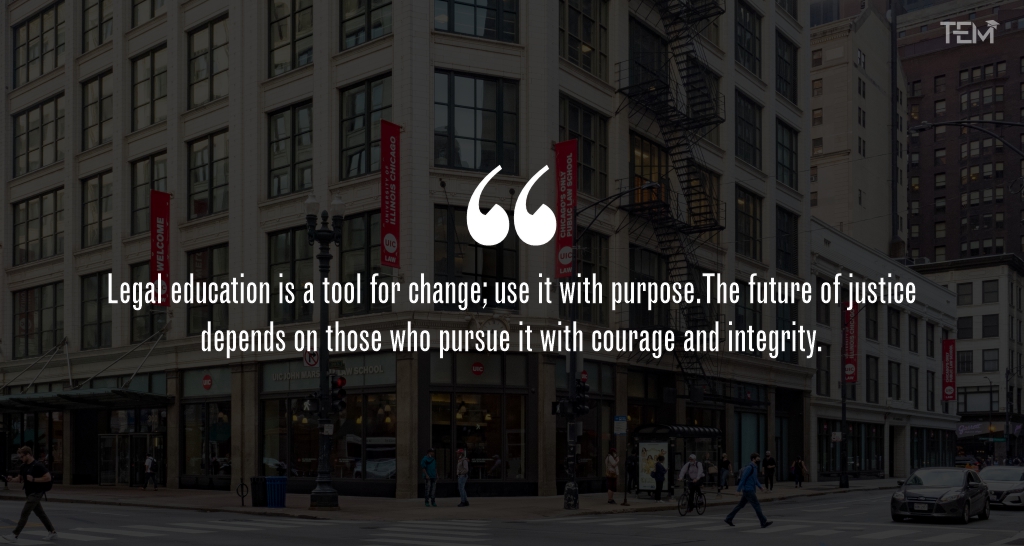
Chicago has long been a city where law is not just practiced but lived. Its courtrooms, neighborhoods, and institutions have shaped debates on justice, equity, and public service for generations. In this setting, legal education carries a certain weight. It is expected to be practical, grounded, and closely tied to the realities of the people it serves.
That expectation finds a clear expression in the University of Illinois Chicago School of Law. The school as it exists today took form in 2019, when the University of Illinois Chicago brought the historic John Marshall Law School into its fold. What began in 1899 as an independent institution became part of a larger public research system, one known for its scale and academic rigor. With that shift, the law school did not lose its identity. Instead, it gained a broader platform and deeper resources.
Now positioned within a Carnegie Research-1 university and the wider University of Illinois System, the school stands as Chicago’s only public law school. That distinction shapes its direction. The focus is not simply on producing graduates, but on opening doors for those who might otherwise be left out and guiding them toward meaningful legal careers.
Its mission reflects this commitment. Students are encouraged to find their purpose early and to connect legal training with real-world impact. The emphasis is on building lawyers who think across disciplines, adapt to change, and approach problems with both skill and integrity. In a legal landscape that continues to shift, the school aims to prepare individuals who do more than respond. It seeks to shape those who can lead, question, and ultimately pursue justice with clarity and intent.
Programs Built for Real Lives and Real Practice
Legal education often asks students to fit into rigid structures. Here, the structure adjusts to the student. At UIC Law, flexibility is not an afterthought but a defining feature. Alongside its traditional three-year JD program, the school offers a part-time evening program designed for those balancing work, family, or career shifts. With a mix of in-person and live online classes, students move at a pace that reflects their reality, not an ideal schedule.
The path into law also looks different. Instead of relying only on conventional admissions routes, the school has built programs that give students a clearer sense of the profession before they commit. Initiatives like R.A.I.S.E. and Vivify provide access and opportunity to pre-law and first-year students, while programs like SCALES offer both exposure and a second chance to law school candidates with potential that may not show up on paper alone.
Inside the classroom, learning rarely stays theoretical. Students step into clinics that serve real communities, take on externships across more than a hundred placement sites, and engage in restorative justice work that asks them to listen as much as they argue, working with both victims and perpetrators to understand the full scope of justice. Unlike most law schools, students complete four years of legal writing training, strengthening their analytical and communication skills beyond the standard three-year model. By the time they graduate, they have not just studied law. They have put the skills and knowledge they learned to use, ensuring their preparation to practice law.
Expanding Access Through Admission
For many aspiring lawyers, the admissions process can feel narrow. A strong score or a high GPA often becomes the deciding factor, even when those numbers fail to reflect grit, growth, or real-world readiness. UIC Law approaches this differently. Each application is read as a full story, not a summary. Academic performance matters, but so does work experience, leadership, and a clear sense of why the law matters to the applicant. This approach is grounded in research showing that traditional metrics like GPA and LSAT scores are oftentimes limited predictors of long-term success in legal education and practice. Relying solely on those metrics can quietly close the door to capable individuals who have taken less traditional paths. UIC Law works to keep that door open without lowering expectations.
The SCALES program brings this philosophy into focus. It offers select applicants an eight-week, performance-based pathway to prove they can meet the demands of legal study. Notably, SCALES is the only conditional admissions program of its kind in Illinois. There are no shortcuts built into the process. Those who earn admission through SCALES do so by demonstrating discipline, skill, and consistency over time.
The result is an admissions model that values readiness in a broader sense. It recognizes that potential is not always immediate or obvious, but it can be developed, measured, and trusted when given the chance.
Leadership That Anchors Purpose and Practice
Leadership at UIC Law reflects a steady and deliberate approach to legal education. The focus is clear. Students are not only trained to understand the law, but to carry the responsibility that comes with it. The program is designed to build judgment, discipline, and the ability to act with clarity when it matters.
Under the guidance of Dean Nicky Boothe, the direction remains grounded in purpose. The expectation goes beyond academic performance. It includes developing conviction, strengthening perspective, and preparing students for roles that shape systems and communities in lasting ways.
“A legal education is not just a credential; it is a powerful tool for change,” she notes. That belief is reflected in how the institution defines success. Graduates are expected to engage with the law thoughtfully and apply it with intent.
The approach to leadership stays practical. It recognizes that the strength of the legal system depends on those who uphold it. By reinforcing values such as fairness, clarity, and accountability, UIC Law continues to prepare lawyers who can meet that responsibility with confidence.
Preparing Lawyers for a Technology-Driven Practice
Technology is no longer an add-on to legal work. It shapes how research is done, how cases are managed, and how decisions are made. UIC Law treats this shift as part of core training, not a separate track.
Librarians play an active role in this process. They introduce students to the tools they are likely to encounter in practice and help them understand when and how to use them. In law practice technology courses, students work with platforms such as Microsoft PowerApps to automate routine tasks, learning to improve efficiency without losing sight of professional responsibility.
Artificial intelligence is approached with the same balance. In research instruction, students are shown how legal-specific AI tools can support their work, along with the limits of relying on them. For those seeking a deeper understanding, advanced coursework explores how AI is shaping the field and what it demands from practitioners.
Access is kept broad. Students engage with tools like Grammarly, Microsoft Copilot, and Power Automate as part of their day-to-day work, allowing them to test where technology helps and where it may fall short.
Faculty efforts continue to build on this foundation, developing policies that integrate emerging tools into the curriculum. The goal remains practical. Graduates leave with both technical awareness and the judgment to use it well.
Building a Culture of Shared Responsibility
Collaboration at UIC Law is structured, not assumed. From the first year, students are placed into support networks through Project Integrate and its Leadership Action Groups. These cohorts bring together peers with shared interests and experiences, meeting regularly to navigate the demands of law school as a group rather than in isolation.
Programs like Vivify extend that support even earlier. Designed to ease the transition into legal education, it addresses gaps that often affect students from underserved backgrounds, helping them enter with clarity and confidence.
The culture also emphasizes accountability. Students take part in the school’s governance, contributing to committees where decisions are shaped. This involvement builds a sense of ownership and responsibility toward the community.
Systems are in place to support that environment. An internal reporting tool ensures concerns are addressed quickly, while leadership workshops guide students in making thoughtful, ethical decisions. The result is a setting where collaboration and integrity are practiced daily, not just discussed.
A Campus Experience That Extends Beyond the Classroom
Student life at the university is active and closely tied to professional growth. With more than 35 student-led organizations, there are consistent opportunities to explore specific areas of law while building connections with peers and practitioners. These groups host panels, workshops, and guest sessions with attorneys, judges, and alumni, giving students a clearer view of how a JD can be applied across different paths.
Engagement is not limited to discussion. Advocacy remains a central part of campus life. Through Moot Court and Trial Advocacy honors programs, students work on real arguments, practice courtroom procedure, and compete at local, national, and international levels. These experiences sharpen skills that matter in practice, from oral advocacy to legal research and writing.
The environment encourages participation without forcing it. Students choose how they engage, whether through organizations, competitions, or networking events, allowing them to shape a campus experience that aligns with their goals while staying connected to the broader legal community.
Systems That Support Student Success
The day-to-day functioning of UIC Law rests on a network of departments that operate in close coordination. Each plays a distinct role, from academic affairs and career services to facilities and student support, ensuring that students can focus on learning without unnecessary friction.
Some functions sit closer to the student experience. Academic Achievement, for instance, works across every stage of the law school journey. It combines academic advising with structured support, including required courses for first-year students and a comprehensive bar preparation program built around bootcamps and guided practice. The approach is hands-on, with access to one-on-one coaching and targeted interventions when needed.
The Writing Resource Center adds another layer of support. It offers individualized guidance on legal writing, helping students develop clarity, structure, and precision. Through coaching sessions and workshops, students refine their work from early drafts to final submissions.
These departments operate with a shared goal. The focus remains on creating an environment where students are supported consistently and prepared to meet the demands of legal practice after graduation.
Recognition That Reflects Steady Growth
Recent years have brought a series of recognitions that point to UIC Law’s continued progress. The school has been named a “Best Law School 2025” by The Princeton Review, a “Leading Law Program 2024” by Newsweek, and a “Best Law School for Women in Leadership” by preLaw Magazine. These distinctions reflect both academic strength and a broader commitment to access and leadership.
Faculty and leadership contributions extend beyond campus. For example, Professor Michael Seng received the Gratias Agit Award for his long-standing work in building international legal education exchanges. Dean Nicky Boothe was recognized among the “2026 Notable Women in Law” by Crain’s Chicago Business and now serves on the Board of Governors for the Society of American Law Teachers.
Engagement with national organizations remains active, with faculty holding roles across the American Bar Association and the Association of American Law Schools. Within academics, the Trial Advocacy and Dispute Resolution program continues to stand out, ranked among the top programs in the country.
Support That Extends Into Practice
Support at UIC Law continues well beyond the classroom, with a clear focus on helping students move confidently into the profession. The Career Services Office anchors this effort, offering individualized guidance on career paths, along with practical support for resumes, interviews, and job searches. Regular workshops and employer events create direct connections with law firms, government agencies, and public interest organizations.
Mentorship plays an equally important role. Through the Alumni-Student Mentor Program, students gain insight from graduates who have already navigated the transition into practice. A second layer of support comes through the Lawyer-to-Lawyer Mentor Program, where experienced attorneys guide recent graduates as they begin their careers.
Networking is built into the students’ law school experience. Events like the Student-Alumni Exchange create space for meaningful conversations around career choices and long-term goals. Alumni remain involved as adjunct faculty and competition coaches, while students engage with local bar associations, building relationships that extend into their professional lives.
Looking Ahead with Focus and Intent
The next phase of growth at UIC Law is closely tied to how the legal profession itself is evolving. Greater attention is being placed on artificial intelligence and curriculum reform, with efforts aimed at ensuring students are prepared for both emerging technologies and changing expectations in practice.
Preparation for the NextGen Bar exam is a key part of this direction. Ongoing assessment is shaping how subjects are taught, with a continued emphasis on academic achievement across the curriculum. Faculty engagement also continues to expand, focusing on methods that improve learning outcomes and support bar readiness.
Experiential learning remains central to these plans. Students are encouraged to apply classroom knowledge to real legal problems, strengthening both understanding and confidence.
Beyond academics, the broader goal is to sustain an environment that values curiosity and progress. The focus stays on building a community that learns continuously, adapts with purpose, and creates an impact that extends beyond the institution itself.
Quote: