There is something almost improbable about the fact that Carthage College has been around since 1847. That is older than the telephone, older than the light bulb, and older than almost every institution most people could name without thinking too hard. When Carthage was founded, the country was still very much deciding what it wanted to be, a frontier nation figuring out its edges, moral and geographic alike.
And yet, from its earliest days, Carthage appeared to know exactly what it wanted to be. A place of learning. A place rooted in values. A place that believed education was not simply about the accumulation of knowledge, but about the shaping of character.
It is worth pausing on a particular historical footnote: President Abraham Lincoln served as an early trustee of the institution. That association is not merely trivia. It says something about the kind of institution Carthage was, even in its infancy: serious, purposeful, and connected to the broader moral ambitions of the nation.
The Move That Changed Everything
For over a century, Carthage did what many small colleges do. It built a tradition quietly and steadily.
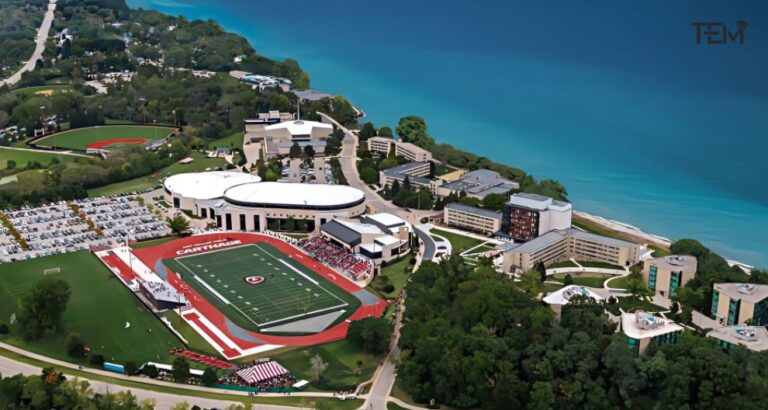
Then, in 1962, everything shifted. The College relocated to its current campus on the shores of Lake Michigan in Kenosha, Wisconsin. It was not merely a change of address. It was a declaration of a new kind of intent.
From that lakeshore campus, a period of growth and transformation began that has not really stopped since. Today, Carthage College serves nearly 3,000 students and has invested more than $250 million in its academic, residential, and arts facilities over recent decades.
The numbers are impressive, but what they represent is more interesting than the numbers themselves: a consistent, institutional commitment to building something durable and meaningful.
What Carthage Actually Believes
Every college has a mission statement. Not every college has a philosophy that you can actually feel when you walk through the door.
At Carthage, the foundational belief is that a liberal arts education should be integrated, experiential, and purpose-driven. The goal is not to produce students who can execute a skill on command. It is to develop the whole artist.
This distinction matters more than it might first appear. There are training programs everywhere that teach technique. What Carthage is interested in is something harder to teach and far harder to measure: the ability to think critically, create boldly, and collaborate across disciplines with genuine fluency.
The curriculum reflects this belief in four specific, deliberate ways.
First, a liberal arts core ensures students develop a broad intellectual context, connecting their creative work to history, culture, and global perspectives. Second, experiential learning places students inside rehearsals, studios, performances, and exhibitions from the very beginning of their studies, not after they have spent years earning the right to do so. Third, collaboration is treated as a skill in itself, with students regularly working across disciplines in ways that mirror professional creative environments. Fourth, the curriculum is genuinely career-focused without sacrificing liberal arts depth, preparing students for both immediate professional success and the kind of long-term creative adaptability that sustains a life in the arts.
That last point is where many arts programs stumble. Carthage appears to have found a way to hold both things at once.
The Programs Themselves
The breadth of what Carthage offers across the Visual and Performing Arts is worth pausing on carefully.
In Art and Design, students may pursue Animation and Film, Studio Art, Graphic Design, Photography, and Art Education for grades K through 12. Under the leadership of Art and Design Chair Jojin Van Winkle, the department has deliberately expanded into Animation, Film, and New Media, a recognition that the visual arts landscape is changing and that students deserve to be prepared for where the industry is actually going.
In Music, the offerings include Music, Composition, Music Education (K–12), Performance, Piano Pedagogy, Piano Performance, and Musical Theatre, available as both a BA and a BM. Music Chair Matthew Hougland oversees curriculum, ensembles, and academic quality across these programs. The College also offers a Master of Music in Music Theatre Vocal Pedagogy, a level of specialization not commonly found at institutions of this size, and a signal of how seriously the institution takes the depth of its graduate offerings.
Theatre at Carthage is, by any measure, remarkable. Under the guidance of Herschel Kruger, the theatre program has earned more than 40 national awards. Students can pursue Theatre Arts (BFA), Theatre Performance, Technical Theatre, Stage Management, Playwriting, and Theatre Education for grades K through 12.
What distinguishes Carthage from comparable institutions is not simply the breadth of these offerings. It is the integration. Small class sizes, close faculty mentorship, and frequent real-world performance opportunities create an environment where the distance between learning and doing is very short indeed.
The People Who Make It Work
Institutions, in the end, are made of people. And at Carthage, the people are worth knowing.
President John Swallow sets the institutional tone, with a focused commitment to experiential learning that shapes priorities from the top down. His message to students, parents, and educators across the country reflects the ethos of the entire institution.
“Carthage is a place where students are known, supported, and challenged. Students are encouraged to grow artistically, discover their voice, and use their work to make a meaningful impact in the world.”
Dean Corinne Ness provides strategic oversight across all Visual and Performing Arts disciplines, leading with a focus on mentorship, rigor, and student development. Her approach reflects the broader institutional philosophy that the best arts education is not transactional but deeply relational.
Leadership here feels less like an administrative structure and more like a sustained, collective commitment to doing things exceptionally well.
Getting In and Getting Support
Admission to the Visual and Performing Arts programs begins with acceptance to Carthage College, followed by a program-specific audition or portfolio review.
Auditions typically include prepared material, technical components, and faculty interviews. Visual arts applicants submit portfolios demonstrating range, creativity, and technical growth. What faculty are looking for is not perfection. They are looking for potential, curiosity, and the genuine capacity for growth, a distinction that says a great deal about what the institution values in its students.
The admissions process is holistic by design. What the faculty want, ultimately, are students who will thrive in a mentorship-driven, immersive environment built around creative accountability.
Access is taken seriously. Renewable talent-based scholarships are awarded through auditions and portfolio reviews, and the College offers multiple audition dates, virtual audition options, and transparent requirements. The commitment is to ensure that financial circumstances do not determine whether a talented student gets a chance to be seen and considered.
Inside the Learning Environment
At Carthage, the classroom is one part of a larger, more dynamic whole.
Students participate in rehearsals, productions, studio work, exhibitions, and performances from the beginning of their time at the College. Facilities like Wartburg Theatre, Johnson Gallery of Art, and Siebert Chapel function not as passive spaces but as active learning environments where the actual work of becoming an artist happens.
Low student-to-faculty ratios allow for genuinely individualized instruction. Courses are scaffolded to support skill development from foundational to advanced levels, meeting students where they are while holding them to consistent professional expectations. Transparent evaluation systems ensure equity and clarity in how student progress is assessed and communicated.
Faculty serve as mentors in the truest sense, present in rehearsals, studios, and critiques, shaping learning through ongoing dialogue rather than periodic, isolated evaluation. Public performances and exhibitions add a dimension of professional accountability that classroom-based programs alone cannot replicate.
Students are also regularly placed in multiple roles. A student might be a performer in one context, a designer in another, and a technician or leader in a third. This versatility is not accidental. It reflects the reality of professional creative life, where adaptability is often as important as virtuosity.
A Program Built Around Career, Not Just Craft
Supporting all of this is the Aspire Program, a nationally recognized initiative that provides structured four-year career development for students.
Through Aspire, students receive mentorship from faculty and alumni networks, participate in career fairs, pursue internships, and connect with industry professionals through networking events. The result is that students graduate not only with artistic skill but with professional experience, real-world exposure, and portfolios that speak to meaningful engagement beyond the campus.
The institution measures student success broadly and intentionally. Artistic growth over time, process-based learning, collaboration, professional behavior, and engagement in real-world experiences all matter. Reflective practice is central, with students regularly invited to articulate their own development and name what they have learned along the way.
Post-graduate outcomes, including employment and graduate school placement, are considered, but they are not treated as the only measure of whether a student has succeeded.
What Is Coming Next
Carthage is not standing still.
Programs across disciplines are expanding to reflect the realities of evolving professional creative industries. In the visual arts, digital media, animation, and hybrid studio practices are being integrated into the curriculum. A new BFA in Theatre Arts is set to launch in 2026-27, with expanded concentrations in performance, design, and playwriting. The Music Department is developing new partnerships centered on integrating Estill Voice into its curriculum.
Recent milestones also include the New Play Initiative, student and faculty-led dance concerts, national recognition across performance and arts competitions, and targeted facility investments of nearly $3 million.
These are not cosmetic additions. They reflect a genuine effort to ensure that Carthage students are prepared for creative careers that will look significantly different in the years ahead than they do today.
A Place Where Students Are Known
There is a phrase that surfaces in conversations about Carthage that deserves to be sat with for a moment: a place where students are known.
Not known in the abstract, administrative sense of being enrolled and accounted for. Known in the way that actually changes a person by faculty who track their development across years, by peers who collaborate with them in ensembles and casts and studio groups, by an institution that has built itself around the conviction that education, at its best, is a relationship.
Since 1847, Carthage College has been refining what it means to offer that kind of education. Originally offering only the Bachelor of Arts, it has grown to include the Bachelor of Music, Bachelor of Fine Arts, and Master of Music, reflecting an evolution that is as much philosophical as it is structural.
On a lakeshore campus in Kenosha, Wisconsin, that work continues with nearly 3,000 students, a faculty of uncommon dedication, and a mission that has remained, through nearly 180 years and all the change those years contain, essentially the same: to develop well-rounded individuals committed to truth, strength, and service.
It is, when you think about it carefully, a beautiful thing to have been doing for that long.
Quote