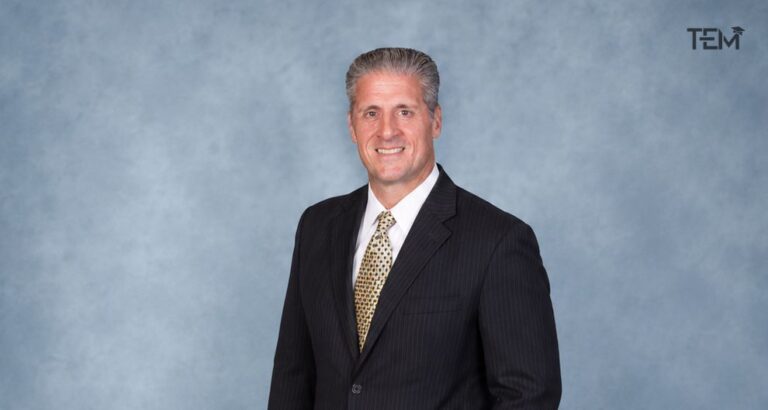
In public education, the path to leadership rarely follows a straight line. Some educators spend years carefully planning each next step. Others arrive there through experience, timing, and a growing sense of responsibility. Anthony (T.J.) Salutari belongs to the second group.
Long before he became Principal of Daniel Hand High School, T.J. planned to pursue mathematics education. That changed during high school, when a personal weight-loss journey reshaped how he viewed health and wellness. The experience pushed him toward Health Education and sparked a lasting interest in helping students make informed decisions about their lives.
His career began in classrooms that demanded patience and adaptability. He worked as a paraeducator in a high-needs setting, spent time as a chemistry substitute teacher, and later taught health education for nearly a decade. Along the way, he earned a master’s degree in
Comprehensive Special Education before moving into school leadership, a transition that began with what he describes as a simple “tap on the shoulder” from a colleague.
Building a School Community That Feels Supported
Inside the school, T.J. approaches leadership much like customer service. His focus stays on creating the best possible experience for students while giving teachers the support they need to succeed in the classroom. The role demands constant balance between staff evaluations, budgeting, hiring, and communication with families and the community.
Several honors have marked that work, including statewide recognition as the 2026 Connecticut Association of Schools High School Principal of the Year. Still, the moment that stands above the rest is Daniel Hand High School earning National Blue Ribbon School status in 2024, an achievement he credits to the entire school community.
Creating a Culture Where Students Feel Seen
Rather than relying on one sweeping reform, T.J. focused on steady cultural shifts inside Daniel Hand High School. Personal Alert Locators, A.L.I.C.E. safety training, wellness initiatives, and a four-year Advisory model helped strengthen relationships between students and faculty. He also expanded opportunities for student leadership and backed every student-led club proposal. “Students perform better when they feel connected, supported, and challenged,” he says.
The results reflect that approach. School data now shows that 82% of students understand how to access social-emotional support services, while 93% report a clear understanding of academic expectations. New curriculum changes also aim to widen access to rigorous coursework for all learners.
Preparing Students for a Changing World
The next chapter at Daniel Hand High School is centered on adaptability. T.J. wants classrooms to move beyond memorization and toward hands-on, project-based learning that reflects real-world problem solving. His long-term strategy focuses on four areas: academics, school climate, talent development, and operational systems.
AI literacy, STEM expansion, and community-connected learning all play a role in that vision. Success, he believes, cannot be measured by test scores alone. “We want students to graduate with the confidence and character to navigate a world that keeps changing,” he says.
Removing Barriers Through Practical Leadership
T.J. approaches equity as a daily responsibility rather than a policy statement. Much of his work centers on identifying barriers that quietly limit student participation and then finding practical ways to remove them. Conversations with student-led groups, including diversity-focused organizations, often shape the initiatives he pursues across the school community.
He has also pushed for structural academic changes, including the removal of restrictive prerequisites and lower-level math tracks. Financial support systems for events, AP exams, and field trips help students participate without embarrassment or public attention. For T.J., access matters most when students no longer have to ask for permission to belong.
Turning Data Into Better Decisions
Inside T.J.’s leadership approach, data serves as a guide rather than a scoreboard. He relies on regular faculty discussions, student portfolios, classroom assessments, and post-graduation feedback to understand whether students are truly prepared for life after high school. Evaluation meetings and academic screenings also help staff identify students who may need support earlier.
T.J. pays close attention to growth beyond grades, including critical thinking, adaptability, and student confidence. “The best feedback comes from graduates,” he says. “When they return and tell us they felt ready for what came next, that tells us we’re doing the right work.”
Learning the Weight of Leadership
One of the most difficult moments of T.J.’s career came during his first year as a high school principal, when a serious issue involving a faculty member quickly became public. With students, parents, and staff searching for answers, he had to respond carefully and quickly while working within legal limits.
He met directly with faculty, communicated with families, and spoke to students grade by grade about available support and next steps. The experience reshaped how he viewed leadership under pressure. “In a crisis, people pay attention to your presence before they process your words,” he says.
Rethinking What Students Need Before Adulthood
T.J. often thinks about how much pressure high school seniors face while making life changing decisions at 17 or 18 years old. Given unlimited resources, he would create a free fifth year of high school focused entirely on exploration. Students could experience college living, test career interests, or spend time in real workplace settings before committing to a path.
He would also invest heavily in educators. He believes compensation across public education rarely reflects the importance of the work. Modern facilities, stronger staff support, and more real-world preparation for students would all become part of that larger vision.
Advocating for the People Behind Public Education
T.J. speaks about education with the protectiveness of someone who has spent years inside classrooms and school hallways. He worries about the growing criticism surrounding public education and the number of educators leaving the profession, but he remains deeply optimistic about its future.
Much of his work now focuses on supporting teachers and administrators, so they feel valued, prepared, and capable of succeeding long term. “Teaching is the most important profession in the world,” he says.
That belief recently extended beyond his own school through a statewide mentoring initiative designed to help new administrators navigate one of education’s most demanding leadership roles.
Finding Space Outside the Principal’s Office
T.J. admits that true work-life balance can feel unrealistic in a high school leadership role. The responsibilities rarely stay inside school walls. Still, he has built small routines that help him separate work from home, including a simple reminder to leave the day’s stress in the car before walking into his house.
Early morning workouts have become part of that rhythm, giving him quiet time before the day begins. Outside school, he values simple moments most: fishing, golf, and time with family. He also credits his wife, Kari, for supporting a career that often demands far more than standard work hours.
Leading Through Trust and Relationships
After years in school leadership, T.J. still speaks about the role with genuine energy. What keeps him motivated is not authority or recognition, but the chance to shape an environment where teachers can teach well, and students feel supported enough to grow.
Much of his work happens quietly behind the scenes, resolving issues before they disrupt classrooms or damage relationships. He believes the strongest schools are built on trust, consistency, and clear expectations. “Students respect high standards when they know those standards come from a place of care,” he says. That balance between accountability and approachability has become one of the defining traits of his leadership style.
Quote
“Always do what is best for students. Everything else follows from there.”