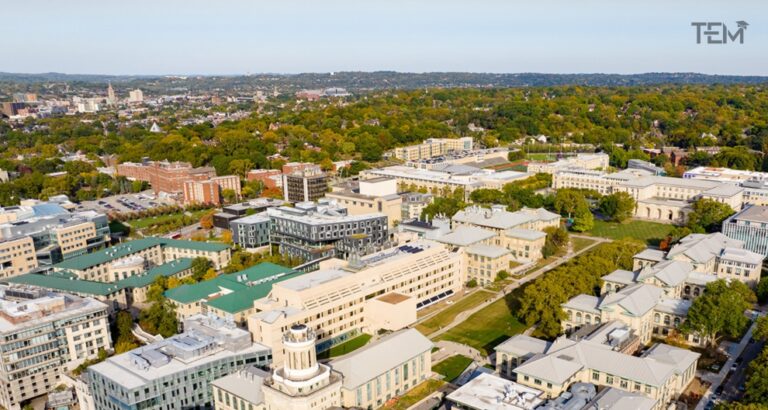
Pittsburgh once made steel. Today, on the site of a former steel mill at Hazelwood Green, it is helping build something closer to intelligence. That is where Carnegie Mellon University’s Robotics Innovation Center now stands, symbolizing both the city’s industrial legacy and its transformation into one of the world’s leading centers for robotics and artificial intelligence. Few places illustrate that evolution more clearly than Carnegie Mellon itself, an institution that continues to reinvent engineering while remaining firmly rooted in the spirit of invention that first shaped Pittsburgh.
Founded in 1900 by industrialist Andrew Carnegie as the Carnegie Technical Schools, the university has grown into a globally recognized research institution comprising seven schools and colleges, including the College of Engineering and the School of Computer Science. Its main campus sits at 5000 Forbes Avenue in Pittsburgh, while its educational and research footprint extends internationally through campuses and partnerships in locations including Qatar and academic collaborations across multiple continents.
The University That Helped Define Artificial Intelligence
During Carnegie Mellon’s 2026 Commencement, NVIDIA founder and CEO Jensen Huang reflected on the university’s unique place in computing history.
“AI started right here at Carnegie Mellon,” he told graduates, pointing to the pioneering work surrounding the Logic Theorist, widely recognized as one of the earliest artificial intelligence programs, and to Carnegie Mellon’s decades-long leadership in robotics and computer science. Huang received an honorary Doctor of Science and Technology degree from President Farnam Jahanian before encouraging graduates to embrace the university’s enduring philosophy: “My heart is in the work.”
At Carnegie Mellon, that history is not treated as nostalgia. It is treated as a foundation for continual reinvention.
The School of Computer Science now offers undergraduate degrees in Computer Science, Artificial Intelligence, Human-Computer Interaction, Robotics, and Computational Biology, with the Bachelor of Science in Robotics, introduced in 2023, reflecting the growing convergence of software, hardware, and intelligent systems. Students enter an ecosystem anchored by the internationally renowned Robotics Institute, one of the world’s largest and most influential academic robotics research organizations.
A President Who Says the Moment Was Built for This School
In his 2026 State of the University Address, President Farnam Jahanian argued that Carnegie Mellon’s greatest strength lies at the intersection of disciplines rather than within traditional academic boundaries.
Among the strongest examples is the AI Science Foundry, an initiative integrating artificial intelligence, robotics, automation, advanced computing, and experimental science. Selected by the National Science Foundation as part of its effort to accelerate AI-enabled scientific discovery, the Foundry connects more than 80 robotically controlled scientific instruments across biology, chemistry, and materials science through cloud-enabled laboratories operating on a secure computational platform. Its ambition is straightforward: dramatically reduce the time required for scientific discovery by allowing experiments to be designed, executed, analyzed, and refined with unprecedented speed.
Carnegie Mellon has also strengthened its national leadership in defense-related AI through the Artificial Intelligence and Innovation Center (AI2C), developed in partnership with the U.S. Department of Defense to advance AI education, workforce development, and national security research.
Rankings That Reflect Sustained Excellence
Recognition tends to arrive at Carnegie Mellon in clusters.
In the 2026 U.S. News & World Report Best Graduate Schools Rankings, the university tied for No. 1 in graduate Computer Science alongside MIT and Stanford. Individual specialties including Artificial Intelligence, Programming Languages, and Systems also earned top national rankings, while Theory ranked among the nation’s very best. Carnegie Mellon’s Information Systems program tied for first nationally, and its Information Technology Management program also secured the top position.
The College of Engineering continued its longstanding reputation for excellence, ranking among the top engineering schools in the United States, reflecting the university’s ability to combine foundational engineering disciplines with rapidly evolving fields such as robotics, machine learning, autonomous systems, and intelligent manufacturing.
Where Autonomous Laboratories Mirror the Institution
One of the university’s most ambitious research efforts is being led by Herman Herman, director of Carnegie Mellon’s National Robotics Engineering Center (NREC).
Supported through the U.S. Department of Energy’s Genesis Mission, the project is developing AI-driven tools that enable autonomous laboratories with entirely different scientific equipment to operate as a coordinated research ecosystem. Working alongside Argonne National Laboratory and Lawrence Livermore National Laboratory, the initiative aims to allow geographically distributed laboratories to collaborate intelligently while sharing experimental knowledge and accelerating discovery.
In many ways, the project mirrors Carnegie Mellon itself.
Its colleges, institutes, and research centers remain distinct in expertise yet increasingly interconnected through artificial intelligence, robotics, engineering, and computational science. Rather than erasing disciplinary boundaries, the university encourages collaboration across them, creating an environment where ideas move as freely as the people developing them.
That philosophy has defined Carnegie Mellon for generations. From pioneering artificial intelligence research to advancing autonomous robotics and AI-powered scientific discovery, the university continues to demonstrate that innovation is rarely a single breakthrough. More often, it is the result of disciplines learning to think together—and of engineers willing to imagine what comes next.