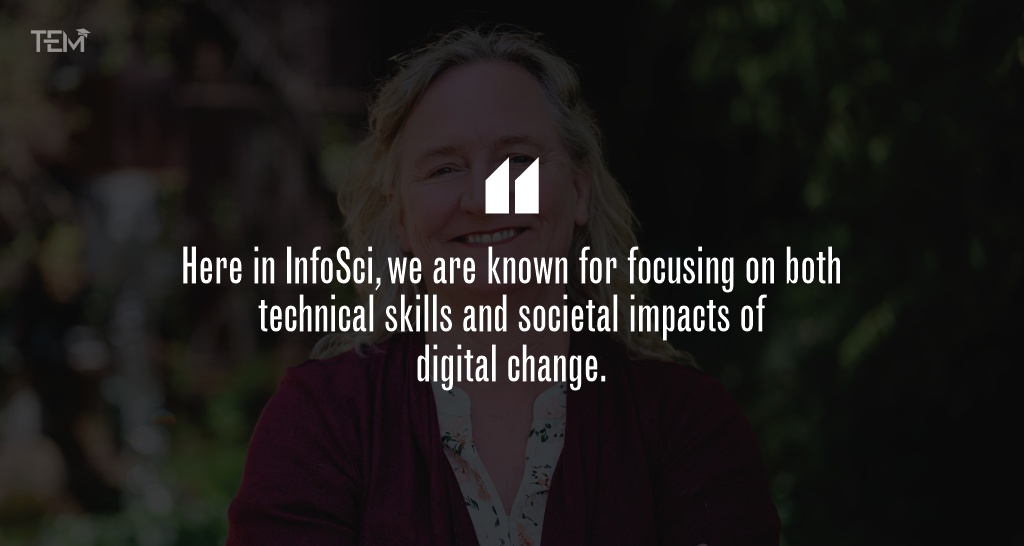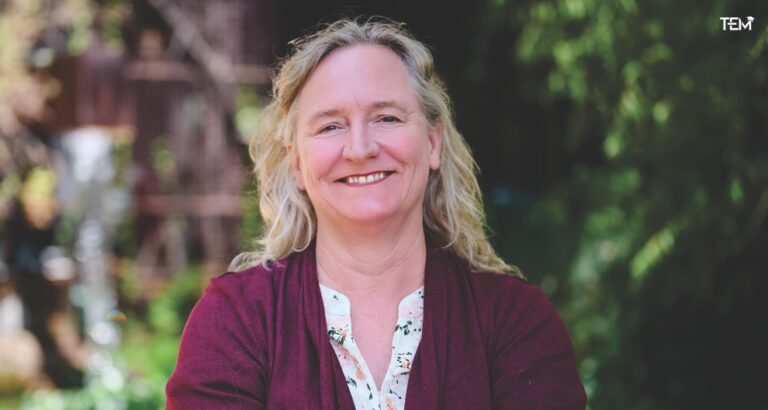
At the University of Arizona College of Information Science, the hallways carry the hum of a field still defining its own borders, part library science, part cybersecurity\, part game design, part data science. Overseeing it all, as Interim Dean, is a leader whose career has been shaped by questions of communication, technology, and trust long before information science became her formal academic home.
Catherine Brooks did not arrive at academic leadership by a straight road, and she is quick to say so. Her career began in communication studies, wound through instructional technology, and only later planted itself firmly in information science, a field she describes as sitting at the intersection of nearly everything she has ever cared about.
It is a fitting home for someone whose interests have always resisted a single department. Her early academic work was already centered on questions about how people communicate and share information, and how technology changes the ways people learn and work in a digital society.
A Path Built on Interdisciplinary Questions
Catherine earned her master’s degree in Communication Studies and a Ph.D. in Education, a combination she built deliberately around what she calls “instructional communication.” At the time, the focus was on emerging instructional technologies and modalities, a niche that, in hindsight, was already pointing her toward the discipline she now leads.
“Information science sits at the intersection of many of the questions that have interested me throughout my career,” she says. How do people communicate and share information? How do technologies change the ways we learn and work in a digital society?
Before Arizona, she was on the faculty in Communication Studies at California State University, Long Beach, where she also served as associate chair of a large department. At Arizona, her footprint widened. She founded the Center for Digital Society and Data Studies, served for several years as associate director of the School of Information, then became its director from 2019 to 2023, and eventually stepped into the role of interim dean of the newly formed College of Information Science.
Leadership, she has learned along the way, is less about issuing direction than about creating an environment where people can contribute. “All of these experiences taught me that academic leadership is about bringing people together and maintaining a positive environment so that they can make decisions and generate new ideas collaboratively,” she says.
The Weight and the Reward of Leadership
At the center of Catherine’s role is the task of helping the college move forward while maintaining a climate in which people can work well, innovate, and thrive.
She points to two things in particular: student support across both undergraduate and graduate programs, and the college’s ability to retain faculty and staff over time. “Generally, people come to our college and don’t leave,” she says, a line she delivers less as a boast than as a description of culture. Managing a rapidly growing organization, she adds, has been one of the more satisfying parts of the job, particularly the work of helping define the college’s strategic direction as one of the university’s essential academic units.
Teaching Students to Question What They Build
The college’s academic mission, as Catherine describes it, is not simply to train students to operate technology but to help them interrogate it. “We are preparing students not simply to use technology, but to understand it, question it, design with it, and lead responsibly in environments shaped by technology,” she says.
That means data literacy, computational thinking, cybersecurity knowledge, and experience with emerging technologies, paired deliberately with communication, critical thinking, ethical reasoning, collaboration, and an understanding of the social contexts information systems operate within. The college’s program list reflects that duality: programs spanning artificial intelligence, cybersecurity, data science, emerging technologies, game design, information science, and library science, alongside certificates in cyber defense, data science and visualization, games and simulation, natural language processing, and digital curation.
A Vision for 2026 and Beyond
Pressed on where she wants the College of Information Science to go, Catherine describes a college that is simultaneously technically excellent, human-centered, and deeply interdisciplinary, with work she hopes will be internationally recognized. The underlying goal, as she puts it, is to develop new knowledge about how society creates, collects, organizes, analyzes, protects, shares, and uses information.
Three priorities anchor that ambition. The first is student success, ensuring growth in enrollment translates into real educational and career opportunity. The second is research excellence, concentrated in artificial intelligence, cybersecurity, digital curation, cultural heritage informatics, archival science, and game development. The third is access, opening the information economy to students from a wide range of backgrounds. As she describes it, she wants learners to bring their skills, knowledge management awareness, and archival practices back to their friends and neighborhoods, in order to secure their histories and instill healthy information practices within their communities.
One Faculty, Many Disciplines
Ask how a college this varied stays coherent, and Catherine provides a succinct phrase. “We bring information scientists, from librarians and data scientists to game developers, information managers, cybersecurity specialists, and ethicists, together as a ‘faculty of one,’ rather than allowing traditional disciplinary boundaries to prevent collaboration.”
That instinct extends beyond the college’s own walls, into partnerships with cognitive science, computer science, management information systems, and mathematics. Even game development, she notes with some amusement, turns out to require physics, a detail her faculty in that program insist she never forget.
It is a small example, but it captures something larger about how she runs the organization. Disciplinary lines, in her college, are treated as useful conveniences rather than fixed walls, crossed as often as the work demands.
Meeting Disruption Halfway
Artificial intelligence, in Catherine’s telling, is simply the latest in a long line of disruptions the college has had to navigate, following the internet, the iPhone, and television before it. The college’s responsibility, as she frames it, is to understand emerging technologies deeply enough to ask better questions about how they affect people, organizations, and society.
Students need to know how AI systems work and how to use them well, she says, but just as urgently, they need to reckon with ethics, information integrity, privacy, bias, policy, and human decision-making. The goal is not simply to prepare students for today’s technology jobs, but to help them continue learning and asking the right questions as technology changes.
The college, in other words, is not trying to predict which technology comes next. It is trying to build students who can meet whatever arrives with the right questions already in hand.
Leading Through the Merger
One of the most significant leadership challenges of Catherine’s career has been organizational change on a large scale, first a school merger in 2015, and more recently, a substantial college merger in 2025, when the College of Applied Science and Technology was integrated into the College of Information Science.
Any integration of that size, she says, involves far more than aligning programs and org charts. It involves people, cultures, and identities, and roughly 300 employees who needed reassurance that the institution’s core purpose was not about to shift beneath them. “Students still matter first, that scholarly knowledge is important, and that our ethos is still focused on serving people, helping them with their information needs,” she told her expanding team, leaning on communication, listening, and relationship building to steady the transition.
If the Purse Strings Loosened
Asked what she would build with unlimited resources, Catherine does not hesitate. She would invest in interdisciplinary studios where students work alongside faculty, industry, government, and community organizations on real problems spanning AI, cybersecurity, data, digital preservation, information integrity, and emerging forms of human-computer interaction. She has already prioritized a partnerships office to create more industry-driven internships, projects, and challenges for students while also benefiting industry.
On the research side, she would put money into shared computational infrastructure, the kind that lets faculty and students work with advanced computing resources, complex datasets, and immersive technologies, while also funding research into the ethical and social implications of those very systems. “How can we prepare learners to work with the most state-of-the-art tools?” she asks, treating the question less as rhetorical than as an ongoing design problem.
Arizona’s iSchool, Looking Forward
Catherine expects the college, known within the field as Arizona’s iSchool, to grow into an even stronger national and international hub for interdisciplinary information science, building on its place within a renowned circle of iSchools worldwide. Her hope is for the college to be recognized as a leading site for training and research, generating more opportunities for students, deeper industry and community partnerships, and scholarly contributions that shape how technology and society intersect.
The Numbers Behind the Momentum
The figures Catherine cites are, by her own admission, only part of the story, but they are a telling part. In the 2024–25 academic year, the college granted 1,020 degrees, 519 at the undergraduate level and 501 at the graduate level. By fall 2025, enrollment stood at 3,300 students, comprised of 2,600 undergraduates, 640 master’s students, and 30 doctoral candidates, supported by 156 faculty members and 61 staff members across 10 research centers, labs, and consortia.
The college counts more than 8,500 alumni and, in FY2025, had 38 active and externally funded research grants and projects, with research expenditures totaling $3.43 million. Its academic portfolio now spans seven undergraduate and five graduate degrees, alongside certificates and minors in artificial intelligence, cybersecurity, data science, game development, information science, and library science.
For Catherine, though, the meaningful measure sits underneath the totals. “The most meaningful measure is what those numbers represent: more students gaining access to information education, more faculty working across boundaries and more opportunities to connect academic knowledge with the challenges facing communities and industries,” she says.
Read against her earlier point about people staying at the college once they arrive, the numbers start to look less like a scoreboard and more like evidence of the culture she has spent years building.
Life Beyond the Office
Even deans need an off switch, and Catherine is candid about how elusive hers can be. Academic leadership, she admits, can easily become all-consuming, so she walks on the treadmill when she can and keeps working, deliberately, on her relationship with email. She tries not to send questions to colleagues on Friday afternoons or through the weekend, emergencies notwithstanding, a boundary made easier, she says, by the fact that she considers the people closest to her at work to be friends rather than simply colleagues.
It is a simple boundary, the kind that rarely makes it into a resume, but it reveals something about how she leads: by protecting, in small and consistent ways, the people around her, the same instinct that shapes how she runs the college itself.
A Philosophy for the Future
Asked what she wants to emphasize about the future of information science, Catherine returns to questions she considers more important than any single technology. “What kind of society do we want to create? Who has access to information and technology? How do we protect trust and privacy? How do we ensure that innovation benefits communities broadly?”
Artificial intelligence, cybersecurity, and data science may be transforming how people work, learn, and communicate at extraordinary speed, but Catherine’s answer to that speed is not more speed. It is a future in which information science is trusted to manage, preserve, secure, authenticate, organize, and make available information that is useful to people, with librarians, information scientists, and archivists playing a vital role in that work.
Quotes