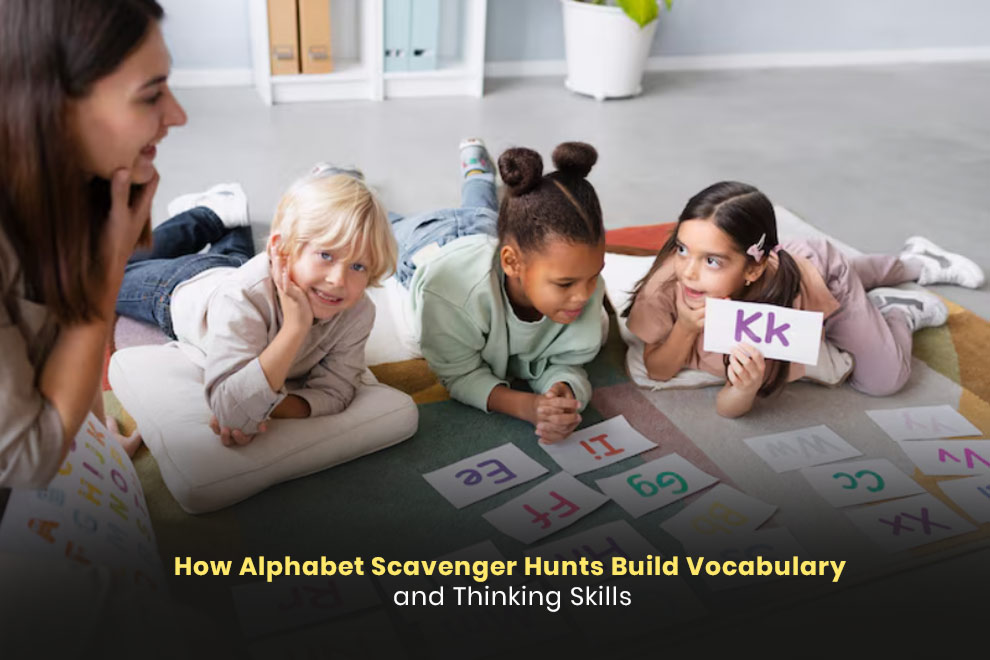
Young children often remember a word more easily when they connect it to something they can see, touch, or use. An alphabet scavenger hunt turns that natural process into a simple lesson. Instead of only studying letters on a worksheet, children search for real objects, name them, and discuss how they are used.
The activity supports early reading, vocabulary, observation, speaking, and problem-solving. It works in classrooms, homes, libraries, and outdoor spaces with few materials.
What Is an Alphabet Scavenger Hunt?
Children search for items connected with a chosen letter. A preschooler might find things beginning with B, such as a book, ball, or bag. Older learners might collect words from categories such as animals, foods, places, actions, and school subjects.
They do not need to pick up every object. They can point, draw, write its name, or take a photo with adult permission. The goal is not the longest list. Learning happens when children explain their choices, compare items, and use the words in conversation.
Decide Whether the Focus Is Sound or Spelling
Before starting, decide what children should notice. A sound hunt focuses on the first sound they hear, while a spelling hunt focuses on the first written letter.
This difference matters in English. “Knee” begins with the /n/ sound, but its first written letter is K. It may fit a sound activity, but it should not count in a spelling hunt for N. Explain the rule before the search so unusual words become useful teaching moments.
Beginners usually do best with familiar objects that have clear initial sounds and regular spellings. Introduce trickier examples once they understand the game.
Why Real Objects Help Vocabulary Stick
A printed word can feel abstract to an early learner. A real object gives it meaning. When a child finds a napkin, says its name, notices its first sound, and explains its use, several pieces of information connect.
Ask about the object’s color, shape, texture, location, and purpose. “Napkin” may grow into phrases such as “soft paper napkin,” “beside the plate,” or “used to clean a spill.”
The hunt helps children practice several skills:
- Letter and sound awareness: Connecting a sound with a written symbol
- Vocabulary: Learning names for objects, animals, foods, places, and actions
- Observation: Noticing details in familiar surroundings
- Reasoning: Deciding which words belong and explaining why
- Communication: Describing discoveries and listening to others
It also reveals where support is needed. One child may know an object’s name but struggle to hear its first sound. Another may identify the sound but not understand the word.
How to Prepare the Activity
Choose one learning goal, such as recognizing a letter, practicing its sound, reviewing vocabulary, or sorting words. A clear goal keeps the hunt focused.
Check the search area before the lesson. Children should not handle medicines, cleaning products, sharp tools, fragile objects, or heavy items. Let them point to or draw anything unsafe to touch.
Prepare a few examples in case the group gets stuck. For a lesson on N, teachers can use these organized examples for a letter-N activity to select familiar objects, foods, animals, and nature terms. A prepared resource should support the lesson without replacing the child’s own thinking.
Five to eight discoveries may be enough for preschoolers. Older children can find ten or more items or search within set categories.
A Simple 20-Minute Lesson Plan
1. Introduce the letter for three minutes. Say its name and usual sound, show how it is written, and give one example.
2. Search for seven minutes. Children can work alone, with a partner, or in a small group. They can record discoveries with words, sketches, or photos.
3. Discuss and sort for five minutes. Group findings into categories such as food, classroom objects, animals, or outdoor items. Discuss uncertain choices.
4. Use the words for five minutes. Each child can make a sentence, give a clue, create a riddle, or add one word to a group story.
Adjust the timing for the children’s age and attention span. A short hunt followed by a useful discussion is better than a long activity that becomes tiring.
Adapt the Hunt for Different Learners
Preschoolers can match objects to a large letter card and repeat each word aloud. Early elementary students can write labels, sort nouns and verbs, or build sentences. Older students can search for subject-specific terms during science, geography, or library lessons.
English language learners may pair a picture with the English word and, when useful, the word in their home language. Children who find writing difficult can point, speak, draw, or use picture cards. A partner can record their answers.
Do not make speed the main measure of success. Give children time to think, and let quieter students share with a partner before speaking to the class.
Questions That Deepen the Lesson
The conversation after the search gives the activity depth. Ask:
- What is this object used for?
- Where would you normally find it?
- How would you describe it without naming it?
- Is it natural or made by people?
- Can you use the word in a sentence?
- Which two items belong in the same category?
- Can you think of another word with the same first sound?
These prompts encourage description, comparison, memory, and reasoning.
Common Mistakes to Avoid
Avoid correcting every mistake immediately. First, ask the child to explain the choice, then guide them back to the rule. This keeps the discussion positive and shows how they were thinking.
Competition can distract from learning. A child who finds three objects and describes them clearly may learn more than someone who quickly copies ten words. Praise careful observation, useful questions, and clear explanations.
Do not end the lesson when the search is over. Sorting, speaking, drawing, or storytelling helps children reuse the vocabulary.
Extend the Learning
Turn the collected words into a word wall, picture dictionary, matching game, or shared story. Children can draw one item and write two facts about it. Families can repeat the hunt in the kitchen, garden, grocery store, or during a walk.
Books offer a quieter follow-up. Choose a story containing some collected words and ask children to listen for them. Parents and teachers can also explore child-friendly stories and playful learning ideas that connect language practice with reading, creativity, kindness, and family learning.
How to Notice Progress
A test is not necessary after every hunt. Look for small changes. A child may identify the target sound without help, remember a word the next day, use it in a sentence, or explain why two objects belong together.
Note which words were easy, difficult, or especially interesting. Use that information to plan the next hunt with a new letter.
Final Thoughts
Alphabet scavenger hunts bring letters out of a workbook and into a child’s everyday world. With a clear goal, safe boundaries, thoughtful questions, and a short follow-up, a simple search can become a useful lesson in reading, vocabulary, observation, and confident communication.