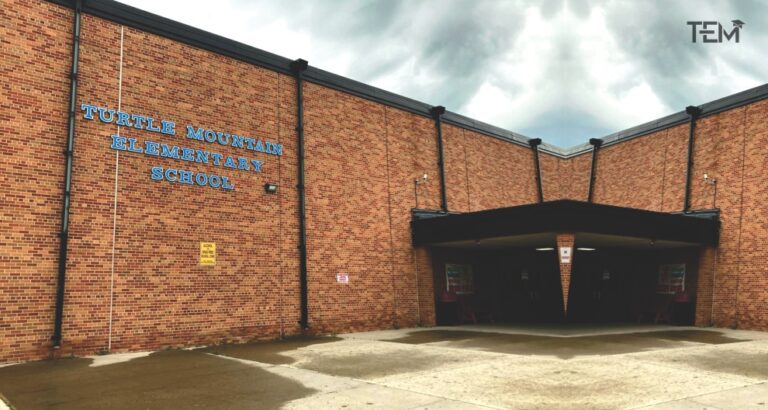
Every school district carries the marks of the time and place in which it was built. Some grow gradually. Others are shaped by moments that test their ability to keep going. Turtle Mountain Community Schools (TMCS) has experienced both.
The district began in 1931 with 16 classrooms serving students in grades one through eight. At the time, students who wanted to continue beyond eighth grade had to leave for boarding schools or attend neighboring schools. That began to change in 1939, when the district added ninth grade. Another grade followed each year, gradually creating a path for students to complete more of their education within their own community.
As enrollment increased, the district continued to expand. A high school opened in 1962, followed by an elementary school in 1972. Progress, however, did not always come easily. In 1984, a devastating fire forced the district to rebuild. The community rebuilt. That chapter became part of the district’s history, reflecting a determination to continue serving its students despite difficult circumstances.
The district opened its current high school in 2007, marking another step in a long period of growth and change. Today, it serves students across a comprehensive K–12 system.
Its mission, “Prepare students for a changing world while preserving our culture and heritage,” speaks to the balance the district works to maintain. Students need the knowledge and opportunities to navigate what comes next, but their education remains connected to the culture, heritage, and identity of the Turtle Mountain community.
That same idea carries into the district’s vision: “Educate and nurture the whole child to empower choices and pathways for success.” Together, these commitments shape how TMCS approaches education, student support, and opportunity.
The district has changed considerably since those first 16 classrooms opened in 1931. Its purpose, however, remains closely tied to the community it serves: helping young people prepare for their futures without losing sight of where they come from.
Four Schools, One Educational Journey
A child entering TMCS can begin their educational journey as a preschooler and continue within the district until graduation. That journey takes place across four schools, each serving a distinct stage of learning.
Tiny Turtles Preschool introduces the youngest students to school. Turtle Mountain Community Elementary School serves kindergarten through fifth grade, while Turtle Mountain Community Middle School supports students in grades six through eight. Students then move to Turtle Mountain Community High School for grades nine through twelve.
Together, the four schools primarily serve Belcourt and the surrounding communities of the Turtle Mountain Reservation and Off-Reservation Trust Lands. The district serves a predominantly Native American student population, which gives culture and community an important place in the educational experience.
Academic instruction forms one part of that experience. Students also have access to cultural programs, social-emotional support, extracurricular activities, and other services designed to support their needs at every stage of school.
Growth That Shows Up in the Numbers
Numbers rarely tell the whole story of a school district. But when several of them begin moving in the same direction, they can reveal meaningful progress. At TMCS, recent results point to changes taking place both inside and beyond the classroom.
During the 2025–2026 school year, the district served 1,533 students and recorded a graduation rate of 82.67 percent. Attendance improved, chronic absenteeism declined, and student achievement increased in both English language arts and mathematics.
Student surveys offered another view. Engagement scores reached 84.69 percent for behavioral engagement, 87.61 percent for cognitive engagement, and 89.50 percent for emotional engagement. The sense of belonging stood at 86.28 percent. Each measure exceeded statewide results.
The district has also earned Cognia accreditation, received NAFOA’s Education Program of the Year recognition, and expanded to 11 career and technical education programs. For the first time, two seniors are expected to graduate in 2027 with both high school diplomas and Associate of Science degrees through expanded dual-credit opportunities.
Learning That Connects Every Stage
The academic path at TMCS changes as students grow, but the district works to keep the journey connected from one stage to the next. Instruction follows North Dakota standards while making room for Turtle Mountain history, cultural knowledge, and community values.
At the elementary level, students build their foundation in English language arts, mathematics, science, and social studies. Early interventions and regular progress monitoring help teachers respond when students need additional support.
Middle school introduces greater independence through core subjects, electives, technology, career exploration, and targeted support. By high school, students can explore a wider range of possibilities through dual-credit courses, Choice Ready, career exploration, and 11 career and technical education programs.
Learning also extends into less traditional settings. Equine and greenhouse programs connect students with agriculture, responsibility, wellness, culture, and potential careers. Throughout the district, data helps guide decisions. ND A+, FastBridge, attendance, graduation data, and MTSS help educators identify needs and provide academic, behavioral, and social-emotional support at the right time.
Leadership Grounded in Shared Responsibility
Leadership in a school system is often measured by policies, plans, and results. But for the people responsible for carrying that work forward each day, leadership is also about creating an environment where students, staff, and families feel seen and supported.
The district leadership reflects the Seven Teachings: Wisdom, Love, Respect, Bravery, Honesty, Humility, and Truth – emphasizing collaboration, accountability, safety, cultural identity, and continuous improvement across the school community.
The Superintendent also serves as Athletic and Activities Director and Title IX Coordinator, contributing to the coordination of districtwide responsibilities alongside the broader leadership team.
That philosophy places students at the center while recognizing that their success depends on a wider community working together.
“TMCS is more than a district. We are a school family grounded in culture, community, compassion, and shared responsibility,” the district’s leadership emphasizes. “Every student belongs and deserves the opportunity to succeed.”
The message is clear for current and prospective families: every child should have access to support, opportunity, and a path toward a future they can choose for themselves.
Defining What Excellence Looks Like
Test scores and graduation rates can reveal part of a school system’s story. They cannot, however, explain whether students feel connected to their school, receive help when they need it, or leave prepared for what comes next.
The district takes a broader view. Educational excellence means nurturing the whole child and preparing students for a changing world. Academic growth matters alongside attendance, engagement, cultural identity, belonging, graduation, and readiness for college, careers, military service, or the workforce.
Those priorities shape the district’s strategic planning. Student data, district needs, and the Cognia improvement and accreditation process help direct work focused on stronger English language arts and mathematics instruction, attendance, dual credit, Choice Ready, career and technical education, student well-being, and culturally responsive teaching.
Progress is measured through achievement, attendance, graduation, engagement, classroom observations, and college and career readiness. Collaboration with families, the Turtle Mountain Tribe, community partners, and the Bureau of Indian Education strengthens that work.
Making Room for Different Ways of Learning
Students do not enter a classroom with identical experiences, strengths, or ways of learning. A teaching approach that works well for one student may need to look different for another. Recognizing those differences shapes how TMCS approaches instruction.
Most students are Native American, primarily members of the Turtle Mountain Band of Chippewa. The district connects North Dakota standards with local culture, history, values, and students’ own experiences through differentiated and culturally responsive instruction.
Teachers also rely on data to identify where additional support is needed. Information from ND A+, FastBridge, assessments, attendance, and behavior helps guide instruction and interventions through differentiated, culturally responsive instruction.
Opportunities extend beyond the regular classroom. Students can access special education, gifted services, dual credit, career and technical education, career exploration, cultural programs, hands-on learning, and Saturday enrichment.
Professional learning helps educators strengthen their instructional and support practices, while partnerships with families, the Turtle Mountain Tribe, the Bureau of Indian Education, and community organizations help students build both achievement and a stronger sense of belonging.
Building a Wider Circle of Support
A student’s education does not begin when the first bell rings, nor does it end when the school day is over. Families, community organizations, local leaders, and other partners all influence the support and opportunities available to young people.
TMCS has made those relationships a strategic priority. The district hired a Family Engagement and Communications Director, developed a communication plan, and expanded its website and social media presence. Communication, events, advisory groups, surveys, and shared planning give families and community members more opportunities to stay informed, share feedback, and take part in the conversation.
Partnerships also extend well beyond school buildings. The Turtle Mountain Tribe, Bureau of Indian Education, local businesses, colleges, workforce agencies, civic leaders, and community organizations contribute to work involving attendance, culture, wellness, career exploration, CTE, dual credit, hands-on learning, and Saturday enrichment.
These relationships bring additional resources and perspectives into students’ educational experiences while connecting the district’s goals with the people and organizations invested in their success.
Life Beyond the Classroom
The school day does not tell the full story of a student’s experience. Some students find their place on a wrestling mat or basketball court. Others discover it through music, leadership, competition, or a deeper connection to their culture.
TMCS offers students many ways to find those connections. Athletics include wrestling, basketball, football, volleyball, and other sports, helping students build teamwork, discipline, wellness, and school pride. Clubs, leadership activities, academic competitions, career and technical student organizations, fine arts, community service, and Native drum and dance groups provide even more opportunities to participate.
Learning also continues after the final bell. The 21st Century program provides academic, cultural, and social-emotional enrichment. Native language learning, Saturday programs, greenhouse projects, and equine-assisted activities give students additional ways to learn and grow.
During the summer, Literacy in Motion combines literacy instruction with engaging activities. Together, these experiences support students beyond academics and help them build stronger connections with their school, culture, and community.
The People Behind the Daily Work
A school system depends on far more than what happens inside a classroom. Every day, decisions about instruction, staffing, transportation, student services, finances, and safety must come together to keep schools running. TMCS brings those responsibilities together through a network of leadership roles and specialized departments.
The superintendent provides overall direction and accountability, while the Assistant Superintendent and HR Director oversee operations, personnel, policy, strategic planning, and professional development. Principals lead the daily work within their schools, including instruction, staff, student support, and family engagement.
Federal and strategic support comes from the BIE Associate Deputy Director, the district strategist, and BIE education specialists. Academic teams oversee curriculum, assessment, federal programs, special and gifted education, MTSS, and career and technical education.
Behind the scenes, finance, technology, transportation, food service, facilities, safety, communications, athletics, and student services handle the work that keeps each school functioning. These teams connect people, resources, and responsibilities around a shared goal: helping students receive the support they need each day.
Creating Opportunity Without Leaving Students Behind
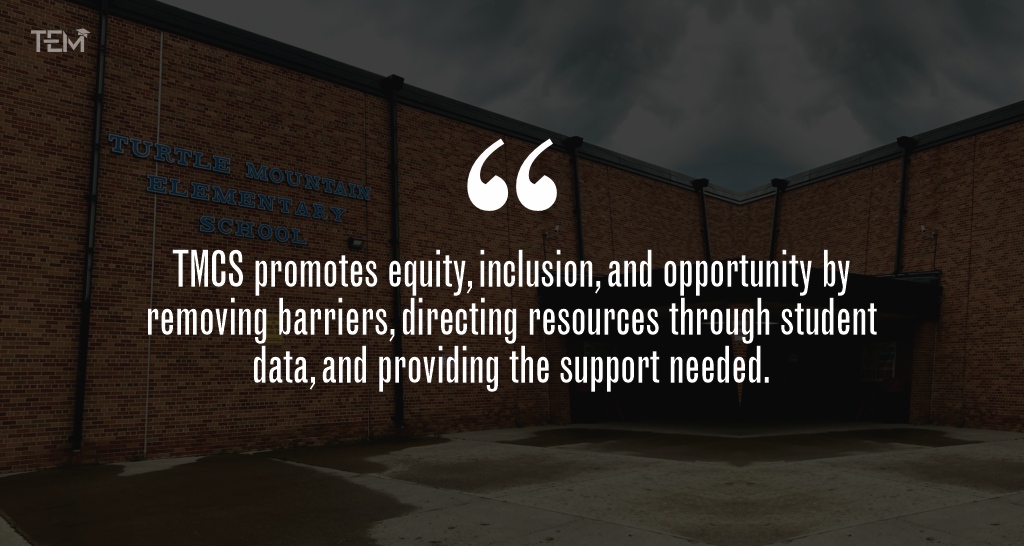
Equity is not simply about offering every student the same thing. It requires understanding where barriers exist and providing the support needed to move beyond them. TMCS serves a student population that is approximately 98 percent Native American. Culturally responsive teaching connects learning with Turtle Mountain language, history, identity, values, and experiences. Data also guides academic interventions, attendance support, special and gifted education, and social-emotional services.
Equitable access is reinforced through the district’s broader academic, career, cultural, and enrichment opportunities, with resources directed according to identified student needs. Recent engagement survey results also showed strong behavioral, cognitive, emotional, and belonging scores, all above statewide comparisons, suggesting that students feel connected, supported, and valued.
Support That Extends Beyond Academics
A student’s needs do not always fit neatly into an academic schedule. Guidance may be needed for a career decision, a personal challenge, or simply the transition from one stage of life to the next.
TMCS provides counseling, social work, tutoring, career guidance, mentorship, and community connections. Mentorship begins early and continues across grade levels. Middle school students work with Mamawi teachers, with Mamawi meaning “together,” while the HOOP program supports high school students through mentoring, career development, graduation planning, and preparation for life after school.
Career guidance includes job shadowing, dual-credit advising, CTE pathways, and connections with colleges, businesses, workforce agencies, tribal programs, and community organizations. Clear crisis and re-entry protocols further help students and families navigate difficult situations safely.
Looking Toward What Comes Next
The work ahead has a clear framework. TMCS will use its Strategic Plan and Cognia improvement process to connect its mission, resources, and expected outcomes with the Seven Teachings.
Three priorities will guide the next phase. School Culture focuses on student-centered schools, stronger relationships, accountable leadership, attendance, and recognizing success. Communication centers on communitywide engagement, partnerships, and training. Student Success will strengthen standards-based instruction, common assessments, professional learning communities, MTSS, social-emotional learning, and technology.
The district will track progress through academic and social-emotional data, graduation and attendance rates, engagement surveys, classroom observations, and stakeholder feedback. The purpose behind these efforts remains practical: improve achievement and well-being while helping students leave school with stronger choices and clearer pathways for whatever comes next.
Quotes