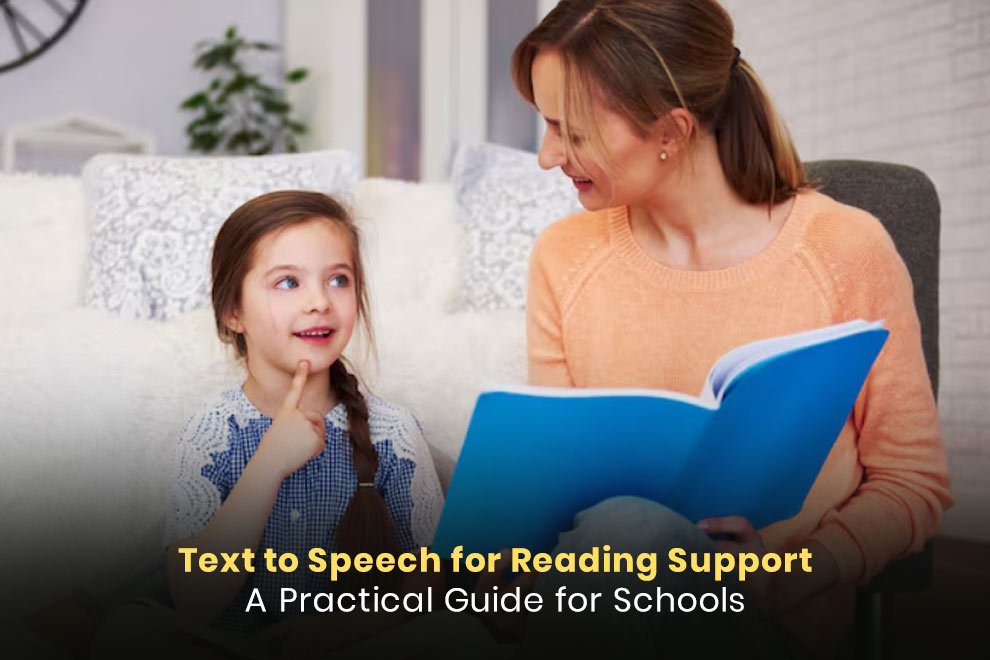
Text to Speech, the technology that reads digital text aloud, has moved from a specialist accommodation to a standard feature of school laptops, tablets and learning platforms. The International Dyslexia Association estimates that perhaps as many as 15–20% of the population as a whole have some of the symptoms of dyslexia, which means most classrooms include students for whom printed text is a daily obstacle.
Why Reading Support Matters Across the Curriculum
Reading difficulties rarely stay inside the English lesson. A student who decodes slowly can understand a science concept perfectly well and still fall behind because the worksheet takes twice as long to get through. History sources, maths word problems and exam instructions all depend on reading speed and accuracy.
Audio support separates two skills that often get tangled together: decoding words and understanding ideas. When a student can hear a passage while following it on screen, the teacher gets a clearer picture of what that student knows about the subject itself.
How Text to Speech Supports Learners With Dyslexia
The International Dyslexia Association lists audio among its recommended accommodations, noting that students can benefit from listening to audiobooks and using text reading and word processing computer programs. Modern voice synthesis technology extends that idea to almost any digital material, including teacher-made handouts that will never exist as a commercial audiobook.
The most effective use pairs audio with visible text. Many reading tools highlight each word as it is spoken, so eyes and ears work on the same line. That pairing keeps the student in contact with print instead of replacing reading with listening.
Control matters as much as the voice. Students should be able to:
- Slow the speaking rate for dense passages and speed it up for review
- Replay a single sentence without restarting the whole page
- Switch audio off when they want to attempt a section independently
Multilingual Learners and Listening Alongside Text
For students learning in an additional language, hearing a text read aloud gives them the pronunciation and rhythm of the language alongside its written form. A learner who recognises a word in speech but not on the page can make that connection faster when both arrive together.
Teachers can use AI voice generation to produce short audio versions of key vocabulary lists, instructions or model answers. Hearing the same sentence several times at a comfortable pace helps learners notice word stress and phrasing that a silent reading would miss.
Keeping Expectations High With Differentiated Instruction
Some educators worry that audio will let students skip the hard work of reading. The answer lies in how the tool is framed. Audio should give a student access to grade-level content, not a simpler version of it.
Several of the fast-growing edtech startups profiled by the magazine already offer reading-level adjustments, and audio fits naturally beside them in a differentiated lesson. One group might read independently, another might read with audio support, and a third might work with an adapted text, while all three discuss the same ideas afterwards.
Clear expectations help. Teachers can ask students to listen once for meaning and then reread a section silently, or to annotate the text while the audio plays. The goal is steady progress toward independent reading, with audio as scaffolding that can be reduced over time.
Revision and Independent Practice Through Listening
Listening is also a practical revision method for students without any reading difficulty. Notes, glossaries and summaries converted to audio can be reviewed on a bus journey or during a walk.
For homework, audio lets students work through assigned reading without waiting for an adult to read it to them. That independence matters for families who may not have time, or the language, to help with every assignment.
How Schools Choose Text-to-Audio Engines
School teams comparing tools tend to weigh a similar set of criteria:
- Voice quality: natural intonation is easier to follow over a long passage than a flat, mechanical voice.
- Pacing control: students and teachers should both be able to adjust speed and pauses.
- Language coverage: multilingual classrooms need voices in the languages students and families use.
- Device and LMS fit: the tool should work on the devices students already have and inside the platforms teachers already use.
Pacing is where synthetic narration most often lets struggling readers down, because a voice that rushes through clauses is hard to track word by word. Newer neural TTS models give teachers more say over delivery. With Fish Audio Text to Speech, for example, a teacher preparing a passage can type a simple tag such as [pause] into the text to slow the natural-sounding voice at sentence breaks, giving a struggling reader more time to follow along.
Web-based Text to Speech generators suit teachers who prepare their own audio resources, while built-in screen readers suit students who need audio on demand across every app.
Student Privacy and Accessibility Checks for Schools
Any tool that processes student work needs a privacy review before classroom use. School leaders should check where uploaded text is stored, whether it is used to train models, and whether the provider meets the data protection rules that apply locally.
A simple approach is to have teachers generate audio from their own materials rather than asking students to upload personal writing to an outside service. Accessibility staff should also confirm that the tool works with keyboards, switches and screen readers, so the support does not create a new barrier for another group of learners.
Text to Speech in Classrooms: FAQs
Does listening to text count as reading?
Listening builds comprehension and vocabulary, but decoding still needs direct practice. Most schools treat audio as a support alongside reading instruction, not a substitute for it.
Which students benefit most from audio support?
Students with dyslexia and other reading difficulties, multilingual learners and students revising large amounts of content benefit most, though any student can use it.
Should audio be allowed in assessments?
That depends on what the assessment measures. The International Dyslexia Association notes that teachers can give recorded tests or allow alternative means of assessment, but a test of decoding itself would not include audio.
The Bottom Line
Used thoughtfully, Text to Speech gives more students access to grade-level material while teachers keep the bar for understanding where it belongs. Pairing audio with visible text, letting students control the pace and checking privacy before adoption will help schools get the most from it.
Also Read: Digital Reading and the Future of Education: Expanding Access Through Affordable eBooks