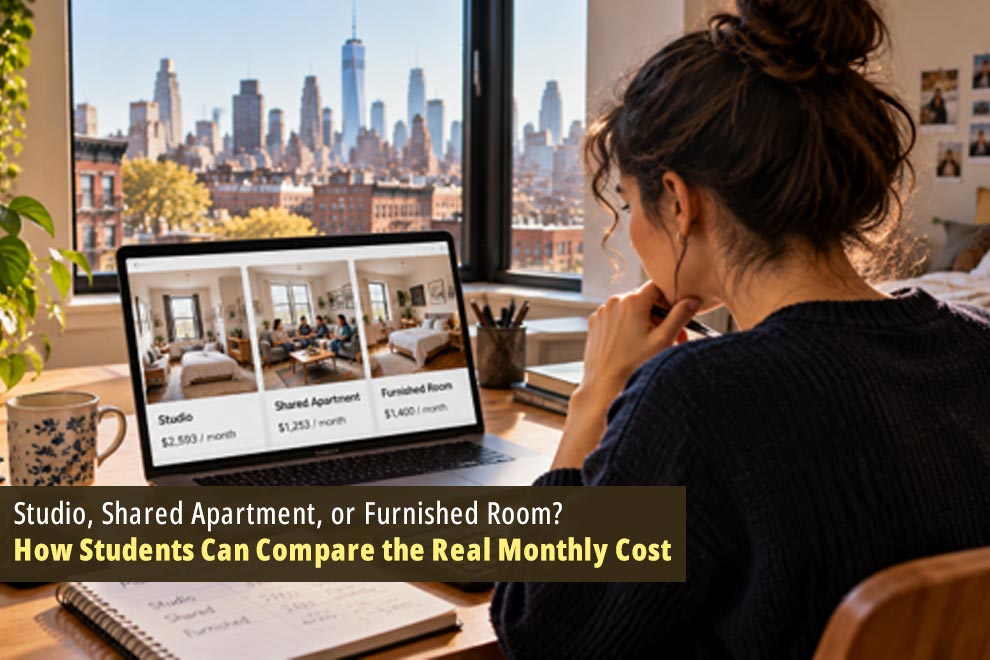
Three browser tabs, three prices, and none of them describe the same thing. One listing is a studio with rent only. Another is a room in a three-bedroom where utilities get split at the end of the month. The third is a furnished room with a single all-in number. If you are a student heading to New York for a semester or a year, the useful question is not which price is lowest. It is which price is complete.
Here is a way to put all three on the same scale, using public data and a bit of arithmetic you can redo for your own dates.
Start With the Number the Federal Government Uses
Every year the U.S. Department of Housing and Urban Development publishes Fair Market Rents for each metro area. HUD defines them as estimates of 40th percentile gross rents for standard quality housing. In plain terms, utilities are counted as part of the cost, and about 60% of comparable rentals in the area cost more. For fiscal year 2027, which started on October 1, 2026, the New York metro figures are:
- Studio: $2,593 a month
- One-bedroom: $2,729 a month
- Two-bedroom: $2,971 a month
- Three-bedroom: $3,760 a month
Two caveats. The metro area covers the five boroughs plus Westchester, Rockland, and Putnam counties, so a listing in a popular Brooklyn or Manhattan neighborhood can sit well above these numbers. And they are baselines, not quotes. Their value is that they tell you whether a listing falls in a normal range before you spend an afternoon on a viewing.
Option 1: A Studio or One-Bedroom on Your Own
The simplest arrangement is also the most expensive per person, because you carry the whole rent. At HUD’s studio figure, that is $2,593 a month before anything else.
Then come the costs a studio starts with: a bed, a desk, a chair, kitchen basics, internet setup, and the move-in payment itself, usually the first month plus a security deposit. New York State caps that deposit at one month’s rent, but on a studio that still means more than $5,000 in cash before you unpack a single box.
A studio makes sense when you need it for a full year or longer and already own furniture or plan to keep it. It works against you when your program is shorter than the lease.
Option 2: A Room in a Shared Apartment
Splitting a larger place is the classic student move, and the math looks good on paper. A HUD-level two-bedroom divided by two comes to about $1,486 per person. A three-bedroom split three ways comes to about $1,253.
Two things change that picture. First, the split only holds if every bedroom stays filled for the whole lease. If a roommate leaves in March, someone covers the empty room. Second, check whose name is on the lease. Under New York’s Real Property Law Section 235-f, a person who holds a lease alone may share the home with one additional occupant and must give the landlord that occupant’s name within 30 days of move-in or of the landlord’s request. The same section says the occupant does not acquire any right to keep living there if the leaseholder moves out, unless the landlord gives written permission.
In practice, if you are the roommate rather than the leaseholder, your housing depends on someone else’s plans. Ask for a written agreement with the leaseholder and find out exactly when their lease ends.
Option 3: A Furnished Room With an All-In Price
The third format bundles rent, utilities, furniture, and building services into one monthly figure. Several coliving operators in New York work this way, and the price can look higher than a split share until you add up what the other two options leave out.
SharedEasy is one example. On October 28, 2026, its New York listings ranged from $840 to $1,129 a month for shared rooms (two or three single beds, same-gender) and from $1,400 to $2,369 for private rooms, each shown as a total with taxes and fees. Stays start at 30 days, with no fixed upper limit.
The trade-off is less private space and shared kitchens and living rooms. For a student who will be in the city for one or two semesters, that trade often works: there is nothing to buy on arrival and nothing to sell on departure.
The Variable That Changes the Answer: How Long You Stay
Most comparisons stop at the monthly rent. The more useful question is what each month costs once one-time expenses are spread across the time you actually live there.
Take a simple example. Say a studio needs $1,500 in furniture, kitchen items, and utility setup. Over a 12-month stay, that adds $125 to every month. Over a four-month semester, it adds $375. The furniture costs the same either way; a shorter stay just means each month carries more of it. Moving costs and any other one-time payment work the same way.
This is the logic behind the NYC rent calculator from SharedEasy. You pick the type of place you are considering, enter the quoted rent and your stay length, and it shows four figures side by side with one of its rooms: the true monthly cost, the total across the stay, the cash needed to get the keys, and the amount held as a deposit until you leave. The page says openly that it does not claim to beat every price in the city and that every default is editable, which makes it more useful as a worksheet than as a pitch.
Studio or one-bedroom
Baseline monthly price: $2,593 to $2,729 (HUD, FY2027)
Usually paid on top: Furniture, setup, deposit, the full lease term
Fits a stay of: 12 months or longer
Room in a shared apartment
Baseline monthly price: About $1,253 to $1,486 per person (HUD three- and two-bedroom, split)
Usually paid on top: Furniture, utility split, covering an empty room
Fits a stay of: As long as the leaseholder’s lease
Furnished room, all-in
Baseline monthly price: $840 to $1,129 shared, $1,400 to $2,369 private (SharedEasy, October 2026)
Usually paid on top: Varies by operator; check what the total includes
Fits a stay of: 30 days and up
Five Questions to Ask Before You Pay Anything
- Whose name goes on the lease, and what happens to my room if that person leaves?
- What exactly does the monthly price include: utilities, internet, furniture, cleaning?
- How much cash do I need on move-in day, and how much of it comes back?
- What does it cost to leave a month early?
- Who handles repairs, and how fast can I reach them?
Run each listing through these questions, and the three tabs turn into three numbers you can actually compare. After that, the decision comes down to what it should be: how long you will be in New York, and how you want to live while you are there.