The Education Magazine
October 30, 2026
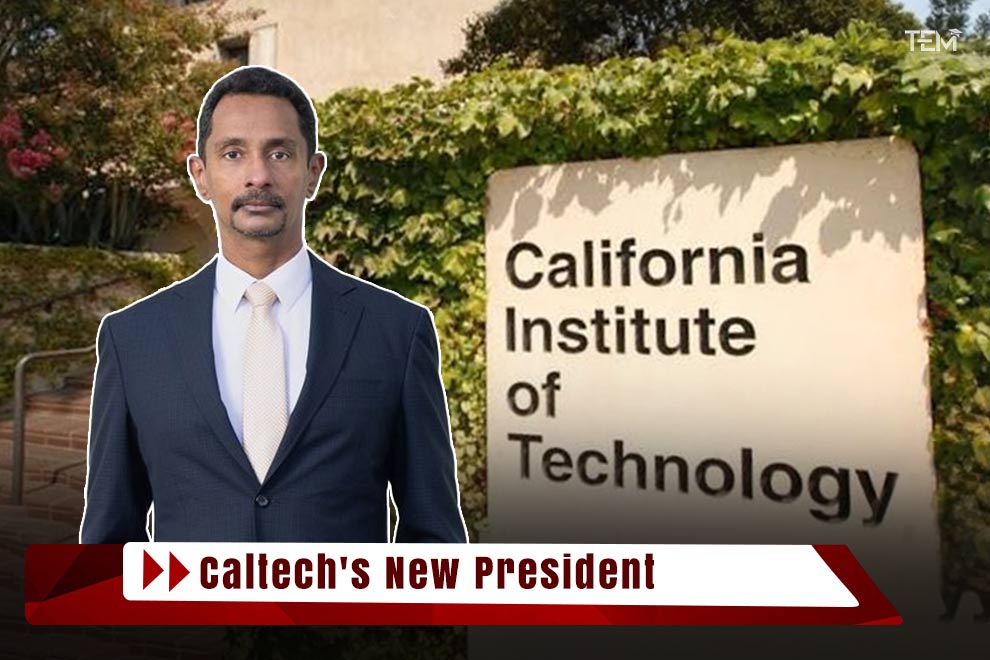
Caltech has formally inaugurated astrophysicist Dr. Ray Jayawardhana as its 10th president, marking a new chapter in the leadership of the California Institute of Technology. The inauguration ceremony took place on October 29, 2026, at the institute’s Beckman Mall, Pasadena campus. Dr. Jayawardhana had already assumed the presidency on July 1, succeeding Thomas F. Rosenbaum, who led Caltech from 2014.
As Caltech’s new president, Dr. Jayawardhana will guide the institute’s academic and research priorities, including its work in astronomy, engineering, and scientific discovery. His leadership also carries significance for the Jet Propulsion Laboratory (JPL), which Caltech manages for NASA. His background as an astrophysicist and experience leading major research universities bring a combination of scientific and administrative experience to the role.
Why Did Caltech Inaugurate Dr. Ray Jayawardhana as 10th President?
Caltech selected Dr. Ray Jayawardhana for his achievements as an astrophysicist, university leadership experience, and ability to communicate science. Before joining Caltech, he served as provost of Johns Hopkins University and held senior academic positions at Cornell University. His inauguration on October 29, 2026, formally marked his appointment as the institute’s 10th president and introduced him to the Caltech community. He had already assumed office on July 1, succeeding Thomas F. Rosenbaum.
Who Is Caltech’s New President Dr. Ray Jayawardhana?
Dr. Ray Jayawardhana is an astrophysicist whose research focuses on planetary systems, stars, brown dwarfs, and exoplanets. His academic qualifications, university leadership experience, and contributions to astronomy have shaped his career.
| Category | Details |
| Current Position | 10th President of the California Institute of Technology |
| Academic Title | Sonja and William Davidow Presidential Chair and Professor of Astronomy |
| Bachelor’s Degree | Astronomy and Physics, Yale University |
| Doctoral Degree | PhD in Astronomy, Harvard University |
| Previous Leadership Role | Provost of Johns Hopkins University |
| Earlier Academic Position | Harold Tanner Dean of the College of Arts and Sciences at Cornell University |
| Teaching and Research Experience | Spent 10 years on the faculty at the University of Toronto |
| Research Areas | Planetary systems, stars, brown dwarfs, and exoplanets |
| Space Research | Member of the science team for the James Webb Space Telescope’s NIRISS instrument |
| Research Publications | Co-authored more than 180 scientific papers |
Dr. Ray’s research on exoplanet atmospheres uses powerful ground-based and space telescopes. His involvement in the James Webb Space Telescope’s Near Infrared Imager and Slitless Spectrograph (NIRISS) instrument also connects his academic work with major space research.
What Is Caltech’s new president Dr. Jayawardhana’s Vision for Caltech’s Future?
Caltech’s new president, Dr. Ray Jayawardhana, has outlined priorities that focus on research investment, education, and public engagement. He wants to strengthen the institute’s research environment while creating more opportunities for faculty, students, and researchers to pursue ambitious ideas.
In an interview with Caltech Magazine, Dr. Jayawardhana emphasized the connection between scientific discovery and practical innovation,
Caltech President Dr. Jayawardhana said,
“I intend to be a fierce advocate for the Institute’s mission, for the people who advance it, and for the case that fundamental discovery and applied innovation are not in tension, that they reinforce each other.”
Caltech’s 10th President Dr. Jayawardhana also identified several areas he wants to focus on during his presidency:
- Investing in ambitious research: Supporting bold, high-risk research ideas across Caltech, the Jet Propulsion Laboratory (JPL), and the institute’s global observatories.
- Improving student education: Enriching the academic experience of undergraduate and graduate students.
- Supporting postdoctoral researchers: Creating more opportunities for postdoctoral scholars to contribute to scientific research.
- Expanding public engagement: Making Caltech’s research and discoveries more accessible to the public.
- Strengthening research collaboration: Encouraging partnerships across academic departments and research communities.
These priorities reflect Dr. Jayawardhana’s intention to connect fundamental research with practical applications while strengthening Caltech’s contribution to science and technology.
What Is the Connection Between Dr. Ray Jayawardhana and NASA’s Jet Propulsion Laboratory?
Dr. Jayawardhana has a personal connection to JPL dating back to his teenage years in Sri Lanka, when he wrote to the laboratory requesting photographs from NASA’s Voyager missions. Caltech manages NASA’s Jet Propulsion Laboratory (JPL), a Pasadena-based research center responsible for robotic space exploration and planetary science. The images of Jupiter and Saturn strengthened his interest in astronomy.
Dr. Jayawardhana’s research on planetary systems, stars, brown dwarfs, and exoplanets also connects with JPL’s scientific work. As Caltech’s president, he now leads the institution that manages JPL for NASA. JPL Director Dave Gallagher welcomed his appointment and expressed interest in working with him on future missions and discoveries.
What Lies Ahead for Caltech Under DR. Ray Jayawardhana’s Leadership?
Caltech’s New President Dr. Ray Jayawardhana’s inauguration brings Caltech’s leadership transition into the spotlight at a time when scientific discovery and space exploration continue to open new possibilities. With experience as both an astrophysicist and university administrator, he brings an understanding of research and academic leadership to the presidency. His role also places him at the helm of an institution closely connected to major scientific work through NASA’s Jet Propulsion Laboratory. As Caltech’s new president, the decisions he makes in the years ahead will help shape the institute’s research direction, academic environment, and contribution to future discoveries.