Cells are built to respond to stress. They alter signaling, reorganize internal structures, protect vulnerable molecules, and activate mechanisms designed to restore normal conditions. Usually, these responses are temporary.
But what happens when they persist?
“Stress responses, when transient, are adaptive. When prolonged, they can be harmful,” explains Lindsay Burns, PhD.
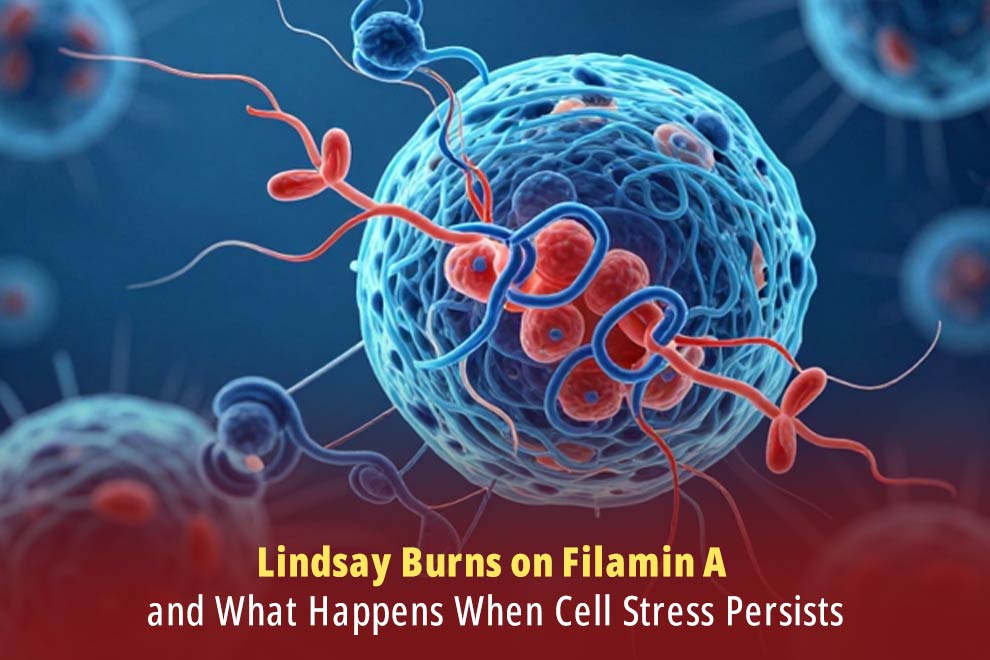
That distinction is central to a recent review by Burns and Alex Romero examining filamin A (FLNA), a large protein involved in cellular structure, mechanical sensing, and signaling. Burns and Romero focus in particular on one site on the protein, serine 2152 (S2152), when and why it becomes phosphorylated, and what happens when that modification persists.
Phosphorylation at S2152 occurs as part of a normal cellular adaptation when FLNA is stretched under stress. But Burns and Romero examine evidence suggesting that when this modification persists, it may help sustain cellular stress rather than simply respond to it.
The possibility raises a larger question: Can a biological mechanism that initially helps a cell adapt eventually become part of what prevents it from recovering?
Inflammation, for example, is adaptive in the short term but can become harmful when it persists. Burns is interested in whether certain cellular adaptations may behave similarly.
Filamin A Is More Than Cellular Scaffolding
FLNA is often described as a scaffolding protein because one of its important functions is to cross-link actin, helping cells maintain their structure and mobility. But Burns’ interest in FLNA extends far beyond its structural role.
The protein interacts with more than 90 other proteins, including receptors, signaling molecules, ion channels, and integrins. FLNA acts as a mechanosensor and mechanotransducer. Put simply, FLNA helps a cell sense physical forces and translate them into biochemical signals and cellular responses.
That ability depends in part on FLNA’s flexibility and ability to stretch. The protein can change its shape in response to mechanical forces and other forms of cellular stress. Those conformational changes can alter which regions of the protein are accessible to other molecules.
As FLNA changes shape, some binding sites can become exposed while others become less accessible. The resulting changes in protein interactions can alter signaling inside the cell, and those changing interactions can reveal how a cell responds to stress.
For Burns, understanding those changing interactions is critical to understanding what FLNA actually does.
How Filamin A Responds to Stress
One modification has become particularly important in Burns’ work: phosphorylation at the 2152nd amino acid of the very large FLNA protein, a serine commonly called S2152.
Phosphorylation occurs when a phosphate group is added to a protein. Cells routinely use phosphorylation to regulate proteins, altering their activity, structure, location, and interactions with other molecules.
S2152 phosphorylation of FLNA plays a normal physiological role in response to stress. It facilitates important processes such as immune responses and wound healing, which involve integrin activation, cell migration, platelet aggregation, and cytoskeletal remodeling.
Its presence alone is therefore not evidence of disease. Rather, it can be evidence that a cell is responding to stress.
The more intriguing question is what happens when that response, or that FLNA alteration, persists.
FLNA contains an auto-inhibitory region that normally restricts certain interactions, helping keep the protein in a relatively quiet state. Mechanical force can alter FLNA’s conformation and relieve that inhibition. Once the inhibitory configuration is unfurled, S2152 becomes more accessible to phosphorylation.
Burns and Romero’s review brings together evidence suggesting that these two events may reinforce one another. Mechanical force or other forms of stress can change FLNA’s conformation, making S2152 phosphorylation more accessible. Conversely, S2152 phosphorylation reduces the force required to unravel the inhibitory configuration, potentially promoting additional protein interactions and downstream signaling.
If that reinforcing relationship persists, a response that began as an adaptation to stress could become increasingly difficult for the cell to shut down—even after the original stress has diminished.
That proposed feedback is one of the central ideas Burns believes deserves greater attention.
When a Temporary Response Becomes Persistent
Cells have multiple systems for managing difficult conditions. They can alter protein production, reorganize internal structures, activate repair mechanisms, and temporarily change signaling while attempting to restore normal conditions.
These responses are useful precisely because they are regulated. They are supposed to turn on when needed and turn off when the threat has passed.
Burns and Romero’s review explores evidence that prolonged S2152 phosphorylation of FLNA may intersect with several cellular stress pathways, including cytoskeletal remodeling, stress-granule formation, integrin signaling, and the unfolded protein response.
Many of these mechanisms temporarily reduce normal cellular activity while the cell deals with stress. Stress granules, for example, sequester and triage messenger RNA, reducing production of nonessential proteins. Similarly, the unfolded protein response can suppress general protein synthesis while increasing production of proteins needed to address a backlog of unfolded or improperly folded proteins.
These responses are protective when they are temporary. When stress persists, however, the same mechanisms can become damaging.
S2152 phosphorylation of FLNA appears to participate in several of these stress responses. The question is whether persistent changes in FLNA could contribute to a larger, self-reinforcing stress state.
The argument is not that a single phosphorylation event independently causes a complex disease. Nor is FLNA itself being presented as a molecular villain.
The deeper questions are more fundamental: How does an adaptive response to stress become harmful? And why does the cell sometimes fail to shut it off and return the protein to its resting state?
One Mechanism, Very Different Diseases
The stress-induced adaptation of FLNA is particularly interesting in the context of cancer and neurodegeneration.
At first glance, the two diseases seem almost opposite.
Cancer involves cells surviving and proliferating when they should not. Neurodegenerative disease involves cells gradually losing their ability to function and survive.
Yet chronic cellular stress can contribute to both.
Burns and Romero reviewed more than 100 publications linking elevated FLNA S2152 phosphorylation—an adaptation associated with cellular stress—to cancer-related processes, including changes in cellular adhesion, migration, and signaling.
In a dividing cell, prolonged activation of stress-related pathways may promote survival, proliferation, or migration as the cell adapts to its harsh environment. Under some circumstances, those same processes can contribute to tumor progression and metastasis.
A mature neuron exists in a very different biological context. Neurons cannot respond to persistent stress by simply proliferating. If a mature neuron is pushed back into the cell cycle, it can instead stall and ultimately degenerate.
Thus, prolonged cellular stress may have very different consequences depending on the type of cell experiencing it.
This does not mean that FLNA S2152 phosphorylation determines which disease develops. Rather, the comparison illustrates a broader idea explored in the review: the consequences of a prolonged cellular response depend on the cell type, its environment, and the other biological pathways operating around it.
From Alzheimer’s Research to Broader Questions
Burns’ interest in this problem is closely connected to her years of research into Alzheimer’s disease.
Her work with collaborator Hoau-Yan Wang examined an altered FLNA conformation and S2152 phosphorylation in Alzheimer’s disease. Stressed FLNA is critical to the toxic amyloid-beta signaling through the alpha 7 receptor that causes tau hyperphosphorylation, the precursor to tangles in Alzheimer’s brains. Stressed FLNA also enables persistent activation of multiple inflammatory receptors, resulting in neuroinflammation—another feature of Alzheimer’s disease. The small molecule drug candidate simufilam reduces the S2152 phosphorylation and altered conformation of FLNA, suppressing both tau hyperphosphorylation and neuroinflammation.
Burns and Wang also reported increased FLNA S2152 phosphorylation and an altered FLNA conformation in Alzheimer’s brain tissue and lymphocytes compared with healthy controls. Simufilam incubation of the brain tissue or oral treatment to the patients whose lymphocytes were examined reduced these changes.
Simufilam was tested in two Phase 3 trials of mild-to-moderate Alzheimer’s disease, which failed top-line, likely due to inaccuracy of the plasma test used to confirm Alzheimer’s disease and the inclusion of moderate patients. In one trial, simufilam slowed cognitive decline in the predefined mild subgroup despite a 21% false positive rate—the percentage of patients in an amyloid PET sub-study who did not have amyloid plaque in their brains, considered a requirement for diagnosis. Because that trial was terminated early, its final timepoint was missing 45% of its data, and the effect disappeared at this unreliable timepoint. Although a false positive rate could not be estimated for the other trial, which did not have a PET sub-study, it may have been even higher: the half of patients with the highest levels of this plasma biomarker also showed a significant slowing of cognitive decline. This half included many of the more difficult to treat moderate patients.
Aside from the learnings from these clinical trials, a broader question remains.
If FLNA changes its conformation during cellular stress, and phosphorylation can help stabilize or reinforce that altered state, could the same underlying biology have relevance beyond Alzheimer’s disease?
The review with Romero explores that possibility. By examining cellular processes that may be shared across seemingly different diseases, the authors consider whether cancer, Alzheimer’s disease, and certain other disorders could involve different manifestations of prolonged cellular stress interacting with cell type, environment, and other signaling pathways.
That perspective raises additional important questions.
How exactly do FLNA conformation and S2152 phosphorylation interact with different cell stress pathways? What determines whether the response resolves? And perhaps most importantly, what makes it difficult to turn the response off?
For Burns, those unanswered questions are reasons to keep exploring the biology.
What Keeps the Stress Response Going?
The review ultimately shifts attention toward a question that can be easy to overlook.
Researchers often focus on what activates a disease-related pathway, or more fundamentally, what causes cellular stress. Burns is particularly interested in what happens next: what makes a normal, protective response become pathological?
What causes S2152 phosphorylation to remain elevated after the original stress should have resolved? Does altered FLNA conformation help maintain that phosphorylation? Do changing protein interactions reinforce the stress response—and perhaps also the stress? And if these processes become self-sustaining, can the cycle be interrupted?
Answering those questions will require additional research. But they also offer a different way of thinking about the transition from normal cell function to disease.
For Burns, that is what makes FLNA S2152 phosphorylation worth studying.
The question is not simply whether filamin A changes during cellular stress. It is whether a temporary change can become self-sustaining—altering the protein’s behavior beyond the original stress response, potentially long after the initiating stress has passed.
Understanding that transition from healthy adaptation to disease-promoting persistence could help researchers address a question that reaches beyond any single disease: When does the machinery a cell uses to protect itself become part of what prevents it from recovering?