The Education Magazine
November 12, 2026
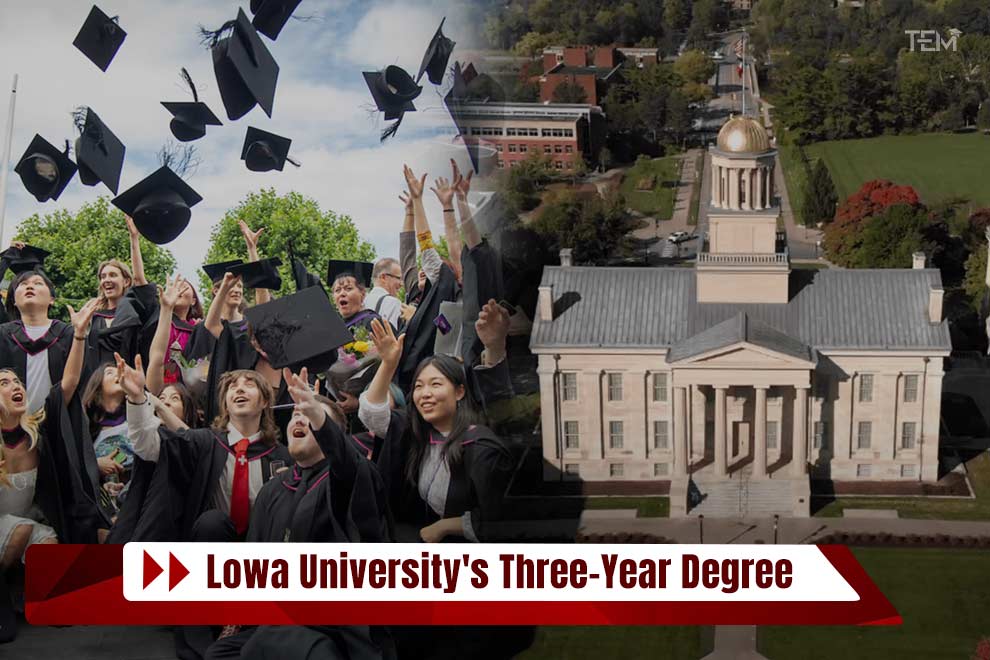
A traditional bachelor’s degree typically requires four years of study, but universities are exploring shorter pathways to make higher education more flexible and accessible. In Iowa, two public universities are seeking to introduce reduced-credit bachelor’s degrees that could help students complete their education sooner.
The Iowa Universities’ three-year degree proposals reflect a broader effort to align academic programs with workforce needs. On November 11, 2026, the Iowa Board of Regents’ Academic Affairs Committee recommended new Bachelor of Applied Professional Studies degree proposals from the University of Iowa and the University of Northern Iowa, alongside changes to existing academic programs.
What Do Iowa University’s Three-Year Degree Proposals Include?
Iowa University’s three-year degree Proposals fall under the Bachelor of Applied Professional Studies (BAPS), a reduced-credit degree designed to provide an alternative to the traditional 120-credit bachelor’s pathway.
The proposed three-year degree programs at the University of Iowa and the University of Northern Iowa follow Iowa House File 440 (2025), which requires the state’s public universities to develop three-year degree options. The Iowa Board of Regents’ reduced-credit degree framework sets a structure of approximately 90 to 95 credit hours.
The Iowa University’s Three-Year Degree initiative is intended to support working adults, transfer students, and people with previous college credits who want to complete a bachelor’s qualification through a shorter, more flexible route.
University of Iowa Proposes an Applied Health Studies Degree
The University of Iowa has proposed a Bachelor of Applied Professional Studies in Applied Health Studies through its University College. The program would offer two pathways:
- Magnetic Resonance Imaging (MRI): Online coursework with an in-person practicum in Iowa City.
- Healthcare Services: Career-focused learning for students interested in healthcare-related work.
The BAPS in Applied Health Studies program targets working adults, healthcare professionals, and students with previous college credits but no completed bachelor’s degree.
The University of Iowa estimates that the program could enroll 98 students within five years. By that time, it is also projected to generate approximately $140,000 in net revenue while using existing courses and resources.
University of Northern Iowa Plans a 90-Credit Bachelor’s Degree
The University of Northern Iowa has proposed a Bachelor of Applied Professional Studies through its College of Graduate, Research and Online Education.
The proposed BAPS degree requires 90 credits and will be delivered entirely online. Its 12-credit core curriculum covers career development, artificial intelligence literacy, technology, and professional communication.
Students can also pursue specialized study in organizational and workplace effectiveness or educational studies. The BAPS program is designed for adult learners, community college graduates, transfer students, and working professionals. It will also recognize qualifying prior learning, including relevant work and military experience.
Interim Associate Provost for Academic Affairs Deirdre Heistad said,
“The new degree will expand access to higher education, support workforce needs and strengthen UNI’s commitment to these principles.”
Why Are Iowa Universities Reviewing Existing Academic Programs?
Alongside the Iowa University’s three-year degree proposals, the Board’s committee considered academic restructuring at Iowa State University and UNI.
Iowa State submitted 11 program termination requests. Several involve combining master’s and doctoral pathways in physics, including astrophysics, applied physics, condensed matter physics, high-energy physics, nuclear physics, and biophysics. Other requests concern graduate programs in earth science and toxicology, a PhD in Wind Energy Science, Engineering and Policy, a Master of Engineering in Energy Systems Engineering, and a secondary major in Environmental Studies.
UNI also proposed consolidating related offerings. Family studies, gerontology, and long-term care administration would come together under a family and lifespan development degree. Geography, environmental resource management, and geographic information science would be combined into a geography and geospatial sciences degree.
UNI said these changes in academic programs would simplify academic pathways while preserving student access and improving alignment with workforce needs.
When Will Iowa University’s Three-Year Degree Programs Begin?
The Academic Affairs Committee recommended the proposals on November 11. The full Iowa Board of Regents was scheduled to consider the recommendations on November 12. The proposed Three-Year Degree programs are expected to begin in August 2027, subject to Board and required accreditation approvals.
The Iowa University’s three-year degree plans could create additional options for students seeking shorter routes to bachelor’s-level education. Their progress will also show how Iowa’s public universities are adapting degree structures and academic offerings to changing student and workforce needs.