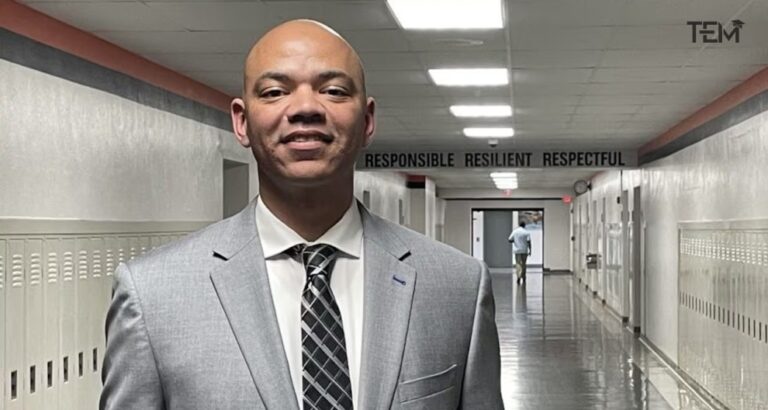
Few careers curve back toward their own beginning as neatly as this one. It started in the hallways of Jackson High School, in the Class of 1993, and in 2025 it arrived at the superintendent’s office of the very same district.
Jeremy Patterson, Superintendent of Jackson Public Schools, describes his starting point plainly: “I am a proud Jackson High School graduate, Class of 1993, and Jackson Public Schools has been part of nearly every stage of my life.”
A Career Built Inside One Community
Jeremy attended Spring Arbor University on basketball and baseball scholarships, earning degrees in Education and Exercise & Sport Science. He later completed a master’s degree in Educational Administration at Michigan State University.
In 1998, he joined JPS and served across the district as a teacher, coach, associate principal, elementary principal, middle school principal, and Assistant Superintendent of Secondary Curriculum. Each one deepened his understanding of what students, families, and educators need. Becoming Superintendent in 2025 felt to him like “a natural continuation of a career devoted to serving the community that raised me.”
Keeping Students at the Center
The job, as Jeremy describes it, is to keep student success at the center of every decision. That means aligning academics, operations, finance, staffing, safety, facilities, and community partnerships around a common direction, while working closely with the Board, staff, families, students, and community partners to “turn vision into action.”
He is proud of his long career within JPS and of being selected to lead the district he graduated from. He received the 2024 Dr. Martin Luther King Jr. Medal of Service Award and the 2024 Quiet Storm Award, and points most recently to the community’s support for the $126 million zero-tax-increase bond, which will create new opportunities for JPS students.
A Plan With a Clear Direction
One of Jeremy’s priorities has been a more connected, districtwide system of continuous improvement. The blueprint is the 2025–2030 Strategic Plan, which centers on academic excellence and workforce readiness, with goals in academics and programs, student and staff support, family and community engagement, and operations.
The district is strengthening Multi-Tiered Systems of Support (MTSS), professional learning and coaching, and opportunities for students to explore college, career, technical, al and hands-on learning pathways. The 2025 bond adds an Innovation Center at Jackson High School and improvements across the district. The aim, in his words: “a consistent, high-quality experience for every student.”
His vision for 2026 and beyond is equally clear. He wants to “bring our community together to create a culture of academic excellence and workforce readiness while developing lifelong learners.” He wants JPS to be known as a district where students are challenged academically, supported personally, and given meaningful choices for their future. Reducing chronic absenteeism, expanding learning opportunities, recruiting and retaining excellent staff, deepening family engagement, and delivering the bond projects sit alongside the push to improve achievement.
Measuring What Matters
Success, Jeremy says, will show up in academic growth, graduation and attendance trends, participation in advanced and career-focused programs, school climate, staff stability and family engagement. Equally important is whether students can clearly see a pathway from the classroom to college, career and life.
He is wary of leaning on a single number. District effectiveness, he believes, must be measured through multiple indicators rather than one test score. Proficiency matters, but so do course completion, behavior and student engagement. He asks whether students who need additional support receive it quickly, and whether interventions are producing results. At the district level, he monitors staff retention, enrollment patterns, operational performance and progress toward strategic-plan goals. “Data should help us ask better questions and improve practice.” The most useful measures, he adds, show educators what is working, where students are struggling, and what to change next.
Equity as a Response, Not a Formula
For Jeremy, “equity means every student should have access to excellent instruction, safe and welcoming facilities, technology, support services, and opportunities that prepare them for what comes next.” At JPS, that requires responding to student needs rather than assuming every learner needs the same thing.
The district draws on academic interventions, special education services, counseling, virtual and alternative learning options, transportation and technology supports, and community partnerships to remove barriers. The bond’s focus on a consistent school experience is designed to reduce differences between buildings while expanding access to rigorous academics, arts, athletics, career exploration, and hands-on learning.
Trust as the Test
Jeremy’s leadership was tested as he stepped into the Superintendent role while the district was developing a new strategic direction, managing financial and staffing pressures, and asking the community to consider a major bond investment. It called for careful listening, consistent communication, and a focus on long-term student needs, supported by collaboration across the school community.
The successful bond campaign reinforced a lesson: people will support ambitious goals when they understand the need, see a thoughtful plan, and know their voice matters. “Leadership is not about having every answer yourself; it is about building trust, bringing the right people together, and staying focused on the mission.”
Investing in People, Looking Toward a Centennial
Asked what he would do with unlimited resources, Jeremy begins with people: exceptional teachers, counselors, mental-health and behavioral supports, tutors, mentors, and career advisers for every student. He would expand early childhood opportunities, reduce barriers to attendance and offer even more individualized academic support. He would build world-class learning environments with modern technology, flexible classrooms, laboratories, arts spaces, athletic facilities and hands-on career and technical education connected to local employers, colleges and universities. After-school, summer, enrichment, and family-support programs would grow so students have what they need to thrive through graduation.
Looking ahead, he sees JPS “entering a period of significant opportunity.” The strategic plan provides direction, and the community’s investment through the bond gives the district the ability to transform learning spaces and expand opportunities. Over the next several years, he wants the district to become a model that combines strong academics, workforce readiness, innovation, historic community pride, and genuine student support. The 2027 centennial of the iconic Jackson High School building offers a chance to honor that history while looking forward. He hopes to show what is possible when schools, families, businesses, higher education and community organizations share responsibility for student success.
Grounded by Family and Service
Jeremy approaches balance intentionally, because the role can easily become all-consuming. His wife, Jill, their four children, and their grandchildren keep him grounded.
Athletics remain a lasting interest. He played basketball and baseball, coached several JPS teams, and continues working with young people through basketball programs and community activities. He also values service through local organizations and his faith community. “For me, balance is about staying connected to the relationships and activities that give the work purpose.”
All In
His message to educators and aspiring leaders is to stay connected to their purpose. Education is demanding, yet it is one of the few professions where the impact of a decision can continue for generations. Jeremy has known JPS as a student, parent, teacher, coach, principal, central-office administrator, and now Superintendent, a perspective that has clarified what every one of those roles asks of a person.
He sums up his commitment in a phrase: “I often say that I am ‘All In for JPS.’ For me, that is more than a slogan. It means believing in our students, staff, and community enough to keep improving, even when the work is difficult.”
Quote