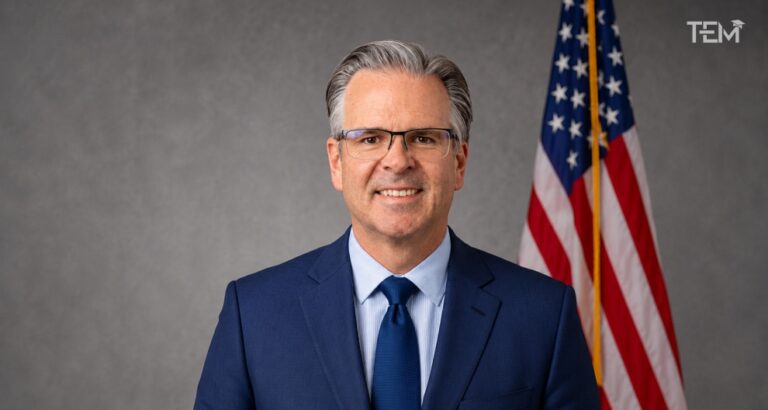
A charter school that once met in a garage does not, on paper, sound like the kind of place that would one day be ranked the best public K to 12 school in its county. And yet that is precisely the trajectory of Santa Rosa Academy, a school in Riverside County that started in 2005 with 59 students and has since developed into a thriving K–12 Early College School. At the helm since April 2020 is Dr. Robert Hennings, Superintendent of Santa Rosa Academy, a man whose own path to the position reads less like a straight line and more like a long, deliberate apprenticeship in what it means to lead a school well.
From the Classroom to the Cabinet.
Dr. Hennings began his career in 1999 as a classroom teacher, moving between science, history, and English Language Development, while also coaching athletics on the side. It was there, in those early years of lesson planning and locker room pep talks, that he says he discovered “my passion for helping students grow both academically and as people.”
From the classroom, he moved into school counseling, and from there into administration, first as a Coordinator, then Principal, Director of Secondary Education, and eventually Assistant Superintendent of Pupil Services. Each title added a new vantage point. “Each role deepened my belief that schools exist to produce graduates who benefit their communities,” he explains. By the time he arrived at Santa Rosa Academy, he had already spent two decades learning to see a school system from nearly every seat in the building.
From Growth to Measurable Progress
That broad leadership perspective became especially valuable as Santa Rosa Academy moved through a period of significant growth and institutional change. Under Dr. Hennings, the academy has been ranked #1 for Best Public K–12 School in Riverside County by Niche, posted a 99.2 percent graduation rate, and maintained high staff retention in recent years.
The school also secured a five-year charter renewal with SB740 eligibility, a milestone with real fiscal weight behind it. At the same time, the completion of the 29,000-square-foot Monterey Hall buildout expanded the school’s capacity and created a foundation for its next stage of development.
Two Tracks, One Mission
Academic structure at Santa Rosa Academy has been deliberately and recently reshaped. The school now runs a streamlined Blue Track, its traditional instructional model, alongside a Gold Track, an independent study option for grades 7 through 12. This replaced the school’s earlier Red and White Tracks, a change Dr. Hennings describes as necessary for “fiscal sustainability and rigorous college-preparatory focus” rather than a retreat from flexibility.
Underneath that restructuring sits a quieter, steadier set of instructional habits: Professional Learning Communities with dedicated weekly collaboration time, i-Ready benchmarking, common assessments, and essential standards aligned vertically across grade levels. Character education is not left to chance either. It is formalized through site-specific curricula, daily instruction, PBIS recognition, and a Superintendent’s Award given for growth on state assessments.
Beyond the Diploma
As an Early College High School, Santa Rosa Academy partners with Mt. San Jacinto College for dual and concurrent enrollment, and the results are tangible. Many students graduate averaging 30 or more transferable college units, and some leave with associate degrees already in hand.
Career pathways have been streamlined too. CTE programs in Administration of Justice, Biomedical, Business, Engineering, Multimedia Arts, and Digital Music now run on a three-year track, giving students room to complete a pathway while still pursuing electives or additional college coursework. Articulation agreements can add another 12 to 24 college credits on top of that. “Counseling supports four-year planning, so every student leaves with a clear next step,” he says.
Measuring What Matters
For a leader this focused on outcomes, the data behind the school is not incidental; it is central. Dr. Hennings and his team track state Dashboard metrics, including graduation rate, suspension rate, chronic absenteeism, and CAASPP results, alongside local measures like i-Ready, CAASPP Interims, and A–G completion. College credit accumulation and postsecondary tracking through the National Student Clearinghouse round out the picture, reinforced by quarterly data dives, PLC analysis, and surveys of staff, parents, and students.
Yet the data is ultimately intended to answer a larger question: whether students are leaving the school prepared for college, career, and citizenship. For him, the most important indicators remain high graduation rates, student connectedness, and evidence of that broader readiness.
Belonging on Campus
Numbers alone do not build a school culture, and Dr. Hennings is careful to note that. More than 70 percent of students participate in sports or clubs, and the school hosts regular Coffee with the Counselors and Coffee with the Principals events. Uniforms, high behavioral expectations, PBIS points, and monthly assemblies reinforce a set of values the school treats as non-negotiable: excellence, integrity, respect, and the development of the whole child. “Students know they are seen and valued as whole people,” he says.
Tested by Circumstance
Every leadership tenure has its hardest stretch, and for Dr. Hennings it arrived as a convergence of pressures: pandemic recovery, tight budgets from enrollment lag and state deferrals, and legislative shifts that made the old independent study model financially unworkable. The response was not to avoid the hard decision but to communicate it transparently and act decisively.
The school sunset its Red and White Tracks, created a sustainable Gold Track, and expanded Blue Track capacity through Monterey Hall, with careful fiscal planning that included a bond strategy. “The result was a stronger, more focused school that still honors parent choice,” he reflects.
What Comes Next
Looking toward 2026 and beyond, Dr. Hennings’ priorities center on full utilization of Monterey Hall for expanded elementary capacity and performing arts, continued growth of the Early College program, and refinement of CTE pathways, all while sustaining high graduation and A–G rates. A key measure of that progress will be whether more students leave with 30 or more transferable college units, while the school continues to maintain enrollment stability and strong college-going outcomes.
Asked what he would do with unlimited resources, his answer is expansive but grounded: more on-site dual enrollment capacity, deeper industry partnerships and internships for every CTE pathway, greater investment in performing arts and STEM, and an alumni network built to mentor the next generation of Rangers.
The Person Behind the Position
Away from campus, Dr. Hennings describes balance as something intentional rather than accidental, built from family time, faith, and pursuits that offer perspective. He gardens, visits museums, studies antique maps, and appreciates classic cars. He follows soccer, hockey, and baseball, with a particular loyalty to the Dodgers, and he makes time to cheer on his own children’s activities. “These pursuits keep me grounded and remind me why the work of educating the next generation matters so deeply,” he says.
It is, in the end, a fitting closing note for a man whose entire career has been about keeping sight of the individual student inside the larger system, while helping build a school culture where academic rigor, character, flexibility, and long-term opportunity reinforce one another.
Quote