Moving to Singapore comes with a lot of big decisions, and school is usually one of the hardest ones. You’re trying to do right by your child while learning a new system at the same time. For international students, school entry isn’t simply based on past report cards alone, unlike if you enroll locally. There’s a specific process, and understanding it early can save you a lot of stress later.
Singapore draws families from all over the world largely because of its education standards. Even with a population of about 5.6 million, the country supports roughly 55,000 foreign students across its schools. That level of demand means placements can’t be handled informally. Students arrive with different learning backgrounds, languages, and academic pacing, so schools need a consistent way to assess where each child belongs. (1)
This article explains why the AEIS exam matters for international students and how it fits into school placement.
What Is an AEIS Exam?
The AEIS test exists to answer one practical question: where does your child fit academically within the local school system? It’s one of the admissions requirements for international students who want to enter mainstream Singapore public schools at the primary school or secondary school level. The exam gives schools a common reference point instead of relying on overseas report cards or curriculum labels that may not always translate well.
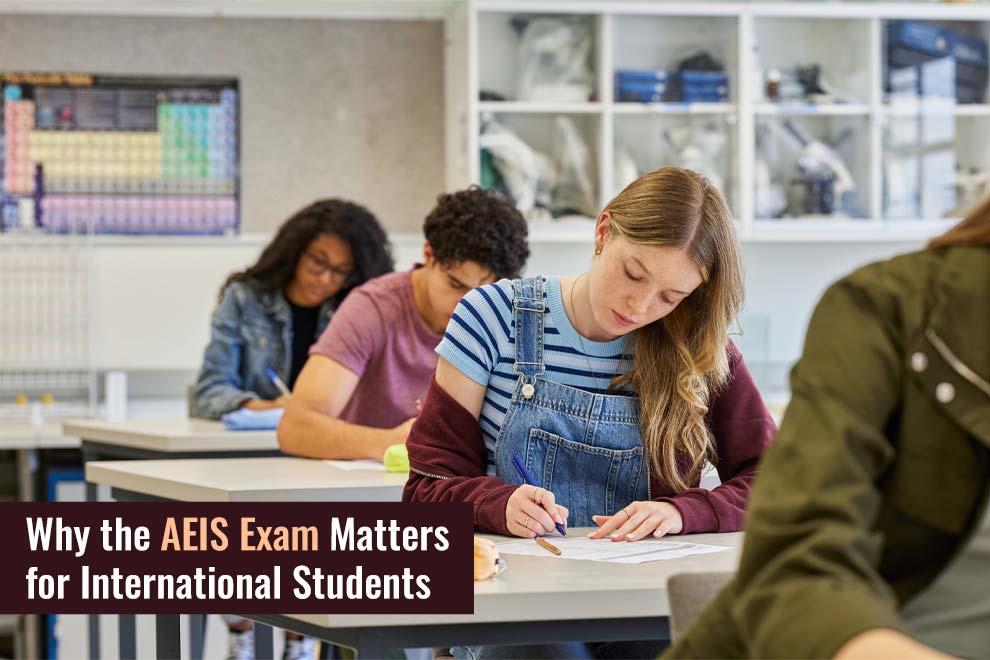
AEIS stands for the Admission Exercise for International Students, and the exam is part of that process. It’s a placement test that checks whether a student can keep up with the Singapore school syllabus at a specific test level. The focus is on English literacy skills and Mathematics, since those subjects form the foundation of daily classroom learning. The results can help determine which grade level, if any, a student can enter. Study, tutor and help with students in classroom for high school academy, future and scholarship. Entrance exams, learning and education assessment with people on campus for knowledge and solution.
Why Is the AEIS Exam Important for International Students?
More families are choosing schools in Asia as study plans shift away from North America. Recent data shows that enrollments in the U.S. dropped by about 6% at the undergraduate level and nearly 19% at the graduate level. At the same time, Asian countries reported growth, with international undergraduate enrollment rising by around 8%. As more families look toward Asia for schooling, competition for places in structured systems like Singapore’s continues to increase. (2)
That growing demand is exactly why school entry cannot be casual or flexible. When thousands of international students apply each year, schools need a consistent way to decide who’s ready and where they should be placed. The AEIS exam will answer those questions clearly, and its importance becomes easier to understand once you break down what it actually influences.
It Determines Where Your Child Actually Belongs Academically
One of the biggest reasons the AEIS test matters is placement. Schools don’t rely on age alone, and they don’t assume that a student’s previous grade level lines up neatly with local expectations. Instead, the test results help determine the right entry point based on academic readiness. That applies across primary and secondary levels, where expectations can vary sharply from one year to the next.
Because placement decisions carry long-term impact, preparation is really important. Families often plan months ahead so children can adjust to unfamiliar content and testing styles. Many parents look into structured options like an AEIS study plan Singapore preparation, to stay organized and avoid last-minute pressure. Having a clear plan helps align preparation with the level your child is actually aiming for.
It Creates a Fair Entry System for Students From Different Backgrounds
International students arrive from many school systems, each with its own grading scale, Singapore curriculum pace, and language focus. Without a shared assessment, placements would depend too heavily on subjective records that schools can’t easily compare. The AEIS exam solves that problem by giving everyone the same starting point.
This approach protects students as much as it protects schools. A child who’s placed too high may struggle daily, while one placed too low may disengage out of boredom. The exam helps reduce both risks by focusing on readiness.
It Tests Skills for Daily Classroom Learning
The AEIS exam focuses on skills students use every day. English language proficiency ability plays a major role, especially in reading comprehension and basic written understanding. Students need enough English proficiency to follow instructions, understand questions, and keep up with classroom discussions without constant support.
Mathematics test also reflects the local Singapore syllabus, which emphasizes logical thinking and problem-solving. Word problems often challenge international students because they combine language and math at the same time. The exam checks whether students can handle that mix, which mirrors what they’ll face once school starts.
It Shapes the Transition Into a Structured School Environment
International students often deal with cultural adjustment, language fatigue, and a sense of isolation during their first year or two. Research has consistently linked these early adjustment periods to higher stress levels, especially when students feel out of place or struggle to keep up in class discussions and instructions. (3)
The AEIS test helps ease that transition by placing students where they’re more likely to cope, not just academically but socially. When a student understands the lesson flow and new learning techniques, follows classroom language with less effort, and keeps pace with peers, they’re less likely to be stressed.
Overall, these factors explain why the AEIS exam carries so much weight. It’s the mechanism that matches international students to the right school level, the right expectations, and a stronger chance of settling in successfully.
Takeaway
The AEIS exam helps schools place international students where they’re more likely to keep up and settle in. For families, it explains how the system works and what’s expected before school even begins. When students start at a level that fits their skills, everyday learning feels less stressful. That smoother start can help students settle in faster, feel more at ease in class, and stay engaged in their new classrooms.