Community service occupies an unusual place in student life. It is framed as civic responsibility, personal growth, and institutional expectation all at once. That combination gives it visibility, but sometimes creates tension around why students participate in the first place and what they are meant to gain from it.
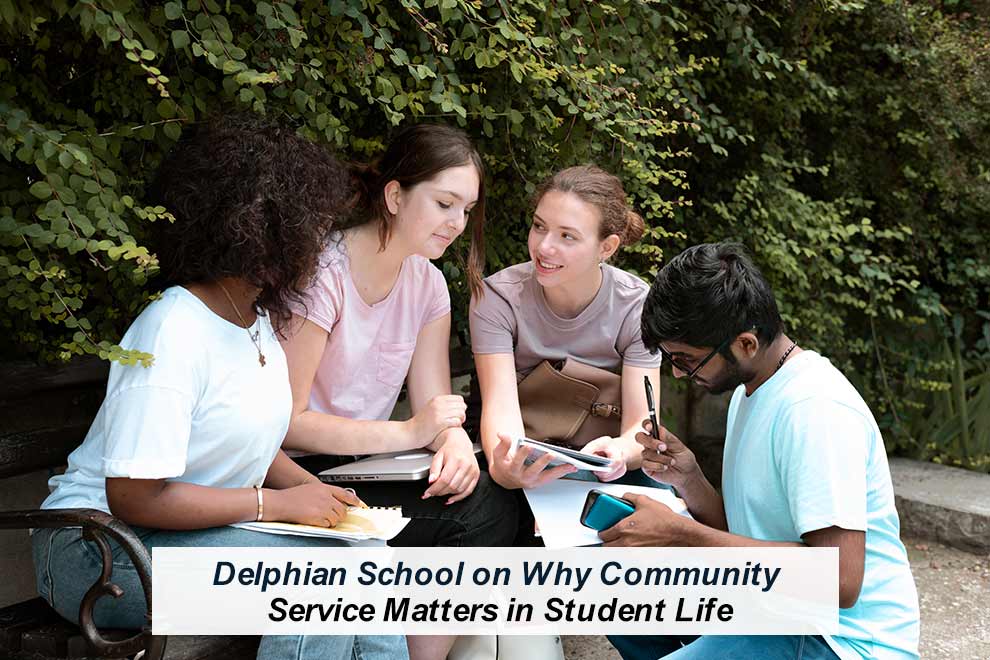
At some schools, service is not peripheral but built directly into daily life. At Delphian School, students are encouraged to regularly take part in community service, positioning service as a regular commitment rather than an occasional activity. That level of integration reflects a belief that sustained contribution plays an important role in student development.
Students at other schools may encounter service very differently. For them, it appears as a requirement layered onto an already full schedule. In those cases, service can feel disconnected from learning, which shapes how students engage long before any work begins.
Some schools often emphasize participation because it can be tracked. Hours can be logged, forms can be signed, and benchmarks can be met. What is harder to assess is whether service leads to understanding, accountability, or sustained involvement. Schools like Delphian, on the other hand, work closely with their students to clearly demonstrate how service benefits not just the students but the community they serve.
Where Student Community at Other Schools May Miss the Mark
Many service programs rely on short-term involvement. Students arrive, complete assigned tasks, and leave without seeing how their work fits into a larger effort. While the activity may be useful in a narrow sense, it rarely builds responsibility or connection. Presence replaces understanding.
Participation levels reflect this limitation. According to data summarized by Youth Service America, only about 37 percent of K–12 students take part in community service activities through their school. Even with formal programs in place, most students remain disengaged, often because service feels disconnected from their interests or daily realities.
Another issue arises when service becomes transactional. When students focus on fulfilling a requirement, the work itself becomes secondary. The incentive structure encourages completion rather than commitment, which limits learning even when intentions are good.
Community organizations also feel the strain of this approach. Supervising large numbers of short-term volunteers requires time and coordination. Without continuity, staff may spend more effort managing logistics than advancing their core work.
That’s why schools like Delphian work hard to mitigate these issues by carefully planning and structuring student community service both with the students and with the organizations they help.
What Makes Student Service Meaningful
Meaningful service usually develops gradually. Repeated involvement allows students to understand expectations, improve performance, and build trust. Familiarity changes how students show up and how their work is received.
Clarity matters as much as duration. Students are more effective when they understand why their role exists and how it fits into a broader effort. Research summarized on Wikipedia’s service-learning overview notes that 57 percent of participating students reported frequent opportunities to work with people from ethnic groups other than their own, suggesting that well-structured service often places students in sustained, real-world interactions rather than isolated tasks.
Ownership is another defining factor. When students are accountable for specific duties, they begin to see the consequences of follow-through and inconsistency. Responsibility encourages attention and problem-solving in ways observation cannot.
Service gains depth when students are encouraged to think about what they are doing and why it matters. Reflection connects effort to purpose and helps students understand their role within a shared community setting.
How Students Gain From Service Outside Academic Metrics
Service places students in situations where reliability matters. Unlike coursework, service work often affects other people directly. Missed commitments or incomplete tasks have visible consequences, sharpening students’ sense of responsibility.
Regular participation reinforces those lessons. Data compiled by VolunteerHub shows that 39 percent of 12th-grade students report volunteering at least once per month, indicating that a substantial share of students experience service as an ongoing responsibility rather than a one-time obligation.
Participation also exposes students to environments where outcomes are not graded. Service settings require attention to people, processes, and constraints that do not bend around academic schedules. That exposure encourages practical judgment and adaptability. Reflection strengthens these effects: When students consider how their actions affected others and where they fell short, service becomes part of personal development rather than an activity tied only to external recognition.
How Communities Experience Student Volunteers
Community perspectives are often missing from conversations about student service. For organizations, student involvement can be helpful, but only when it aligns with real needs and realistic timelines. How students arrive, how long they stay, and how clearly their role is defined all affect that experience. Delphian School understands this, which is why it carefully structures programs to meet the needs of both the students and community organizations.
Many communities encounter student volunteers through school-affiliated programs, while others see students arrive independently. Schools differ widely in how they present and communicate expectations around service. Some, such as Delphian School, publicly include community service as part of their institutional profile, while others treat it as an informal or optional activity.
Consistency matters from a community standpoint. Irregular participation or constant turnover limits what organizations can plan or delegate. Reliability often carries more weight than enthusiasm, particularly when staff time is limited.
Communities also respond differently to service framed as partnership rather than assistance. When students listen and adapt, their work is more likely to fit existing efforts instead of disrupting them. Respect and clarity shape whether student involvement is experienced as support or strain.
Constraints Students at Other Schools May Face
Time remains one of the most significant barriers. Academic workloads, employment, and family responsibilities restrict how much students can commit. Programs that ignore these realities often see reduced engagement. That’s why Delphian is so committed to integrating community service into its core programs and not treating it as an “extra” to force into a schedule.
Access varies as well at schools. For example, transportation, scheduling, and awareness of opportunities differ widely. Without thoughtful planning, service programs may unintentionally favor students with more flexibility. Burnout can follow when service feels imposed or disconnected from student interests. Repetition without meaning erodes motivation, even among students who initially engage in good faith. Again, this is why it’s important to carefully plan and integrate a community service program as Delphian does.
Delphian School: How Student Service Can Be Structured More Effectively
Delphian School understands that alignment improves outcomes. Matching students to roles that fit their interests and abilities increases engagement and usefulness while reducing frustration on both sides. When students feel capable in their roles, they are more likely to take responsibility for the work they are asked to do.
Some schools report higher levels of student participation than others. At Delphian School, students are encouraged to regularly participate in community service, which reflects a level of involvement that goes beyond occasional or one-time volunteering. That figure alone highlights how expectations for service can vary widely across educational settings.
Depth should be prioritized over volume. Sustained involvement in fewer settings allows students to build familiarity with their responsibilities while giving communities more dependable support. Repeated engagement also reduces the learning curve that often limits the effectiveness of short-term volunteering.
Reflection works best when it is focused and practical. Brief prompts or discussions can help students connect effort to learning without turning service into another academic exercise. When reflection is tied directly to experience, it reinforces accountability rather than abstraction.
Evaluation should move beyond hours alone. Attention to responsibility, continuity, and contribution provides a clearer sense of whether service is functioning as intended, both for students and for the communities involved.
Lasting Effects of Early Civic Participation
Early service experiences shape how students think about participation outside school. When service feels purposeful, it can influence future choices around involvement and leadership.
Habits formed through consistent contribution often persist. Students who learn to show up reliably tend to carry that expectation into other settings. Service also normalizes civic engagement. Rather than viewing participation as exceptional, students may begin to see it as part of everyday life.
These effects depend on design. Positive outcomes are more likely when service is structured with care rather than treated as an add-on.
Rethinking student service requires shifting attention away from checklists. Completion does not guarantee learning or benefit. Commitment does. Schools, students, and communities each influence how service functions. Clear expectations, honest feedback, and shared goals help move service beyond obligation.
When approached with intention, as it is at Delphian, community service can support student growth while addressing real needs. That balance takes effort, but it is achievable when service is treated as a relationship rather than a requirement.
Also Read: Fairfax County Public Schools Approve First Boundary Change in 40 Years