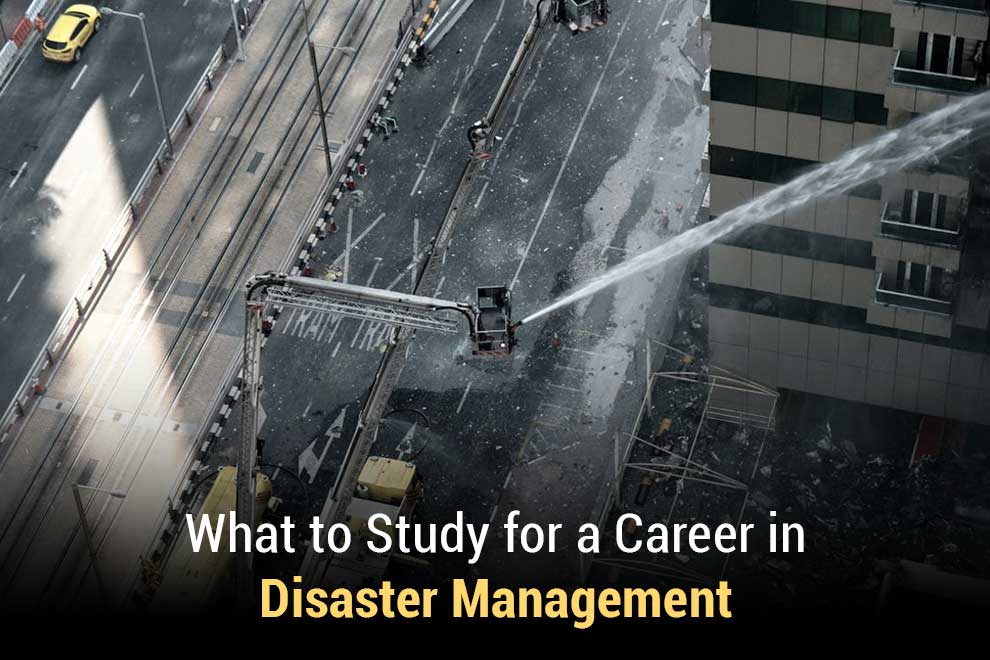
Have you ever watched a natural disaster unfold on the news and wondered who coordinates the response? Not the politicians giving press briefings, but the people actually organizing evacuations, distributing aid, and rebuilding homes afterward? In this blog, we will share what to study for a career in disaster management.
This Field Is About More Than Emergencies
Disaster management isn’t just about hurricanes and earthquakes. It’s about systems that keep functioning even when nothing is. It covers everything from floodplain planning to disease outbreak response to handling industrial accidents that send entire cities scrambling for clean air and bottled water. And lately, it’s also about helping people survive disasters that no longer feel rare—they feel constant.
Climate change has turned extreme weather into a weekly event. Heatwaves are frying infrastructure. Wildfires are torching suburban neighborhoods. Storms are bigger, faster, and less predictable. Add pandemics, cyberattacks, and unstable power grids, and the idea of “once in a generation” crises starts to sound like a punchline.
In response, the field of disaster management is evolving. No longer confined to fire drills and hazmat suits, it now requires leaders who understand science, logistics, communication, and data. The work spans forecasting, planning, coordinating, and rebuilding. Whether the goal is to prevent, respond, or recover, the common thread is this: people depend on these systems working even when everything else doesn’t.
For those seeking a serious entry into the field, earning a master of disaster management provides a structured, interdisciplinary foundation. This degree goes far beyond emergency kits and warning sirens. It trains professionals to model disaster impacts, interpret risk data, design response plans, and navigate real-world resource constraints. With a focus on policy, communication, and long-term resilience, this path prepares graduates to lead in both crisis and calm. In a world where disruptions are no longer isolated incidents, having leaders who understand how to protect vulnerable populations while coordinating large-scale logistics is no longer optional—it’s essential. That’s where the real value of a program like this shows itself: in practical readiness, not academic theory.
What You’ll Actually Learn
The field of disaster management pulls from multiple disciplines—environmental science, engineering, logistics, public health, and even psychology. Programs that train disaster professionals reflect this diversity. The coursework needs to prepare you for a world where you’re expected to think like a planner, act like a first responder, and report like a diplomat.
You’ll study disaster risk reduction, which includes understanding hazard mapping, urban vulnerability, and early warning systems. This isn’t just about forecasting. It’s about knowing which neighborhoods get hit hardest and how social inequality affects survival and recovery.
You’ll dive into emergency response coordination, which includes the Incident Command System (ICS), multi-agency cooperation, and public communication during chaos. A good program will make you roleplay scenarios where every second counts and no one has all the facts.
You’ll also learn disaster law and policy. Every action in a disaster zone has legal and political consequences. Understanding the Stafford Act, FEMA protocols, international humanitarian frameworks, and recovery funding rules makes a big difference when the cameras are off and the rebuilding begins.
Another critical focus is public health in emergencies. From waterborne disease outbreaks to mental health triage, disasters hit the most fragile systems first. Students study epidemiology, crisis communication, and strategies to keep health services running when the usual rules collapse.
And because modern disasters unfold in real-time across social media and international news cycles, training now includes risk communication and media strategy. You’ll learn how to cut through noise, correct misinformation, and deliver messages that keep people calm without making them complacent.
Choosing a Specialization
As with many evolving fields, disaster management lets you specialize. Some focus on climate adaptation, working with cities or global agencies to make infrastructure more resilient. Others choose technology and logistics, designing smarter supply chains that hold under pressure.
Some shift toward community preparedness, especially in areas where natural disasters hit hardest and rebuilding never seems to end. Others lean into international relief, joining organizations that respond to disasters in conflict zones, refugee camps, or collapsed health systems.
And then there are those who gravitate toward policy and governance, crafting the frameworks that guide disaster funding, insurance, infrastructure planning, and equity during response. These are the people behind the plans, not just the ones implementing them.
Understanding where you want to land will help you select the right mix of coursework, internships, and post-grad roles. But all paths lead to the same core: helping people stay alive and recover when everything else falls apart.
Field Experience Isn’t Optional
No matter how strong your academic background, disaster work isn’t a spectator sport. Field experience—whether through internships, field simulations, or volunteer deployments—is what separates planners from practitioners.
The work rarely happens under ideal conditions. Communication fails. Budgets shrink. Partners cancel. In the real world, success often looks like creative problem-solving, not flawless execution. Programs worth your time build that reality into the training.
That might mean coordinating a mock evacuation, shadowing emergency managers during hurricane season, or managing logistics for a public health drill. These are where instincts sharpen and mistakes become lessons, not liabilities.
The Mental Load Is Part of the Job
Disaster work isn’t just physically demanding—it’s emotionally relentless. You’ll witness suffering. You’ll navigate political blame games. You’ll have to function when every decision could make someone safer—or not.
Good programs don’t ignore this. They talk openly about burnout, secondary trauma, and decision fatigue. They train you to work hard without hollowing out your personal life. They normalize support, not stoicism.
This matters, because people in this field often stay longer when they feel prepared to take care of themselves as much as others. Sustainable disaster leadership doesn’t come from adrenaline. It comes from reflection, discipline, and community.
The disasters aren’t slowing down. The headlines might rotate from fire to flood to cyberattack to pandemic, but the underlying challenge stays the same: how do we build systems that hold under stress? And who do we trust to lead when nothing is going according to plan?
If you’re someone who runs toward the mess, not away from it, disaster management might be more than a career—it might be a calling. Just be prepared to study hard, adapt fast, and get comfortable making decisions in conditions that rarely feel certain.
Because certainty is a luxury. Resilience is a skill. And this field is where those who have it make a difference.