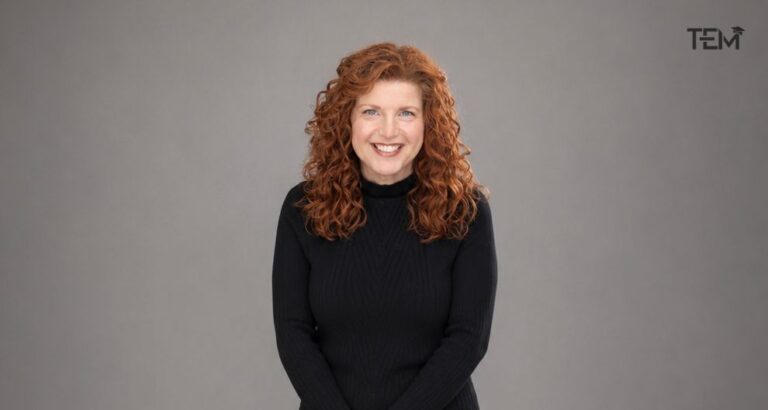
There is a question that has followed Dr. Corinne Ness since the earliest days of her academic life, and it has never sat well with her. When she chose to major in music as a first-generation college student, people around her immediately wanted to know about a fallback. “Everyone asked me, ‘What is your Plan B?’ I always hated that question. There was no Plan B.”
That refusal to entertain a retreat is not stubbornness. It is clarity. And it has shaped everything that followed.
Roots and the Road to Carthage
Dr. Ness grew up watching her mother pour herself into the work of shaping young minds. Her mother was an early childhood teacher, and that quiet dedication left a lasting impression. When she entered higher education herself, she found something that felt like confirmation: educators who seemed to hold multiple identities at once, artists who were also scholars, performers who were also teachers.
“They instilled in me the belief that one could be a performer and a teacher and a scholar all at the same time,” she says, “and I carried this into my journey into higher education.”
Her first mentor in higher education was Dick Sjoerdsma, who recognized something in her and encouraged her to draw on her background to build something new: a musical theatre program at Carthage College. The program succeeded. With that success came expanded responsibility. She moved from program director to music department chair, and eventually into her current role as Dean of Arts, Humanities, and Education at Carthage College.
Three Small Words
Ask Dr. Ness about her teaching philosophy, and she will give you exactly three words: “To lift up.”
Simple enough to fit on a sticky note, and consequential enough to organize an entire career. As Dean, lifting up takes many forms: curriculum planning, staffing, mentorship, managing budget spreadsheets, and leading special projects. It is, at its core, about “lifting up the disciplines of my division, the students in my division, and the faculty.”
The mission of Carthage College resonates with her for exactly this reason: seeking truth, building strength, inspiring service, together. She does not treat these as institutional talking points. She treats them as living commitments, ones she returns to when deciding where to direct her energy and her resources.
“We are better when we work together,” she says simply, with the kind of ease that suggests she genuinely means it.
A Global Stage
One of the more remarkable chapters in Dr. Ness’s career is one that spans continents. For 21 years, she has served as a guest professor at major conservatories in China, contributing to the development of music theatre education and forging curriculum partnerships across global boundaries. This is not a footnote in her biography. It is a sustained, decades-long commitment rooted in the conviction that the arts are not confined by geography.
She also serves as a mentor with two significant professional organizations: the National Association of Teachers of Singing and the Music Theatre Educators Alliance. Both have been formative in her own professional growth, and she is proud to now give back through mentorship.
The Graduate Program
As director of Carthage’s graduate program in music theatre vocal pedagogy, Dr. Ness oversees a program designed to fill a very specific gap: training music theatre specialists for higher education.
Its alumni reflect the breadth of what that training makes possible. They include Broadway performers, professors, scholars, and working performers, a community that continues to grow. The global partnerships she has cultivated in China have further extended the program’s reach and ambition.
Opening Doors
Access is a word Dr. Ness returns to often, and deliberately. She wants to remove the barriers that keep students from fully engaging with arts education, and she has worked closely with Carthage’s advancement office to fund initiatives that make a direct difference. One she is particularly proud of is the performing arts series, which brings professional performers in residence to work with students. She wrote these grants collaboratively with faculty, ensuring that every student has the opportunity to learn alongside working professionals, regardless of their background or means.
Recruitment, too, has become an area of genuine innovation under her leadership. She and her faculty have transformed their recruitment events into immersive creative experiences, designed not just to showcase the college, but to create a real exchange between institution and prospective student. “I’m really proud of that work,” she says.
Measuring What Matters
Dr. Ness is candid about the way she approaches assessment. Quantitative data matters, and she uses it. But she does not let it crowd out the questions that numbers cannot answer.
“How are students growing? How are faculty growing? How is our community doing collectively?” These sit alongside the spreadsheets in her thinking.
Her most meaningful measure of institutional effectiveness is simpler and more human: she looks at her alumni. Did they reach their goals? The answer looks different for every graduate. Some are performing. Some are teaching. Some are supporting the arts from other fields entirely. All of it counts.
When the Lights Went Out
The COVID-19 pandemic tested every institution, and Carthage was no exception. As an administrator, Dr. Ness faced the challenge of keeping the arts vibrant at a moment when people could not share the same room. Her team rose to meet it. They became, out of necessity, experts in video and sound production. They navigated the complexities of air quality standards and audience safety guidelines. They found ways to create and collaborate safely, holding an artistic community together through one of the most isolating periods in modern memory.
“I’m really proud of the way that our team came together during that time to find ways to create and collaborate safely,” she says.
What Unlimited Resources Would Look Like
Dr. Ness has two sons, both engineers, and she has watched them benefit from early internships that pay quite well, opportunities that arts students simply do not encounter in the same way. Arts students frequently volunteer or earn a small honorarium for a performance or exhibition.
If she had unlimited resources, her answer is immediate and pointed: she would fund arts experiential learning at the same level as engineering internships. It is an observation that says a great deal about where she believes the system falls short.
The Road Ahead
Two words define Dr. Ness’s vision for the years ahead: sustainability and innovation.
National trends are already signaling what the next decade will bring: fewer college students and less support for the arts. She is not looking away from that. Instead, she is focused on re-envisioning programs to reflect new ideas and new forms of creativity, while remaining anchored in artistic tradition. The goal, in her words, is for the arts to be “thriving at Carthage and beyond.”
Life Beyond the Office
Work-life balance, Dr. Ness will tell you, is like good posture.
“It’s something you have to always be mindful of.”
For years, much of her personal time was spent as what she warmly calls a ‘boy mom,’ spending her free time attending football games and cheering on her sons. Now that they are both grown and graduated, her time looks different. She cooks. She reads. And she has just started lifting weights, a new skill she is looking forward to building.
There is something fitting about that last detail, from a woman whose philosophy has always been about lifting things up.
The Lesson That Stayed
Dr. Ness often tells her students about her very first music theory class. When the professor explained that the lines of the treble clef could be remembered with the phrase ‘every good boy does fine,’ she took notes. She had never had the opportunity to learn to read music before that moment, and she needed those basics.
“Not knowing something is not a sign of ignorance,” she tells them, “just a sign of an experience you haven’t yet had.”
It is the kind of wisdom that only comes from having started without a safety net, and from choosing, every time, to keep going. For Dr. Corinne Ness, there was never a Plan B. There did not need to be.
Quote
“It’s important to keep asking questions and learning what we don’t know, and then, when we know better, we do better.”
Also Read: The 10 Leaders Transforming Education, 2026