There is a certain kind of clarity that only arrives after a long period of discomfort, and Dr.Matthew Flippen found his in Haiti. He had gone there not as an educator, not yet, but as an entrepreneur, founding and leading a construction materials company in one of the most economically strained places on earth.
The work was demanding and practical in the most literal sense. But it was what he witnessed off the job sites that stayed with him. He watched single mothers navigating lives of extraordinary difficulty, holding together households and futures with very little infrastructure to support them. He watched communities where the absence of real educational opportunity was not an abstract policy problem but a daily, grinding reality.
He watched, and he could not stop watching.
“That experience reshaped how I viewed leadership and education,” Dr. Flippen reflects. Today, as the Founder and President of Gracelyn University, he leads an institution marked at every turn by that particular kind of knowledge. It is the kind you absorb not from a seminar, but from years of standing in the middle of something that matters.
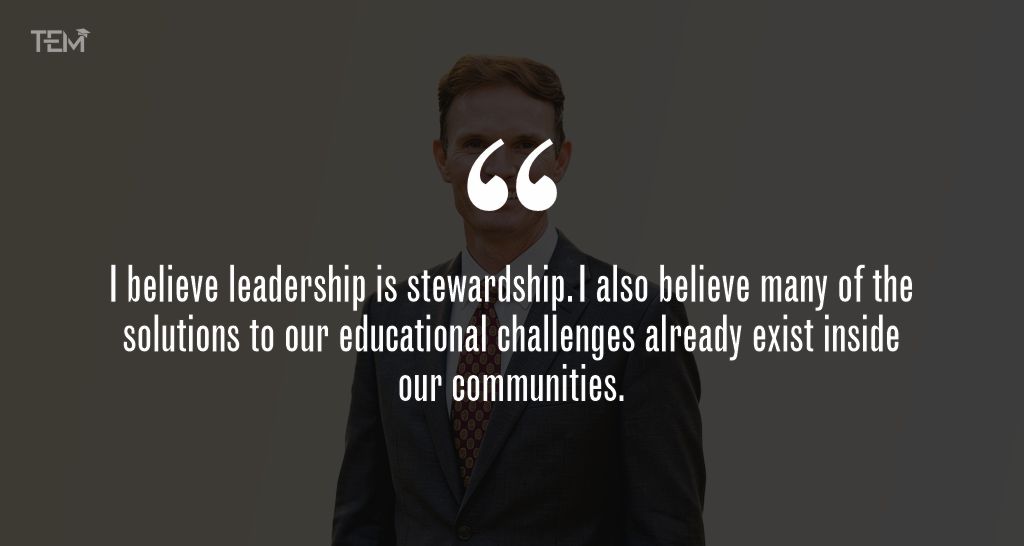
What he came to believe in Port-au-Prince, and what he has built his entire subsequent career upon, is deceptively simple. One of the most durable ways to transform a community is to prepare strong educators from within that community. The future teachers that schools desperately need are already there. They are working as paraprofessionals, as teacher assistants, and as childcare workers. They know the children by name. What they often lack is a pathway affordable and flexible enough to actually fit a life already full to the edges.
A University Built Around Real Lives
Gracelyn University was founded in 2021, and from the very beginning, it was designed to look different from virtually every other institution of higher learning in the United States.
Most universities, he points out, were designed around a central assumption that a student’s primary responsibility is school. For the traditional student arriving at a residential campus with a meal plan, that assumption holds. For most of the students at Gracelyn University, it is almost comically disconnected from reality.
Gracelyn’s students are working adults. Many are working full-time and raising children. A significant number are already employed inside the school systems they hope to eventually serve at a higher level, doing the indispensable, underpaid work of paraprofessionals while the sun is up, and then opening a laptop to complete coursework after the kids are in bed.
Dr. Flippen built Gracelyn around the realities of their lives. The university offers fully online degree programs taught from a biblical worldview. The programs are practical by design, focused on preparation that translates directly into stronger classrooms and stronger communities.
And then there is the number that stops nearly everyone when they hear it: approximately $111 per month.
That is what most Gracelyn students pay in tuition, without financial aid. In a higher education landscape where student debt has become a generational wound, Gracelyn charges roughly the cost of a weekly grocery run and asks only that students show up ready to become the kinds of educators children deserve.
The Numbers That Refuse to Apologize
In higher education, it is broadly assumed that you get what you pay for. Prestige costs money, outcomes cost money, and affordability has become a euphemism for lower standards. Dr. Flippen has spent his presidency systematically dismantling that assumption, and he has the data to prove it.
Gracelyn University has achieved approximately 95 percent student satisfaction among its predominantly low-income, working-adult student body. The institution boasts a student retention rate of approximately 96 percent. Furthermore, graduation rates have surpassed 80 percent, a figure that outperforms many traditional institutions whose students face a fraction of the competing obligations Gracelyn’s students carry.
When it comes to post-graduation success, the outcomes are equally striking. Teacher certification exam pass rates are nearly 100 percent, and job placement rates for graduates pursuing educator roles are likewise approaching 100 percent.
“Those outcomes matter far more to me than growth alone,” he notes. Gracelyn has managed to remain financially self-sustaining while charging what it charges, serving whom it serves, and producing outcomes that would satisfy any serious evaluator.
The Shape of a Leader
To understand how Dr. Flippen arrived at this moment, it helps to understand that Gracelyn University is not the first time he has oriented a professional life around expanding opportunity. Over 25 years of entrepreneurial work, his pursuits evolved into impact-focused efforts.
He completed a doctorate in transformational leadership, which functions in his story as a formal articulation of what he had already been doing intuitively. He became the host of the Transformational Educators Podcast, engaging with leaders driving measurable change in schools across the country. He also authored the number one bestselling book ‘Win With Your Talent Pipeline,’ which serves as a practical playbook for school and district leaders.
Building a university is not for the faint of heart. Building one while pursuing accreditation and scaling rapidly created significant pressure. There were moments when the operational complexity and the weight of responsibility felt genuinely overwhelming.
What he learned in those difficult seasons was the importance of staying anchored to the mission. “When leadership remains focused on purpose, difficult decisions become clearer,” he observes.
Technology That Removes Friction
Among the priorities Dr. Flippen has articulated for 2026 and beyond, one philosophy stands out with particular precision. The university believes technology should remove friction, not humanity.
At Gracelyn, artificial intelligence and digital systems are deployed to increase responsiveness and improve operational efficiency. Administrative processes are streamlined so the team can spend more time doing what technology cannot do, encouraging students who have spent years doubting whether higher education was realistic for them.
“Technology alone cannot solve that,” he asserts. “Students need people who believe in them and help them persist through challenges.”
The Vision Is Planetary
UNESCO estimates that the world will need approximately 44 million additional teachers by 2030. Dr. Flippen’s strategic vision for Gracelyn extends far beyond the United States to meet this staggering need. By 2026 and in the years that follow, the university is focused on expanding graduate programs, strengthening district partnerships, and growing internationally in underserved regions.
If resources were unlimited, he explains that he would focus on building affordable, technology-enabled educator preparation programs available in every tongue possible. The goal is to drastically reduce the barriers preventing capable people around the world from becoming highly effective educators.
When he talks about how he evaluates success, he begins with the standard metrics of retention and job placement. But he ends somewhere else entirely. The true measure of Gracelyn’s impact is whether students leave with expanded opportunities and the ability to positively impact children. Education should create both personal transformation and economic mobility.
Because strong educators influence thousands of lives over the course of a career, the downstream math of Gracelyn’s outcomes compounds for generations. Every classroom they enter is a community that benefits.
For Dr. Matthew Flippen, the mission has never simply been to build another university. It has been to create pathways for people already serving children to step fully into leadership and opportunity. In many ways, Gracelyn University is built on a belief that traditional higher education often overlooks: the future of education may already be standing inside today’s classrooms.
Quote