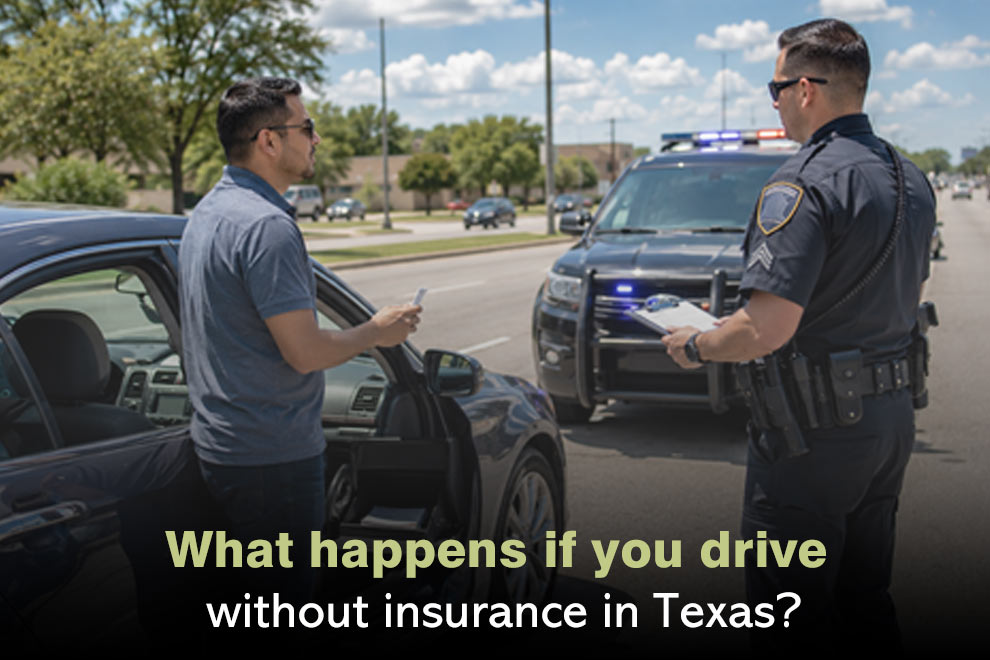
Every country has different traffic laws. Some may be lenient, while others may be very strict about following road rules. In Texas, you must be extremely careful. You would not want to be pulled over without proper insurance. Not only is this classified as a misdemeanor, but the outcome can turn costly real soon, as you cover the fines, impound fees, and reinstatement costs.
Here’s what happens if you get caught driving uninsured in Texas, starting from the initial citation step by step. Having an understanding of the consequences of one coverage lapse can help bring a change in how people think about car insurance Texas. It is far cheaper to maintain your car policy than to work through the fallout of one lapse.
What Texas actually requires
Texas car insurance laws require drivers or car owners to hold at least 30/60/25 in liability coverage. That means $30,000 in bodily injury coverage per person, $60,000 per accident, and $25,000 for property damage. Officers on the road can easily verify your coverage limits via a digital system called TexasSure. This means you must have proper proof whether you get pulled over or not. In case the system can’t verify your policy, you can still be cited even if you have valid coverage that is yet to be updated in the current database.
What happens on a first offense
Got convicted for driving without insurance in Texas for the first time? Here, the typical consequence is a fine between $175 and $350, excluding court costs. In case you are unable to pay the initially cited fine, the court can sometimes ask for a lower maximum fine. Even then, the base penalty itself is still a real financial hit for many, on top of legal fees and other related fees.
If your vehicle gets impounded with the citation, the storage fees can again run $15 per day for up to 180 days. Your car won’t generally be released without valid proof of financial responsibility. Even though these fees seem small, they can accumulate quickly and can add up to a few hundred dollars in fines. They might as well go into thousands if the vehicle is impounded for an extended period.
What happens if it happens again
A second offense? Again? Well, this can escalate things real fast. Fines for a subsequent conviction often range from $350 to $1,000. Plus, a second no-insurance conviction leads to automatic suspension of both the driver’s license and vehicle registration for up to 2 years. This suspension takes effect about 30 days after the state issues notice, giving the driver a small window to file for a hearing if they feel unjust and want to dispute the violation.
After a second offense, you will have to get your license reinstated by filing an SR-22, which is a certificate of financial responsibility proving that you carry the state’s minimum coverage. Texas law requires that the filing be active for 2 years, and you pay a reinstatement fee of around $100, on top of any other costs that might have been added by that point.
What if you are in an accident while uninsured
The consequences become more severe if you are in an accident while driving with no insurance. Texas law follows a fault-based system, where the driver responsible for the crash has to bear the costs of the resulting damages. But without insurance, that liability comes out of your own pocket, likely covering tens of thousands of dollars in medical bills and property damages.
If the accident results in severe injury or even death, there will be a dramatic escalation in penalties. Texas law usually fines up to $4,000 and imposes a year in jail for the driver responsible for a fatal crash while uninsured. Moreover, an accident-related suspension triggers an SR-22 requirement that lasts up to 3 years, along with automatic suspension of your license and registration for up to 2 years, on top of whatever criminal penalties apply. These legal and financial consequences often become a burden for convicted drivers for years to come only due to a single uninsured accident.
What Texas drivers say about close calls
People having experiences with a coverage lapse often remember the specifics vividly. One such incident is having been pulled over during the exact window when their insurance lapsed for about two weeks due to a payment processing issue. Hence, TexasSure flagged them as uninsured even though they technically had a policy that just hadn’t synced with the system. This incident made them double-check their coverage regularly since getting out of the first offense took a long time.
How to avoid ending up in this situation
Nobody wants to be convicted, even for the smallest of things. In this scenario, the most reliable way to avoid it is to ensure that you never make a coverage lapse, even for a brief time, and confirm with your insurer that your policy is updated on TexasSure. This eliminates the risk of having gaps in the state’s records even if your actual policy never lapsed. Furthermore, set up autopay, keep your contact information updated, and double-check your coverage status post-payment, or in case of a change in provider, to prevent any kind of accidental gap that could occur. But if a lapse does occur, it must be resolved immediately and updated on TexasSure simultaneously.
As a law-abiding nation, Texas takes driving without insurance as a grave offense, and with penalties that can easily add up for repeated offenses, especially if an accident is involved. Therefore, drivers or car owners must stay ahead of such incidents with consistent, verifiable insurance to avoid heavy fines, impound fees, and suspension periods. A car insurance policy that is active, with no lapse, and timely reported to the state is always a cheaper and wiser choice than having to get entangled after a citation that usually takes way longer to get out of.