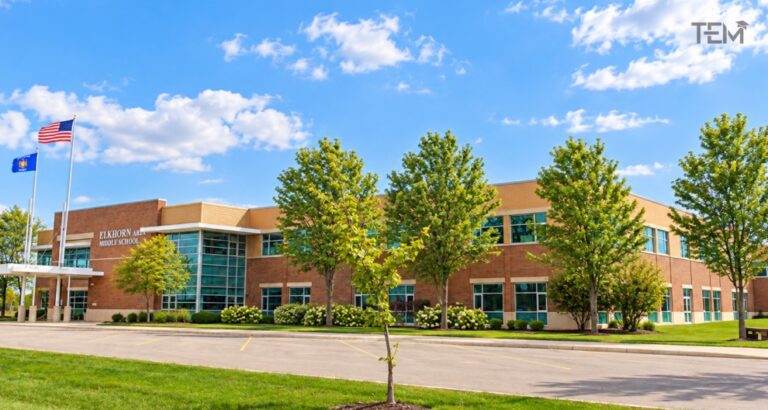
In southeastern Wisconsin, Elkhorn Area School District (EASD) has evolved from traditional neighborhood schools into a unified PreK-12 system serving approximately 3,500 students. Today, EASD combines seven brick-and-mortar schools with three public charter schools and extensive college and career pathways. Its mission is to challenge every student to continually improve and excel as a respectful, responsible, and productive member of society, while its vision is to be “in the top ten percent in all we do.” That commitment has moved the district toward personalized learning, early-college access, career credentials, virtual education, and stronger partnerships with families, colleges, employers, and community organizations.
Neighborhood Schools, Grown Into Something Else
Every school system has an origin story, and Elkhorn’s began with traditional neighborhood schools serving the community. Over time, those schools developed into a broader system designed to provide students with multiple ways to pursue their education and future goals. What makes Elkhorn’s story worth telling now is what happened after that familiar beginning. The district evolved into what it describes as a ‘unified PreK-12 system,’ one that layers seven brick-and-mortar schools with three public charter schools and a wide range of college and career pathways.
The mission is short, almost bracingly plain: to challenge every student to continually improve and excel as a respectful, responsible, and productive member of society. Rather than treating that as a statement for the page, the district has translated it into a system built around continuous growth and varied opportunities.
That ambition has steered the district toward personalized learning, early-college access, career credentials, virtual education, and, as its leaders describe it, deeper partnerships with families, colleges, employers, and community organizations.
Seven Schools, Three Charters, One System
Structurally, Elkhorn is a study in how to build flexibility without losing coherence. The traditional backbone includes three elementary schools, Jackson, Tibbets, and West Side, along with Elkhorn Area Middle School, Elkhorn Area High School, and additional district learning sites. Layered on top of that backbone are three tuition-free public charter schools: Career and College Academy, Options Virtual Charter School, and Southern Lakes College Academy.
The effect is a kind of educational Swiss Army knife. Families who want the reassurance of a neighborhood school get one. Families who need something else, virtual instruction, an alternative track, an early start on career or college, get that too, without leaving the system. And while the district is centered in the city of Elkhorn, its charter and open-enrollment programs reach students from across the region, pulling in the surrounding rural community.
By the Numbers, and the Numbers Are Loud
Ask any school district for its statistics, and you will usually get a modest handful of talking points. Elkhorn offers several measures that show both academic performance and postsecondary preparation.
The 2024-25 Wisconsin Report Card rated the district ‘Exceeds Expectations,’ with a score of 74.9. Every single school in the system improved for the third consecutive year, a streak that reflects the district’s emphasis on continuous improvement. The district’s graduation rate landed at 98.6 percent, and its on-track-to-graduation score outperformed 87 percent of Wisconsin districts statewide.
Then come the numbers that highlight the district’s emphasis on college and career readiness. Elkhorn students fill more than 2,500 dual-credit seats annually, the highest total of any district in the state of Wisconsin. In the 2024-25 school year alone, they earned 70 professional credentials through Gateway Technical College, again the highest total among Wisconsin high schools. Work-based learning participation reached 66.8 percent, compared with 8.0 percent statewide. And 31.4 percent of Elkhorn students earned industry-recognized credentials, against a state average of 5.5 percent.
The figures point to a system where academic performance is accompanied by substantial opportunities to earn college credit, build workplace experience, and secure recognized credentials.
Classrooms Built to Point Somewhere
Walk through the academic offerings at Elkhorn, grade band by grade band, and a pattern emerges: nothing is treated as a dead end.
At the elementary level, students receive instruction across literacy, mathematics, science, social studies, technology, the arts, physical education, and social-emotional learning, with early exposure to Project Lead The Way. By middle school, that foundation widens into engineering, technology education, agriculture, music, world language, and exploratory coursework, all inside what the district calls an AVID Demonstration School culture.
By high school, the menu becomes genuinely expansive: Advanced Placement courses, dual-credit options, career and technical education, fine arts, agriculture, health sciences, business, automotive, welding, machining, culinary arts, and engineering. The charter schools extend the offering further still, adding virtual learning, alternative pathways, and tuition-free early-college experiences that can lead to certificates, technical diplomas, and associate degrees before a student ever collects a high school diploma.
What “Excellence” Actually Means Here
It would be easy for a district with numbers this strong to let the numbers do the talking. Elkhorn’s leadership, instead, keeps circling back to a more human definition of success.
Educational excellence, in Elkhorn’s telling, means that every student grows, belongs, and leaves prepared for a meaningful next step. Test scores matter, but they are only one part of the picture. The district also values literacy and mathematics growth, graduation, attendance, college credits, credentials, work-based experiences, student engagement, leadership, service, and successful postsecondary transitions.
That philosophy shapes the strategic planning underneath it: high expectations, safe and supportive schools, excellent core instruction, multiple rigorous pathways, responsible stewardship, sustainable enrollment, and continuous improvement. The guiding question the district asks of itself is whether its programs are producing broad, durable results and opening doors for students who might otherwise be overlooked.
Meeting Students Where They Actually Are
Elkhorn’s approach to diverse learners begins, its leaders say, with relationships, and with the belief that students should have more than one way to prove what they know. AVID strategies, universal design, differentiated instruction, intervention and enrichment systems, special education, multilingual supports, gifted services, counseling, and flexible scheduling all work together to meet students where they are rather than where a standard curriculum assumes they should be.
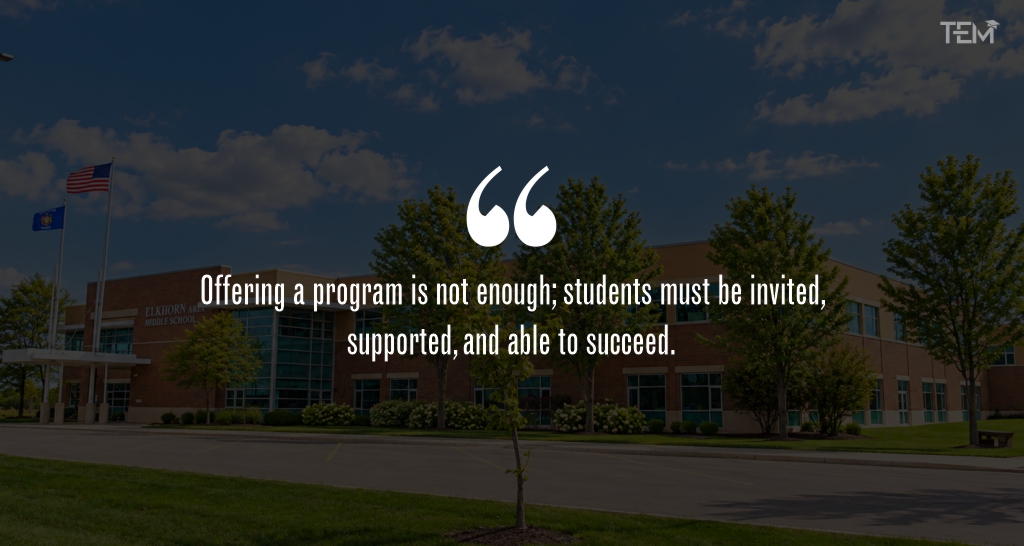
The district’s traditional, virtual, alternative, career-focused, and early-college options give families room to choose the setting that actually fits their child. Rather than assuming that offering a program is the same as reaching a student, the district reviews participation and outcome data to find gaps, then follows up with advising, transportation solutions, academic support, technology, and community connections, so that access becomes genuine participation and success.
Partnerships That Reach Past the Fence Line
No district builds a system like this alone, and Elkhorn is candid about that. Partnership, its leaders say, is built into the mission itself. The district communicates frequently with families, solicits feedback, and runs Parent Connections programming alongside parent and booster organizations that support academics, athletics, and the arts.
Local businesses show up for career days, internships, youth apprenticeships, mentoring, equipment donations, and authentic projects through the district’s ElkWorks initiative. Higher-education partners, including Gateway Technical College and UW-Whitewater, help deliver college coursework and credentials directly to Elkhorn students. Beyond that, the district collaborates with the City of Elkhorn, public-safety agencies, service clubs, the Chamber of Commerce, healthcare and human-service organizations, and the EASD Education Foundation. Together, those relationships expand opportunity while keeping the schools connected to community needs.
Life Outside the Classroom Door
A district defined only by its academic statistics would be missing something, and Elkhorn seems to know it. Student life across the system includes a broad range of interscholastic sports, music, theater, visual arts, academic teams, service organizations, student government, and interest-based clubs.
Career-connected student organizations, FFA, HOSA, and SkillsUSA, link classroom learning to competitions, leadership development, travel, and service. Middle and high school students have ample room to perform, compete, lead, and contribute, while elementary students get their own version of that same experience through clubs, enrichment activities, community events, and summer programming. Co-curricular life, the district maintains, is not an extra. It is part of how students build belonging, resilience, teamwork, and readiness for whatever comes after graduation.
Who Keeps the System Running
Behind a district this coordinated is a leadership structure built for collaboration rather than isolated silos. The Board of Education sets policy and direction, and the District Administrator aligns the broader system around those priorities. Principals lead teaching, learning, culture, and day-to-day operations at each school.
District-level leadership spans curriculum, special education and pupil services, human resources, business, technology, facilities, transportation, food service, communications, and community partnerships, all working in coordinated support of the schools themselves. Counselors, psychologists, social workers, nurses, instructional coaches, and support staff help connect district decisions to individual student needs. Regular collaboration, the district says, allows it to respond consistently as a system while still letting each school hold onto its own relationships and identity.
Equity as a Daily Practice, Not a Slogan
Ask Elkhorn’s leadership what equity means, and the answer is concrete: opportunity cannot depend on a family’s income, transportation access, prior knowledge, disability, language, or a family’s ability to navigate a complicated system.
To close that gap, the district brings college courses directly into its schools, reduces tuition barriers, and provides technology and academic support built around student pathways. Staff actively recruit students into advanced coursework, credentials, apprenticeships, activities, and leadership opportunities, then monitor whether those students actually stay and succeed. Special education, multilingual services, counseling, McKinney-Vento support, meal assistance, mental-health partnerships, and flexible charter options are all aimed at specific, named barriers rather than general good intentions.
A Broad Network of Student Support
The student-support network underneath Elkhorn’s students includes counselors, psychologists, social workers, nurses, special-education teams, interventionists, career planners, and mental-health partners. Career fairs, employer visits, job shadows, internships, and youth apprenticeships give students direct exposure to working professionals and workplaces. AVID also supports organization, study skills, confidence, and college knowledge, while tutoring, mentoring, transition services, scholarship guidance, community service, and targeted assistance provide additional layers of support. Students can access these resources through the High School, Career and College Academy, Options Virtual Charter School, and Southern Lakes College Academy.
What Comes Next
Elkhorn’s leadership is not treating any of this as a finished project. The district’s next phase centers on strengthening core instruction while expanding flexible, high-value pathways: continued literacy and mathematics growth, broader access to dual credit and credentials, and more youth apprenticeships and employer partnerships.
The plan is to keep binding traditional, charter, college, and career programs into a single coherent system rather than a patchwork of separate offerings. Success, going forward, will be measured through student growth, graduation, attendance, college credits, credentials, work-based experiences, engagement, postsecondary outcomes, family confidence, staff retention, enrollment trends, and financial sustainability – a long list, for a district that has made clear it does not want to be measured by any single number.
The Person Behind the System
The district’s approach also reflects the career of its superintendent Jason Tadlock, who began as a Spanish teacher and coach, then moved through roles as a K-12 principal, a middle and high school principal, and a K-8 superintendent. Early professional preparation in technology education, service in El Salvador, leadership work through Project Lead The Way, and hands-on experience with AVID all continue to inform his approach to district leadership.
The message for families, current and prospective, is deceptively simple: “Elkhorn will know your child, challenge your child, and help your child build a pathway toward a meaningful future.”
It is a small sentence for a district that has clearly done a great deal of work to put that philosophy into practice. But perhaps that is the point. The strongest ideas, Elkhorn’s leadership insists, emerge when students, educators, families, and community partners work together, and the district’s responsibility, as they see it, is to keep those high expectations and opportunities at the center of the educational experience.
Quote