In Midtown Atlanta, inside a facility that Georgia Tech describes as the nation’s first university-based, AI-driven autonomous manufacturing laboratory, robots move between machines with a confidence that would have seemed like science fiction only a decade ago. Researchers can ask the system questions in natural language, have it generate manufacturing plans, instruct robotic equipment, and oversee complex production workflows without needing expertise in every individual machine. It is, in many ways, a factory capable of teaching itself—and it stands at the center of what the university calls the Georgia AI Manufacturing (GA-AIM) Corridor, a statewide initiative supported by a $65 million grant from the U.S. Economic Development Administration.
“We’re going to accelerate the adoption of AI across Georgia’s manufacturing sectors,” said Georgia Tech President Ángel Cabrera, describing an effort designed to extend well beyond metropolitan Atlanta into rural and underserved communities, pairing advanced manufacturing technologies with workforce development so the benefits of automation are shared across the state.
A University Built for Scale
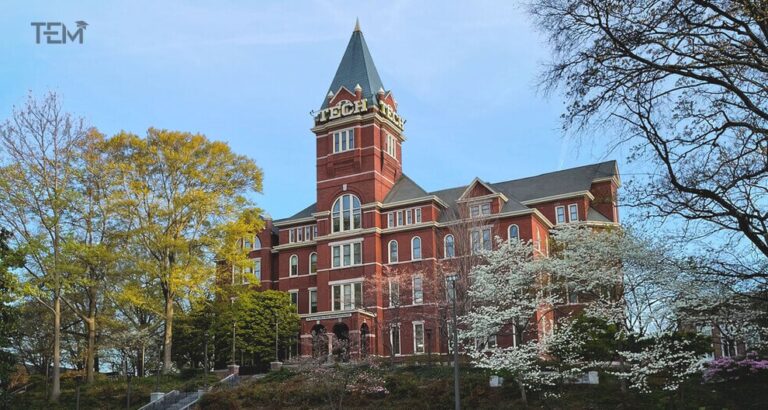
Founded in 1885, the Georgia Institute of Technology has evolved from a technical school into one of the world’s leading public research universities, serving more than 56,000 students across seven colleges.
Its College of Engineering remains the largest engineering college in the United States, educating more than 21,000 students through eight schools, nearly 500 faculty members, and more than 50 degree programs. Consistently ranked among the nation’s top engineering schools, the College’s undergraduate program continues to rank among the country’s best according to U.S. News & World Report, while all eleven engineering disciplines remain nationally recognized for academic excellence and research impact.
The College is also entering a new chapter of leadership.
After serving as dean since 2021, Raheem Beyah became Georgia Tech’s provost in November 2025 following a tenure that strengthened both the College’s national reputation and its leadership among public engineering programs. He was succeeded by Mitchell L. R. Walker II, a longtime faculty member in the Daniel Guggenheim School of Aerospace Engineering and an internationally recognized expert in plasma propulsion, who assumed the deanship on June 15, 2026, after Doug Williams served as interim dean during the transition.
Walker has already helped shape Georgia Tech’s interdisciplinary approach to artificial intelligence, contributing to the development of the Minor in Applications of Artificial Intelligence and Machine Learning while supporting major investments in aerospace engineering infrastructure, including funding for a new Aerospace Engineering Building.
The Intelligence Behind the Machines
If the College of Engineering designs intelligent machines, the College of Computing develops the intelligence that powers them.
In the 2026 U.S. News & World Report rankings, Georgia Tech’s graduate Computer Science program ranked No. 5 nationally, including No. 5 in Artificial Intelligence, No. 6 in Systems, and No. 13 in Theory. Its undergraduate computer science program also ranked among the nation’s elite, earning No. 5 overall, while leading individual specialties including Mobile and Web Applications, Cybersecurity, and Software Engineering.
Together, the two colleges have created one of the country’s strongest ecosystems for integrating engineering, computing, robotics, and artificial intelligence.
An AI Manufacturing Laboratory With a Broader Mission
The autonomous manufacturing laboratory did not emerge in isolation.
It evolved from Georgia Tech’s Advanced Manufacturing Pilot Facility, which expanded in 2026 under the leadership of Aaron Stebner, Professor in the School of Materials Science and Engineering. The facility enables startups and manufacturers without access to industrial-scale production equipment to develop, validate, and refine AI-powered manufacturing systems before deploying them in commercial environments.
Stebner has described an ambitious long-term vision in which entrepreneurs, manufacturers, and researchers could interact with the facility through intuitive digital interfaces, specifying what they want to produce while AI recommends appropriate materials, manufacturing methods, and production workflows.
Equally notable is the university’s emphasis on responsible innovation. Every proposed AI project submitted to the facility includes an evaluation of its anticipated societal impact, reflecting Georgia Tech’s commitment to ensuring that technological advancement is accompanied by ethical consideration rather than treated as an afterthought.
Elsewhere on campus, the H. Milton Stewart School of Industrial and Systems Engineering advances its own AI research initiative, applying machine learning to production optimization, asset management, logistics, and human-centered manufacturing systems. The emphasis remains consistent across the university: automation should enhance human capability, not simply replace it.
Building Intelligent Factories That Still Need Intelligent People
What distinguishes Georgia Tech is not simply its investment in artificial intelligence or robotics. It is the recognition that intelligent factories ultimately depend on intelligent people.
From GA-AIM’s statewide workforce development initiatives to the Advanced Manufacturing Pilot Facility’s emphasis on ethical AI deployment, the university approaches automation as both a technological and societal transformation. Rather than viewing AI as a replacement for human expertise, Georgia Tech continues to position it as a tool that expands what engineers, manufacturers, and communities can achieve together.
In doing so, the Institute is helping redefine manufacturing for the next generation—one where the smartest machines are built alongside an equally prepared workforce capable of guiding them.