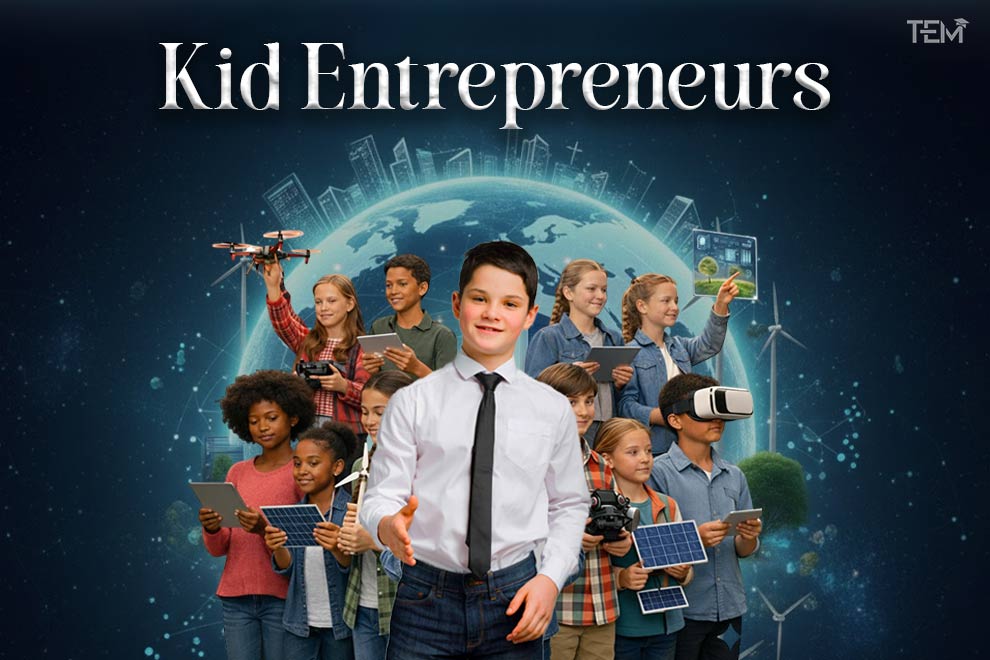
Kid entrepreneurs are not simply younger versions of adult founders. They represent a fundamental shift in how learning, creativity, and leadership are developing in the modern world.
With early access to technology, online learning platforms, and global information, children today learn by doing. They experiment, test ideas, fail early, and improve often outside traditional classrooms. Entrepreneurship becomes an extension of education rather than a separate career choice.
What makes kid entrepreneurs especially important is their ability to connect learning with real-world impact. Whether through technology, sustainability, digital media, or education itself, these young innovators show how problem-solving, curiosity, and responsibility can develop at an early age. Their journeys offer valuable insights into how future-ready education systems can nurture skills that matter beyond exams and degrees.
How This List of Kid Entrepreneurs Was Curated
This list of kid entrepreneurs was curated using strict editorial and educational criteria aligned with global education journalism standards.
Each individual featured meets the following benchmarks:
- Age relevance: All entrepreneurs are under 18 and belong to today’s generation
- Verifiable recognition: Covered or acknowledged by credible media, education, or innovation platforms
- Educational value: Their journeys demonstrate applied learning, critical thinking, creativity, or social impact
- Global balance: Representation across regions, including India and major innovation hubs
This article prioritizes learning outcomes and leadership development over popularity alone.
Here Are the 10 Kid Entrepreneurs Shaping the Future
1. Mikaila Ulmer (USA) – Founder of Me & the Bees Lemonade
Mikaila Ulmer was just 4 years old when she was stung by two bees in the same week. Instead of developing fear, she developed curiosity. With help from her grandmother, she researched bees and learned about their importance to the ecosystem and how endangered they’ve become in the present times.
Using her great-grandmother’s flaxseed lemonade recipe, she started selling lemonade sweetened with honey instead of sugar. A portion of the profits went toward saving bees.
What began as a small neighborhood stand grew into Me & the Bees Lemonade, a brand now sold in major U.S. retailers. Mikaila gained national recognition after appearing on Shark Tank and receiving mentorship from business leaders.
Her journey shows that entrepreneurship doesn’t have to start with profit; it can start with purpose. Mikaila’s success lies in connecting a simple product to a meaningful cause.
2. Alina Morse (USA) – Founder of Zollipops
Alina Morse was 7 years old when she attended a bank event and was offered candy, followed by a reminder from her parents about sugar and dental health. Instead of accepting this contradiction, she asked a simple question: Why can’t candy be good for your teeth?
That question led to the creation of Zollipops, sugar-free lollipops that help reduce acidity in the mouth. With guidance from her parents and dentists, Alina developed a product now sold in thousands of stores.
Zollipops are also used in schools and hospitals, making Alina one of the youngest entrepreneurs to blend health, education, and business successfully.
Her journey proves that curiosity paired with guidance can turn everyday observations into impactful ventures.
3. Shubham Banerjee (USA) – Inventor of Braigo
At just 12 years old, Shubham Banerjee learned that most Braille printers cost thousands of dollars, making them inaccessible to many visually impaired people worldwide.
Using a Lego Mindstorms kit, he built a low-cost Braille printer called Braigo. His innovation attracted global attention and funding support from major technology leaders.
Shubham’s work focuses not on disruption for profit, but accessibility through innovation.
His story shows how problem-solving skills taught in classrooms can translate into life-changing technology when students are encouraged to think beyond grades.
4. Ryan Kaji (USA) – Creator of Ryan’s World
Ryan Kaji started reviewing toys on YouTube at the age of 4, guided by his parents. What began as simple videos grew into Ryan’s World, one of the most influential child-led media brands globally.
Beyond entertainment, Ryan’s brand now includes educational toys, books, science kits, and learning-based content for children.
While Ryan does not manage the business alone, his role as a creator highlights a new form of entrepreneurship, content-driven digital enterprises.
His journey reflects how creativity, when structured responsibly, can become a powerful educational and business platform.
5. Moziah Bridges (USA) – Founder of Mo’s Bows
Moziah Bridges learned to sew bow ties from his grandmother at the age of 9. When he couldn’t find bow ties he liked, he made his own and began selling them.
Mo’s Bows soon became a fashion brand worn by celebrities and featured in major retail outlets. Moziah appeared on Shark Tank and secured mentorship rather than immediate funding, focusing on learning the business.
His journey emphasizes craftsmanship, branding, and patience, qualities often overlooked in fast-scaling startup culture.
6. Samaira Mehta (USA) – Founder of CoderBunnyz
Samaira Mehta was introduced to coding at a young age and quickly recognized that many children find programming intimidating. To solve this, she created CoderBunnyz, a board game that teaches coding concepts through play.
The game is now used in schools and learning programs, making STEM education more accessible and enjoyable.
Her work highlights how education innovation doesn’t always require screens; it requires understanding how children learn best.
7. Isabella Rose Taylor (USA) – Founder of Isabella Rose Taylor Brand
Isabella Rose Taylor launched her fashion brand at 12 years old, blending design, entrepreneurship, and education. Her work was showcased at New York Fashion Week, and she continued her education while building her brand.
Isabella’s journey reflects the balance between creative ambition and academic grounding.
Her story reinforces that entrepreneurship does not require choosing between education and enterprise; they can grow together.
8. Nick Dobroshinsky (USA) – Teen AI Entrepreneur
Nick began exploring artificial intelligence at 16, driven by a desire to make learning more interactive and personalized for students. He co-founded a platform that uses AI tools to help students grasp complex concepts in math and science.
His initiative has received recognition from major technology publications and educational forums, highlighting the growing role of teenagers in EdTech innovation.
Nick’s journey demonstrates how technical curiosity, when combined with mentorship and practical application, can create solutions that impact learning at scale. His work reflects that age is no barrier to contributing meaningfully to technology and education.
9. Raghav Arora (USA) – Co-Founder, Teen AI Startup
At 17, Raghav Arora co-founded a startup that applies machine learning to personalize student learning experiences. By analyzing learning patterns, his platform helps students improve at their own pace, making education more effective and engaging.
Raghav has been featured in credible tech and education publications, earning recognition for applying AI to real-world educational challenges.
His journey underscores how modern learning is becoming interdisciplinary, blending coding, data science, and pedagogy. Raghav’s work shows that teen entrepreneurs can innovate solutions with both social and educational impact.
10. Alby Churven (Australia) – Founder of Teen AI Initiative
Alby Churven, at just 14 years old, launched a youth-led initiative to teach AI and coding fundamentals to school students. His program focuses on hands-on projects that make technology accessible and fun for peers, bridging gaps in traditional classroom learning.
The initiative has been acknowledged by educational journals and technology platforms for its innovative approach to peer-to-peer learning.
Alby’s story illustrates how leadership, collaboration, and purpose-driven innovation can develop in children when they are given the right tools and autonomy. His work highlights that young innovators can meaningfully contribute to shaping the future of education.
Trending Now: Eco Wala: Young Founders Impress Business Leaders
Recently highlighted by Harsh Goenka on Twitter, Eco Wala, founded by three Indian teenagers, is creating sustainable solutions for waste management and environmental awareness. Their work integrates science, design, and community impact, making them an inspiring addition to the world of kid entrepreneurs.
Eco Wala shows that even current school projects can evolve into impactful ventures, reinforcing how learning, creativity, and social responsibility intersect in modern youth entrepreneurship.
Key Takeaways: What Kid Entrepreneurs Reveal About Modern Education
1. Practical application accelerates learning more than theory alone
Kid entrepreneurs learn faster because they apply ideas immediately, whether through building products, managing money, or communicating with customers. This shows that education becomes more effective when knowledge is used, not just memorized.
2. Early access to resources shapes capability, not age
These stories demonstrate that when children are given access to tools, mentorship, and learning opportunities early, they develop advanced skills regardless of their age. Exposure, not maturity, is often the deciding factor.
3. Modern learning is inherently interdisciplinary
Kid entrepreneurs rarely work within a single subject. Their journeys combine technology, creativity, communication, and basic economics, highlighting the need for education systems that encourage cross-disciplinary thinking.
4. Ownership builds confidence and leadership naturally
Running initiatives or businesses teaches children responsibility and decision-making. When learners are trusted with ownership, leadership skills develop organically rather than through instruction alone.
5. Purpose-driven learning creates deeper engagement
Many kid entrepreneurs are motivated by solving meaningful problems, health, sustainability, or education. Purpose gives learning direction, making children more focused, motivated, and invested in long-term outcomes.
Final Note
As education systems worldwide continue to evolve, kid entrepreneurs offer valuable insight into the future of learning and leadership. Their journeys demonstrate that when children are given access, autonomy, and encouragement, they do not merely prepare for the future; they begin shaping it.
Share the Conversation
If these stories changed the way you think about learning, leadership, or what children are capable of achieving, share this article with fellow educators, parents, students, and policymakers. Conversations shape progress, and the future of education begins when ideas are shared.
FAQs
1. Who is the youngest ever entrepreneur?
One of the youngest entrepreneurs ever documented on a major business platform is Kiowa Kavovit, who appeared on Shark Tank at just 6 years old to pitch her product Boo Boo Goo
2. Can kids legally run businesses?
In most cases, children operate businesses with parental or guardian support, often under family ownership structures, until they reach adulthood.
3. What can other children learn from kid entrepreneurs?
They show that age is not a limitation. Curiosity, consistency, and learning by doing are often more important than resources or experience.