By The Education Magazine | March 6, 2026
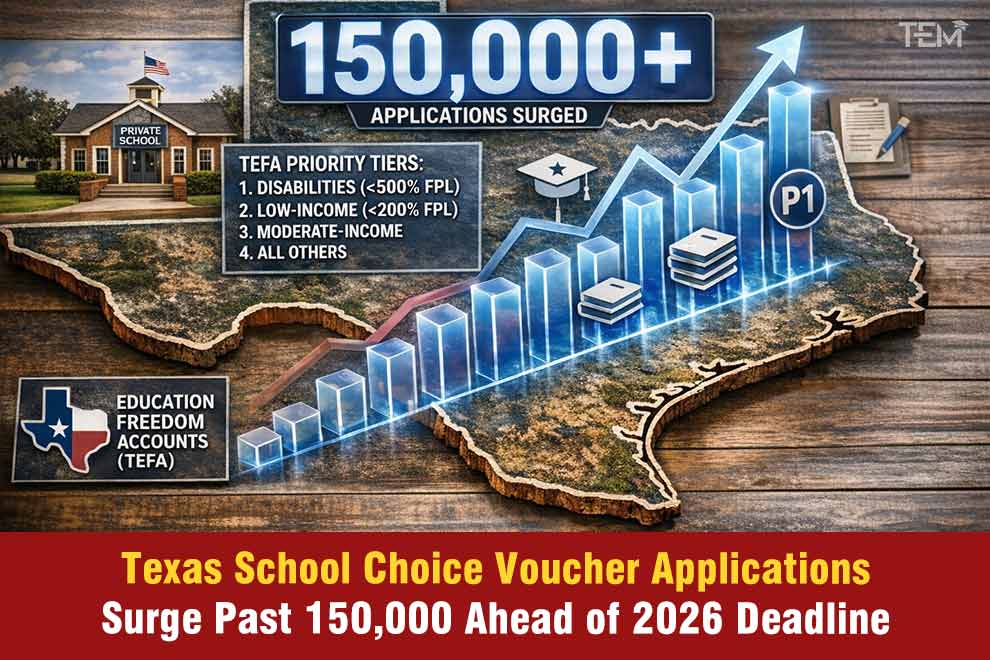
Texas school choice voucher applications have surged past 150,000, making it the largest year-one launch of a school choice program in United States history, according to the Texas Comptroller of Public Accounts.
Officials say the overwhelming response to the Texas Education Freedom Accounts (TEFA) program highlights a growing national appetite for alternatives to traditional public schooling.
With the deadline fast approaching, thousands of parents across Texas are racing to secure a spot in the program that could help pay for private school tuition, tutoring, and other educational services under Senate Bill 2 (SB 2), signed into law by Governor Abbott.
What the Texas School Choice Voucher Program (TEFA) Offers Families in 2026
TEFA can be used for:
- Private school tuition
- Educational therapy services
- Tutoring or academic support
Supporters argue that these private school tuition subsidies empower parents to choose the educational environment that best fits their children’s needs.
Policy advocates supporting school choice say the massive application numbers and the program’s record-breaking national launch show parents want greater flexibility in how education funding is used.
The Priority Tiering System and the School Voucher Income Debate
However, the surge in voucher applications has sparked a major debate over who will ultimately benefit.
Because demand far exceeds available funding, the Comptroller’s office has confirmed participants will be selected through an income-based priority tiering system under SB 2, not a random lottery:
- Priority 1: Students with disabilities from families earning up to 500% of the federal poverty level
- Priority 2: Low-income students (below 200% of the federal poverty level)
- Priority 3: Moderate-income students
- Priority 4: All other applicants
Critics warn that without strict school voucher income limits enforced across all tiers, the program could still disproportionately benefit families who already send their children to private schools.
Research from Education Week has consistently found that voucher programs without strong income caps predominantly serve middle- and upper-income households.
Some analysts argue that this structure risks turning the program into a taxpayer-funded subsidy for families already able to afford private education, rather than expanding opportunities for students from underfunded public schools.
A National School Choice Flashpoint
Texas has become a central battleground in the national education policy debate, with the program’s rollout drawing attention from policymakers across the country.
Proponents of school choice argue that the high number of applicants proves parents want alternatives to traditional public school systems.
Meanwhile, education equity advocates warn that expanding vouchers without strong safeguards could divert public funding away from already-strained school districts.
Observers say the Texas rollout may influence future education policy discussions across the United States.
What Happens Next?
The Comptroller’s office will begin processing applications after the March 17, 2026, at 11:59 PM CT deadline, with selected families notified in early April 2026.
Families selected through the priority tiering process will gain access to TEFA funds, providing:
- $10,474 per year for private school students
- Up to $30,000 per year for students with disabilities
- $2,000 per year for homeschooled students
The record volume of Texas school choice voucher applications has already reshaped the national conversation around public education funding, and regardless of how the tiering process unfolds, the debate over school vouchers is far from settled.
FAQs
- Can public school students apply for the TEFA program?
Yes, the program is open to all families regardless of whether their children currently attend public or private school. However, under SB 2’s tiering structure, students with disabilities and those from lower-income households receive priority placement when demand exceeds available funding.
- What is the application deadline, and what happens after?
The submission window closes on March 17, 2026, at 11:59 PM CT. After that, the Texas Comptroller of Public Accounts will process submissions and notify selected families in early April 2026.