The lumber from four old country schools, Birthright, Addran, Posey, and Beckham, went into the building of one new school. Later, Independence, Tira (South Sulphur, Oak Grove, and Sand Hill had joined Tira earlier), Emblem, Peerless (Sunny Slope had consolidated with Peerless earlier), and Old Tarrant joined North Hopkins ISD. More lumber was purchased from Camp Maxey to build the gym, and a building bought from Camp Maxey was put to use on the campus. The district’s early history reflects the resourcefulness of the communities that came together to build it.
Many Communities, One District
In 1942, the communities of Posey, Birthright, and Addran came together to discuss consolidating their country schools into a single district. Macedonia and Beckham joined shortly after. After brief stints by superintendents Dudley Allan and Octave Chapman, W.S. “Pete” Long served as the district’s longest-serving superintendent. Early on, the district had 10 teachers and 220 students.
Today, North Hopkins Independent School District (NHISD) is one of the larger rural schools in its area, with a current enrollment of 514 students. It has kept pace with changes in technology, opportunities, and academic offerings while preserving the values of a small-town community, thanks largely to its families, faculty, and staff through the years.
The district’s vision is excellence in education that leads to successful learners prepared for the challenges of today and tomorrow. Its mission is to provide high-quality instruction, instructional staff, and facilities so that every student can reach their greatest academic potential, while helping students graduate as responsible people of high moral character who can achieve personal and professional success and positively affect society.
One Plot of Land, Two Campuses
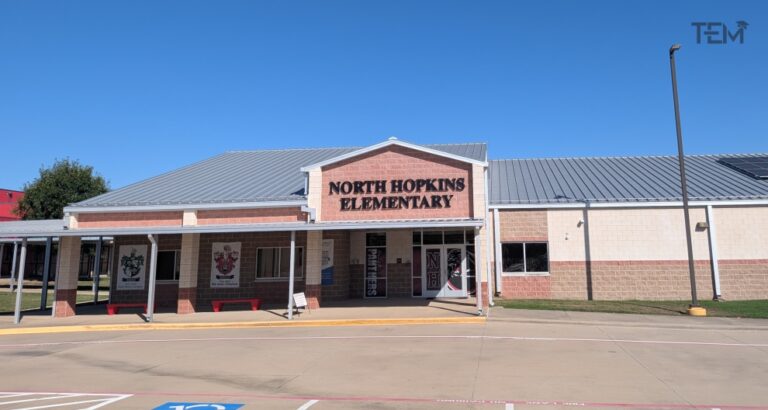
The district sits on one plot of land with a PK-6 elementary campus and a 7-12 secondary campus. Their proximity helps students transition between grade levels in a familiar setting, where students and faculty see one another and interact daily.
North Hopkins still serves the original communities, though farms and fields are slowly giving way to more houses and driveways. Enrollment has increased modestly but steadily over the past decade, apart from a decline following COVID-19.
The Record
The district boasts a graduation rate of 100%. The secondary school offers traditional pathways to graduation, credit by exam, and additional academic support for students who need it.
Over the past five years, the district has received an accountability rating of A or B. In 2024, the elementary campus was recognized by U.S. News & World Report among the top 40% of elementary schools in Texas. The secondary campus also earned recognition in U.S. News & World Report’s 2025 Best Secondary Schools rankings. Ranked No. 421 among 4,069 Texas secondary schools, North Hopkins Secondary placed in the top 11% statewide and the top 40% nationally. The rankings consider student proficiency in mathematics and reading in the context of socioeconomic demographics. The secondary campus has also repeatedly earned National Beta School of Merit recognition. In the 2025–26 school year, the Junior High UIL Academic Team placed first in district, and the High School Speech Team earned first place at the UIL District Meet.
Growth as a Lifelong Habit
Excellence here is defined by student growth, from the start of a student’s academic career to graduation. “No matter how well someone achieves, we all have room to grow.”
Teachers put this philosophy into practice by using beginning-of-year assessment data to identify each student’s starting point, plan the next steps in learning, structure curriculum to support progress, and assess individual gains at the end of each school year. The aim is to help students recognize that learning and personal development continue throughout life.
This commitment to growth is also reflected in classroom practice. In one 8th-grade English Language Arts lesson on mood, students analyzed paint sample cards, first without and then with each color’s name, and wrote original mood descriptions in their journals. The activity offered a creative way to explore how visual details influence interpretation and how students can express their understanding through writing.
Pathways That Begin in Eighth Grade
Students select a pathway during 8th grade to guide their graduation plan. Beyond the core, the secondary campus offers Agriculture (Mechanics, Plant, and Animal), Culinary, Business, and Health Sciences. The campus has also expanded its technology coursework, allowing students to compete in gaming contests and develop audio/video skills by producing short “news” clips and other media.
The secondary program spans all five Texas endorsement areas. Students can earn industry-based certifications in welding, floral design, tax preparation, and food safety. The Diagnostic and Therapeutic Services pathway helps students explore healthcare careers and work toward credentials such as EKG Technician certification or Certified Nursing Assistant (CNA) through college coursework.
Students also have access to 27 college credit hours through face-to-face instruction on campus. Health Science students may earn dual credit, and students pursuing an associate degree can use a Learning Lab period during the school day to complete concurrent college coursework. These options help students experience college-level expectations and earn credit before graduating from high school.
Where Every Student Finds Someone
The district’s staffing helps it respond to varied learning styles and cultural backgrounds. Not every staff member will form the same connection with every student, but “there is always someone to connect with each student.” Faculty readily seek support from one another, and clubs, groups, and events give students additional ways to find connection and belonging.
Equity begins with identifying each student’s needs, whether that means academic support, help with day-to-day living needs, someone to listen, or a club or organization created to give the student a place to belong. “It is always people over programs and then programs to support people.”
Grade-level teachers are the central classroom leaders, supported by campus instructional facilitators and a state and federal programs coordinator. One SEL counselor and one academic counselor serve students. The superintendent, a principal at each campus, and an assistant principal covering both wear multiple hats, which in a rural district includes fixing things and driving buses. The secondary counselor meets with students about career, college, and military planning, and on-site career days bring in local community members.
A Community That Shows Up
Parents and community members turn out for student activities, and generations of families have attended a district that serves as a major hub for the rural community. A network of churches sponsors meetings, offers meals and support, and visits throughout the year. Local businesses are few, but they sponsor events and students and serve as trusted sources for many of the district’s purchases. “Support is never lacking.”
Houses, Gardens, and a Grinch
This is the elementary campus’s tenth year implementing the Ron Clark Academy House System in some form. About five years ago, staff visited the Academy to see the system in action and decided to commit fully to it. Working alongside PBIS, the House System helps the campus build a positive culture and encourage, reinforce, recognize, and reward positive behavior. Students are recognized with “Lollipop” moments, reading celebrations, students of the month, and nine-week awards such as Honor Roll and Perfect Attendance. For the 12 Days of Christmas, they pose with the Grinch, played by the county’s lead investigator.
In science, students plant gardens, learn about the growing process, and eat the produce they harvest. The campus has also had a chicken coop where students feed and care for chickens, learn about their life cycle, gather eggs, and have the opportunity to take eggs home to their families. City National Bank’s CNB Kids program visits monthly to teach fourth through sixth graders how to complete deposit slips, balance a checkbook, and plan their savings.
This year, the elementary campus is hosting Careers on Wheels for the second time, introducing students to careers in which vehicles play an important role. A partnership with East Texas A&M University also brings the Level Up Texas program, which encourages students to explore options after high school, from college and technical training to entering the workforce. The librarian’s new Book Club has already attracted approximately 60 students. Student Council (fifth and sixth grade) and Elementary Beta (fourth through sixth) visit local nursing homes and the Senior Citizens Center, and Jr. FFA is also offered.
The elementary campus’s vision is to help students become critical thinkers, productive citizens, and lifelong learners.
Student Life Beyond the Bell
UIL Academics run from elementary through secondary, alongside One Act Play and UIL sports, including volleyball, boys’ and girls’ cross country, basketball, track and field, golf, baseball, softball, and cheerleading. Elementary adds Little Dribblers Basketball, the Region 8 Science Fair, Strategy Lunches, weekly Spotlight Students, the Panther Bucks Store, and PTO Fun Day.
BETA students recently competed in 10 events at the National BETA Convention. FCCLA students regularly advance to state, and some placed high enough to qualify for national competition. FFA students compete and gain hands-on experience through livestock and agricultural mechanics projects. Both campuses take part in the local VFW “Patriot’s Pen” writing contest, and secondary students enter “Voice of Democracy.” Every year, students win locally and go on to state and national levels.
What Comes Next
As the district anticipates possible growth, it continues to review its course offerings and consider new clubs, events, and programs. Student interest and teacher willingness to lead an activity help determine which opportunities can be introduced. Culinary began only a few years ago with four hotplates in the Home Economics room. An old science lab became the culinary kitchen, and the Home Economics room became the culinary cafe. The program has since grown to approximately 100 students and developed a full FCCLA program.
Quote