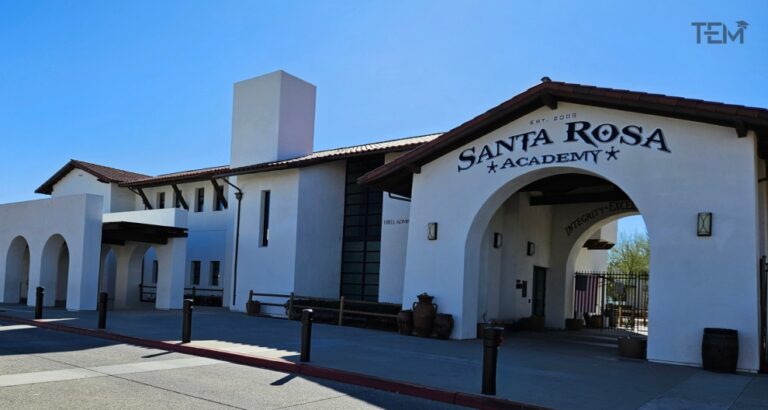
Some schools are born out of ambition. Others are born out of necessity, a handful of families deciding that what exists is not enough and building something new out of sheer stubbornness. Santa Rosa Academy belongs to the second category. It began in 2005, when a small group of educators in southwest Riverside County looked at the options available to local families and decided the list was too short. What they built was modest by any measure: 59 homeschooled students, a scattering of temporary facilities, and a plan that had more conviction behind it than infrastructure.
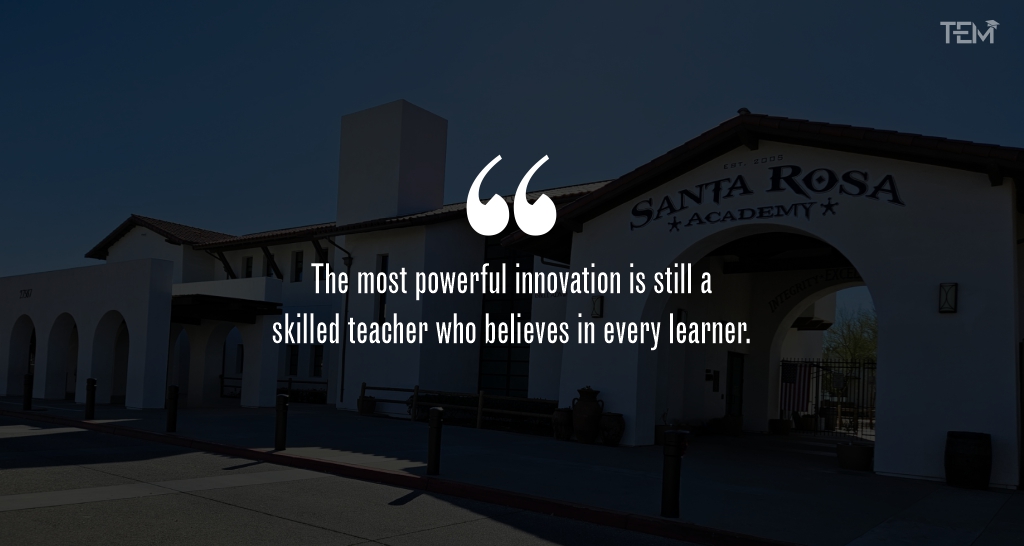
Two decades later, the numbers tell a different story. Santa Rosa Academy is now a WASC-accredited K to 12 public charter school, serving more than 1,800 students, housed on a campus styled after the Spanish missions that dot this stretch of California. What began as an effort to expand high-quality educational options has developed into a flexible, academically rigorous school serving students across the K–12 spectrum.
The Ranger Way
Ask anyone connected to Santa Rosa Academy what holds the place together, and the answer arrives without hesitation: excellence, integrity, and respect, three words the school has folded into a single phrase, the Ranger Way. Those core values guide the school’s decisions and shape the expectations it sets for students and staff.
The school’s stated mission is to be “highly regarded for academic excellence within a flexible and innovative learning environment”, one built to develop, in the school’s own words, “the skills necessary for lifelong learners and productive citizens.” It is a mission that asks for two things simultaneously, rigor and flexibility, which sound, on paper, like they might pull against each other. The Academy’s evolving educational structures are designed to preserve both.
Growth That Shows Its Work
Change at Santa Rosa Academy has not been cosmetic. In 2023, the school introduced its Early College High School program, giving students the opportunity to engage with college-level coursework while still in high school. The school also completed Monterey Hall, a 29,000-square-foot facility that added classrooms and a theater, expanding space for both academic and performing-arts experiences.
The Academy also did something schools rarely do gracefully: it simplified. Earlier Red and White tracks were phased out, a decision made to concentrate resources on fewer, stronger options rather than spreading them across many. The result is a more focused structure built around the Blue and Gold tracks.
Where Science Meets Story
STEM education, as practiced at the Academy, is not confined to a single wing of the building or a single set of students. It is described as project-based, interdisciplinary, and grounded in real-world relevance, woven across the school’s entire range of career pathways so that STEM is not a track some students opt into, but a thread running through nearly everything.
At the center of this sits the school’s Project Lead the Way (PLTW) sequences in Engineering and Biomedical Sciences, the structural core of its STEM programming. Around that core, the school has built complementary pathways in Multimedia Arts, Business Management, and Administration of Justice, each one carrying its own version of technical literacy: data analysis, design thinking, systems reasoning. The intent, as the school frames it, is that “whether students pursue a traditional STEM major or a related technical field, they develop the inquiry skills, technical competence, and collaborative habits needed for college and career success.”
Five Pathways, One Philosophy
It helps to see the pathways laid out plainly, because together they form a kind of map of what a Santa Rosa Academy education can look like:
- Engineering, where students design and test solutions using the PLTW process.
- Biomedical Sciences, where students investigate medical cases and model human body systems.
- Multimedia Arts and Technology, where students build digital media and film projects.
- Business Management, where students study systems, data, and entrepreneurship.
- Administration of Justice, where students engage with forensic and justice-related technologies.
These pathways are not standalone electives. They are paired with dual-enrollment opportunities through the Early College High School program, and Early College graduates earn an average of more than 30 transferable college units, positioning them for a smoother transition into university STEM programs or technical careers.
Choosing a Track
Not every student at the Academy learns the same way, and the school’s enrollment structure reflects that. There are two primary tracks now. The Blue Track is full-time, on-campus instruction, the traditional daily rhythm of a school day. The Gold Track, beginning in the 2026 to 2027 school year, is independent study for grades 7 through 12, designed for students whose lives or learning styles call for something less fixed. Even within that flexibility, Gold Track students retain limited access to on-campus courses when space permits.
Families do not navigate this alone. Students work with a counsellor to select the track and pathway that fits their goals, academic needs, learning preferences, and postsecondary plans.
The Labs Behind the Lessons
Ask what makes the learning at the Academy feel different, and the answer keeps circling back to hands. Students in the Engineering pathway build and test prototypes using the PLTW design process. In Biomedical Sciences, students investigate real medical cases, model human body systems, and conduct research in lab settings.
Elsewhere, the hands-on ethos takes different shapes. Multimedia Arts students create digital products, films, and interactive media that ask for both technical skill and creative instinct. Business Management students apply data analysis, financial modeling, and entrepreneurial design to real-world scenarios. Administration of Justice students take part in simulations, forensic applications, and scenario-based investigations, the kind of work that demands both critical thinking and ethical reasoning.
None of this happens by accident. Teachers across every department meet during a regular Professional Learning Community (PLC) session, using shared assessment data to refine projects, a mechanism that keeps hands-on learning rigorous, coherent, and responsive rather than improvised.
Beyond the Classroom Walls
A pathway is only as valuable as the door it opens, and Santa Rosa Academy has worked to make sure those doors lead somewhere real. Classroom learning connects to the wider world through dual-enrollment courses, articulated college credits, career pathway projects, and skills the school describes as embedded into every CTE sequence. Students explore what comes next through counseling, college and career nights, and experiences specific to their chosen pathway.
Through Early College, students can also experience college-level STEM content and expectations while remaining on the Academy campus, strengthening the connection between secondary education and postsecondary study.
Measuring What Matters
Test scores are part of the picture at the Academy. The school tracks a wider set of indicators: a graduation rate of 99.2 percent, an A to G completion rate of 61 percent, pathway completion, extracurricular participation above 70 percent, leadership roles, and growth on interim and benchmark assessments.
College and career readiness is further reflected in dual-enrollment success and postsecondary enrollment patterns, while critical thinking, collaboration, and creativity are assessed through project performance, presentations, and authentic assessments.
The People Behind the Numbers
No school runs on structure alone, and Santa Rosa Academy is candid about crediting its people. High teacher retention, sitting between 96 and 98 percent, supports instructional continuity and deep program knowledge.
In the 2024 to 2025 school year, leadership restructured into three site principals, a change made specifically to increase capacity for personalized support and innovation. That structure is reinforced by the same weekly PLC collaboration that shapes classroom projects, along with data-driven instruction and shared goals that keep teaching aligned across the school. Together, these practices help faculty and leadership maintain consistency while responding to student needs.
A Year of Recognition
Momentum tends to attract attention, and by 2026, Santa Rosa Academy has had a run of it. Since 2021, the school secured its designation as an Early College High School, opened the doors of Monterey Hall, and completed a five-year charter renewal with SB740 eligibility. Niche named it the #1 Best Public K to 12 School in Riverside County, and the California Charter Schools Association recognized the school for Latino Academic Excellence. Alongside these headlines sits something steadier: sustained high graduation and college-credit outcomes, the kind of result that does not arrive in a single flashy year but accumulates quietly across many.
The Full Student, Not Just the Full Transcript
Academics are the backbone at Santa Rosa Academy, but the school is careful not to let that be the whole story. Students have access to comprehensive counseling that spans academic, college and career, and mental health support, alongside dual-enrollment advising and pathway-aligned projects. There is room, too, for athletics, clubs, and performing arts, the last of which found a new home in Monterey Hall’s theater. Community-service opportunities and character development further reinforce the school’s emphasis on belonging and whole-student support.
What Comes Next
For a school with this much recent momentum, the future goals are less about starting something new and more about deepening what already works. Leadership points to fully leveraging Monterey Hall, expanding and refining STEM and CTE pathways, and increasing participation in dual-enrollment and Early College programs. There is a stated commitment to deepening experiential and industry-connected learning, alongside continued investment in teacher collaboration, data-informed instruction, and the balance the school keeps returning to: flexible yet rigorous.
A Message to the Ranger Community
When asked what they most wanted students, parents, and educators to understand, Santa Rosa Academy’s leadership, its site principals, program directors, and central office, answered with a shared conviction: that every student deserves an education that is both rigorous and responsive, and that young people thrive when they are known, challenged, and supported by adults of integrity.
That philosophy shapes the leadership team’s message to the wider Ranger community: students should approach their education with curiosity and character, parents should remain active partners, and educators should recognize the lasting impact of believing in every learner.
Together, the school says, they are developing the next generation of thinkers, creators, and leaders, Rangers ready for whatever comes next.
Quotes