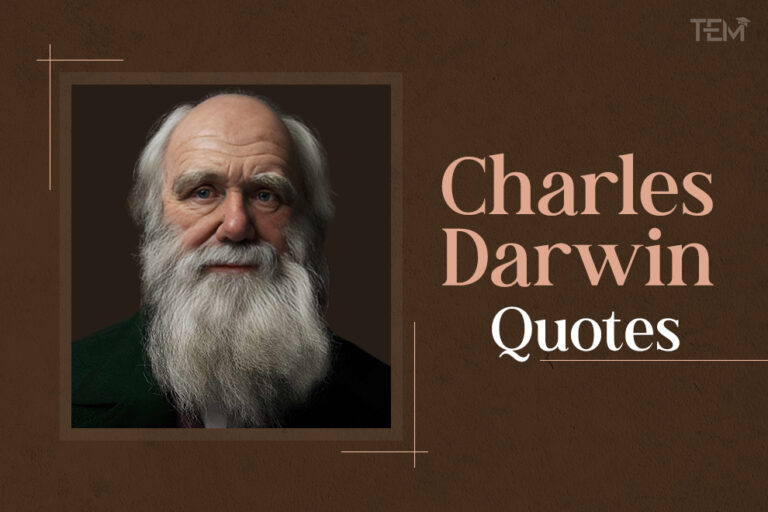
Today, February 12, marks Darwin Day, a moment to revisit the ideas that quietly reshaped how humanity understands life itself.
When Charles Darwin published On the Origin of Species in 1859, he wasn’t trying to inspire motivational posters. He was documenting evidence carefully, patiently, scientifically. Yet more than a century later, his words feel strikingly modern. In classrooms, boardrooms, and even conversations about AI and career shifts, one theme keeps resurfacing: adaptability.
That’s exactly why Charles Darwin quotes continue to be widely read and shared today.
Darwin observed something simple but profound. Survival does not belong to the loudest or the strongest. It belongs to those who adjust.
But here’s the problem: many quotes online are misattributed, stripped of context, or flat-out wrong. So we went back to primary sources, The Origin of Species, The Descent of Man, The Voyage of the Beagle, and the Darwin Correspondence Project to curate fifteen authentic and historically grounded lines.
Read them slowly. They’re not slogans. They’re lenses for thinking differently.
Here are 15 Charles Darwin Quotes that will inspire you to think differently
- “The most important factor in survival is neither intelligence nor strength but adaptability.”
- “Even people who aren’t geniuses can out think the rest of mankind if they develop certain thinking habits.”
- “A man who dares to waste one hour of time has not discovered the value of life.”

Darwin’s early reflections center on discipline. Survival, he believed, is not about raw talent or physical power but about the habits we cultivate. This mindset is vital today, as highlighted in our guide on Empowering Students with Essential Life Skills, where adaptability is ranked as a top requirement for future success.
- “The world will not be inherited by the strongest, it will be inherited by those most able to change.”
- “Intelligence is based on how efficient a species became at doing the things they need to survive.”
- “A mathematician is a blind man in a dark room looking for a black cat which isn’t there.”

Here, Darwin blends biology with wit. He frames intelligence as usefulness and adaptability as destiny, while adding humor about the abstract struggles of mathematics. His observations show a scientist grounded in practicality, always focused on what truly works in the real world. For students, this translates to mastering modern resources; for instance, knowing the best college AI tools is the 2026 equivalent of refining one’s ‘thinking habits’ for survival.
- “If every one were cast in the same mould, there would be no such thing as beauty.”
- “The highest possible stage in moral culture is when we recognize that we ought to control our thoughts.”
- “Every new body of discovery is mathematical in form, because there is no other guidance we can have.”

These quotes reveal Darwin’s respect for diversity, ethics, and logic. Progress depends on variation, thoughtful self-control, and structured reasoning. For him, science and morality were not separate paths; they evolved together.
- “If the misery of the poor be caused not by the laws of nature, but by our institutions, great is our sin.”
- “I am turned into a sort of machine for observing facts and grinding out conclusions.”
- “Man selects only for his own good: Nature only for that of the being which she tends.”

Darwin also examined society with the same critical lens he used for nature. He believed evidence should guide decisions and that human systems, not fate, often create inequality. His commitment to objectivity made him both a careful scientist and a thoughtful social observer.
- “The mystery of the beginning of all things is insoluble by us; and I for one must be content to remain an agnostic.”
- “The most energetic workers I have encountered in my world travels are the vegetarian miners of Chile.”
- “A scientific man ought to have no wishes, no affections, – a mere heart of stone.”

In his final reflections, Darwin shows humility and restraint. He accepts uncertainty, respects ordinary human resilience, and insists that science must rise above emotion. It’s a mindset built on curiosity, honesty, and intellectual courage.
2026 Fact-Check: Myths vs. Reality
Before you share a Darwin quote online or use one in a classroom or presentation, it’s worth pausing for accuracy. The internet is filled with misattributions, and Charles Darwin is one of the most frequently misquoted scientists in history.
Here are a few important clarifications backed by academic sources and the Darwin Correspondence Project at Cambridge University:
Myth 1: “Survival of the fittest” was coined by Darwin.
Reality: The phrase was introduced by philosopher Herbert Spencer. Darwin later adopted it in later editions of On the Origin of Species because it neatly summarized natural selection.
Myth 2: “It is not the strongest of the species that survives…” is a direct Darwin quote.
Reality: This popular line is a paraphrase by Professor Leon C. Megginson, not Darwin’s original wording. It reflects Darwin’s ideas but does not appear in his texts.
Myth 3: Charles Darwin had a “slogan.”
Reality: He didn’t. This search query often confuses the scientist with the city of Darwin, Australia. Darwin communicated through evidence, not taglines.
By separating fact from folklore, we don’t just quote Darwin; we respect him.
Your Evolution Starts Today
More than 160 years after On the Origin of Species, Darwin’s thinking still guides how we understand growth, learning, and resilience.
These Charles Darwin quotes are more than historical lines; they are reminders that progress comes from patience, evidence, and the courage to adapt.
They teach us that success isn’t sudden. It’s gradual. Intentional. Earned.
Whether you’re a student choosing a direction, an educator shaping minds, or a professional navigating change, Darwin’s lessons offer something rare: clarity in uncertain times.
Which quote spoke to you the most? Share this with someone who’s evolving alongside you and keep the conversation going this Darwin Day.
FAQs
- What is Charles Darwin most famous for?
Darwin is best known for developing the theory of evolution by natural selection, explained in his landmark 1859 book On the Origin of Species. It transformed modern biology and remains the foundation of evolutionary science today.
- What was Darwin’s biggest question?
He sought to answer one central problem: How do species change over time? His decades of observation during and after the HMS Beagle voyage helped him explain how small variations accumulate through natural selection.
- What are Charles Darwin’s last words?
Historical accounts suggest he told his wife Emma, “I am not the least afraid of death.” The statement reflects his calm, rational outlook even at life’s end.
- What does Darwin say about love or compassion?
Darwin often emphasized empathy as a defining human trait. He wrote that sympathy and care for other living beings are part of humanity’s moral evolution, not weaknesses.