Imagine a working professional attempting to master a highly complex generative artificial intelligence platform to optimize corporate operations while simultaneously balancing a demanding forty-hour work week, professional certifications, and domestic responsibilities. Adults learn differently from children because they bring work experience, responsibilities, and clear goals into the learning process. Research indicates that the adult brain begins to experience a decline in rapid neuroplasticity (the brain’s ability to change and adapt) and cognitive flexibility around age 25, meaning that passive, rote memorization strategies often fail to engage mature learners.
As the McKinsey Global Institute predicts that up to 375 million workers globally may need to transition across occupational categories by 2030 due to automation and artificial intelligence, adult education has shifted from an elective pursuit to an essential requirement for career survival. Consequently, continuing education, workplace learning, and workforce development must be rebuilt around how mature minds actually process, retain, and execute knowledge.
By understanding how adult education theory works, organizations and educators can design training ecosystems that turn mandatory compliance into genuine performance improvement.
What Is Adult Education Theory?
Adult education theory is a collection of mental, social, and psychological models, most notably Malcolm Knowles’ adult learning theory of andragogy, explaining how mature individuals acquire, process, and apply knowledge. It asserts that adults learn best through self-direction (guiding their own learning), hands-on experience, and immediate problem-centered application, rather than the instructor-led, passive structures of child-centered pedagogy.
Core Elements of Adult Learning
To understand how adult education theory functions as a competitive advantage in modern corporate and academic settings, it is helpful to analyze its foundational trends.
Why Adult Learning Is Different
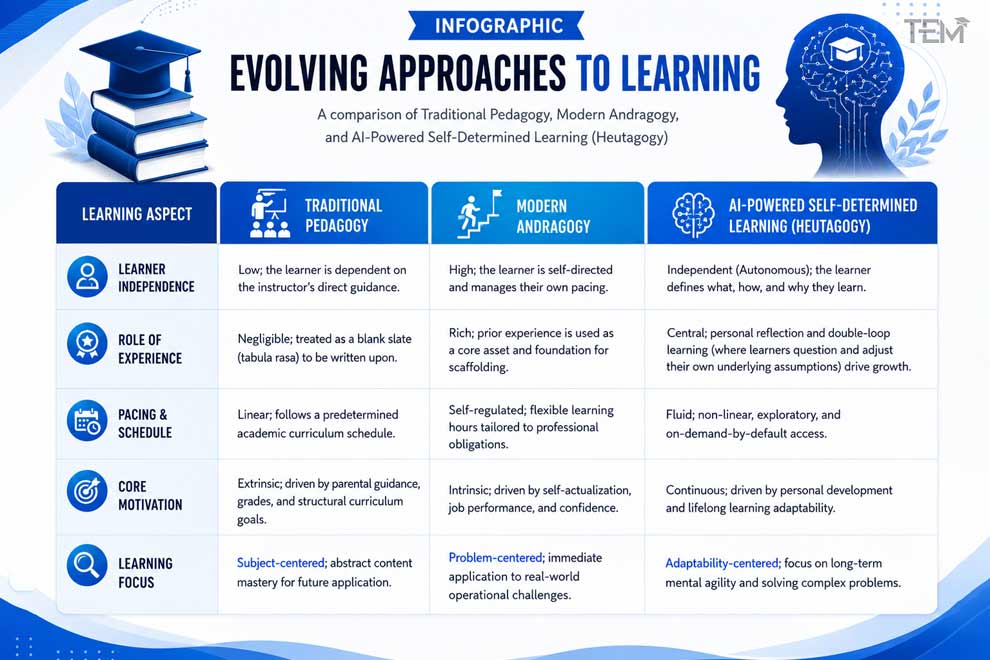
The core principles of adult learning strategies are built on several key assumptions regarding adult learner characteristics. Under traditional pedagogy, childhood learning relies on teacher-directed instruction where the pupil has limited life experiences. Conversely, adult education theory recognizes that a mature student brings an established personal and professional identity into the learning environment.
First, self-concept dictates that adult learners value autonomy and require ownership of their education. Instructors who treat professionals like college freshmen risk inducing mental resistance, as adults prefer to guide their own development rather than being passive recipients of training.
Second, prior experience serves as a mental filter through which new data is interpreted. When continuing education programs recognize and validate this internal knowledge bank, they build psychological safety, a concept heavily emphasized by humanist psychologist Carl Rogers, who noted that learning is optimized when individuals feel free to fail without judgment. However, entrenched professional habits can also foster resistance, requiring supportive step-by-step guidance (cognitive scaffolding) to help learners deconstruct and rebuild their existing mental models.
Third, an adult’s readiness to learn is closely coordinated with their immediate life roles. Mature individuals are motivated to engage when the curriculum aligns with real-life needs, such as professional certifications or career transitions.
Core Models and Adult Education Examples
Effective adult learning strategies are built on several distinct theoretical frameworks that explain how learning translates into workplace performance.
Experiential Learning and Knowles’ Andragogy
Malcolm Knowles’ adult learning theory of andragogy is built on the premise that adults learn by doing. This matches David Kolb’s 1970 Experiential Learning Theory, which models learning as a four-stage loop: concrete experience, reflective observation, abstract conceptualization, and active experimentation.
- Harvard Business School’s Case Method: Instead of relying on passive lectures, HBS places adult students in the roles of actual general managers to analyze real business dilemmas, debate key decisions, and justify their solutions in peer-led discussions.
- Johns Hopkins Medicine’s Simulation Center: In an interprofessional setting, healthcare students and professionals refine critical care procedures, hone clinical decision-making, and learn to deliver sensitive news using realistic patient simulators and immersive VR environments.
Transformative Learning Theory
Transformative Learning Theory focuses on how adults critically reflect on and fundamentally alter their pre-existing assumptions and worldviews.
- IBM SkillsBuild AI Ethics Training: To navigate modern automated workplaces, professionals utilize specialized courses to analyze bias, robustly examine data privacy, and critically re-evaluate how technological systems interpret social values .
Self-Directed and Project-Based Learning
Self-Directed Learning (SDL) gives individuals control over their own learning pace, goals, and evaluation methods, while instructors act as guiding facilitators rather than lecturers. This pairs naturally with John Dewey’s 1897 Project-Based Learning model, which advocates for “learning by doing”.
- Google Career Certificates: This platform allows non-traditional students and adult professionals to bypass traditional classrooms, self-pacing their way through structured portfolio projects to build skills for IT support and data analytics careers .
- IBM SkillsBuild for Adult Learners: Free, self-directed paths enable independent learners to customize their upskilling curriculum in cloud architecture, coding, and cybersecurity, earning industry-recognized digital credentials at their own pace AI Learners
.Cooperative, Collaborative, and Social Learning
Adult learning is shaped by observing and modeling the behavior of others. This is closely related to situated learning, which suggests that learning occurs naturally within the specific social and physical context where it is applied .
- University of Louisiana System’s AI Initiative: A statewide, self-paced “AI Literacy” micro-credential program united over 82,000 adult participants in collaborative modules to master digital fluency and contextual tool usage personalized Learning.
The Integration of AI and EdTech in Modern Andragogy
The rapid growth of generative artificial intelligence has changed the speed and scale of corporate training and academic support. Rather than replacing human educators, AI aligns with the core principles of andragogy to make learning more responsive and personalized.
Dynamic Personalization and Adaptive Content Delivery
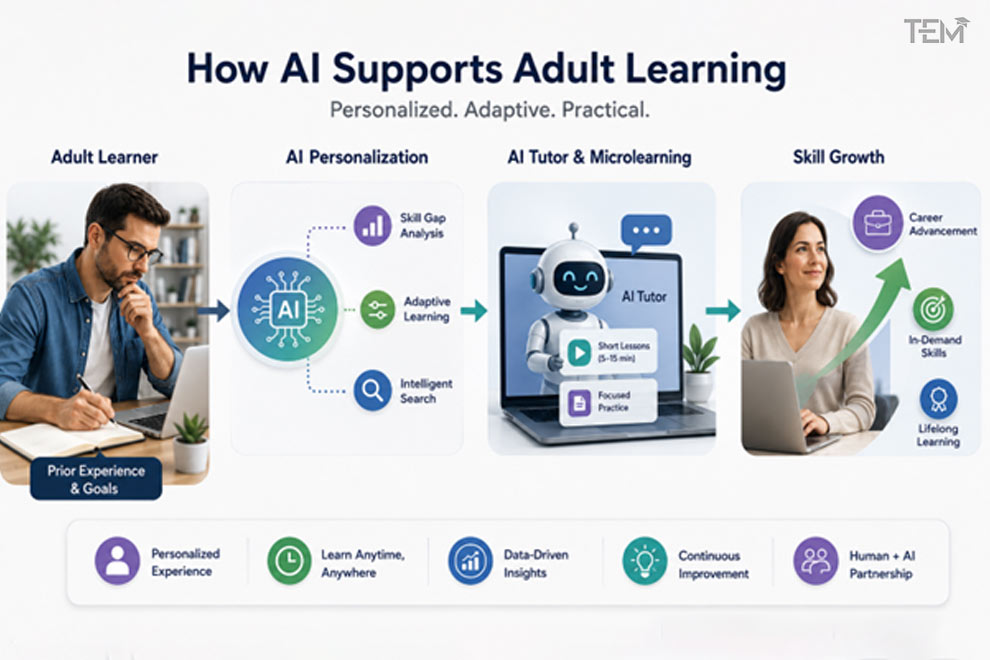
Traditional learning management systems (LMS) often present identical content catalogs to all employees, ignoring individual backgrounds and goals. By utilizing AI-powered Learning Experience Platforms (LXPs), organizations can deliver hyper-personalized programs.
The LXP analyzes a professional’s current role, past performance, and stated career goals to suggest targeted, adaptive content in real time. This is a direct, practical application of Personalized Learning, matching the curriculum directly to the learner’s immediate professional needs.
Real-Time Coaching and Adaptive Assessments
Adults require psychological safety and immediate, constructive feedback to refine their skills AI tutors, and conversational coaches provide real-time feedback on classroom tasks, such as business plan drafts or technical code, helping learners adjust without waiting for an instructor’s review.
Additionally, static, high-stakes assessments are shifting toward adaptive assessments. AI-driven evaluations analyze a learner’s answers in real-time, adjusting question difficulty to match their progress and pinpointing mental gaps with precision. This makes evaluations more accurate and meaningful.
Dynamic Skill-Gap Analysis and Microlearning
Because time is a major barrier for working adults, AI-accelerated course production is helping designers break down complex curricula into 5-to-15-minute microlearning modules. This directly supports Knowles’ principles of readiness and problem-centered learning, delivering targeted information exactly when the professional needs it.
This shift represents a highly effective application of AI in Education, balancing rapid delivery with content quality.
Academic Integrity and Critical AI Literacy
To maintain standards in digital environments, organizations must build strong AI Literacy. This includes establishing clear guidelines for AI Academic Integrity.
When adult learners use AI as a shortcut to bypass critical thinking, they miss out on developing the problem-solving and Communication skills that are essential in the modern workplace. The standard for digital learning is that AI should support, not replace, active human thinking.
Small Language Models and Classroom Games
To address data privacy concerns, organizations are increasingly turning to private Small Language Models. These localized systems protect proprietary data while providing customized instructional support.
Additionally, trainers are using digital Classroom Games to encourage collaboration. These active strategies build connection, keeping learning social and cooperative even when completed remotely.
The Evolution of Heutagogy and Neogogy
As AI tools automate routine analytical tasks, adult education must focus on higher-order capabilities. This shift is moving learners past standard self-directed learning (andragogy) and into self-determined learning (heutagogy).
In this environment, learners do not just follow a path; they curate their own goals, practice double-loop learning (reflecting on and changing their basic assumptions), and cultivate adaptability. This technological fusion of pedagogy, andragogy, and heutagogy is defined by modern educational theorists as Neogogy a digital-first, AI-integrated framework designed to guide adult learners through highly fluid, technology-rich landscapes.
Modern Challenges and Strategic Solutions in Workplace Learning
While digital learning platforms offer great flexibility, they have also introduced new challenges that can disrupt the learning process. Traditional barriers like financial limits, learning anxiety, and family responsibilities remain, but they are now compounded by digital distractions and changing workplace expectations.
Addressing these modern challenges requires targeted, human-centered solutions.
Time Investment Doubts
- The Challenge: Adults have highly demanding schedules. They often hesitate to invest limited time unless they are confident of a high return on investment
- The Solution: Ensure clear value and explicit, real-world learning outcomes are communicated directly at the start of instruction.
Relevance Decay
- The Challenge: Rapid technological change means that software, tools, and processes can become outdated within months.
- The Solution: Design for durability; prioritize core, transferable cognitive skills, strategic frameworks, and general adaptability.
Overwhelming Interactivity
- The Solution: Practice design restraint; use interactive elements selectively and keep them tightly connected to specific learning outcomes.
Lonely Personalization
- The Challenge: Hyper-customized individual paths can isolate learners, removing the shared peer experiences that build social proof and community.
- The Solution: Intentionally design collaborative checkpoints, peer-review sessions, and mutual verification exercises.
Meaningless Rewards
- The Challenge: Automated digital badges and low-stakes certificates are everywhere, but they often lack depth and carry little real value.
- The Solution: Align recognition with tangible, applied outcomes, portfolio reviews, and observable real-world competence.
Early Attention Cessation
- The Challenge: Short-form content is highly convenient, but it can create a false sense of mastery, causing learners to stop before developing true depth.
- The Solution: Create smooth transitions from bite-sized content into deeper, applied inquiry loops and analytical tasks.
Identity & AI Anxieties
- The Challenge: The rise of AI can cause professional anxiety as automated tools absorb tasks that once defined a learner’s expertise.
- The Solution: Affirm the value of human judgment; design training that highlights emotional intelligence, ethics, and strategic oversight.
Student Tip: Start with one practical learning goal, such as mastering a new workplace tool or earning a certification. Applying new knowledge immediately helps adults retain information more effectively.
Strategic Benefits and Educational Importance of Andragogy
Applying adult learning theory is not just an academic exercise; it offers a competitive advantage for corporations, professional associations, and higher education institutions.
- Career Advancement and Upskilling: Programs designed around adult learning principles drive genuine behavior change in the workplace. By focusing on immediate real-world challenges, upskilling and reskilling initiatives are directly connected to daily operations, helping organizations adapt to rapid economic shifts.
- Continuous Talent Development: Incorporating psychological safety and hands-on learning helps build confidence, leadership capability, and strategic thinking. This leads to improved decision-making and performance improvement across the enterprise.
- Supporting Lifelong Learning: Recognizing that learning is a continuous process helps organizations build engaging learning environments that support long-term talent retention. It encourages professionals to take ownership of their continuous development, maintaining employability in an automated economy.
- Improving Workforce Readiness: For academic institutions, including the Best colleges in india, incorporating active and problem-based learning ensures that curricula align with modern industry requirements. This bridges the gap between theory and practice, helping graduates transition smoothly into the workplace.
Did You Know?
Malcolm Knowles’ concept of andragogy shifted the primary axis of adult training from teacher-centered instruction to learner-centered, experience-based learning. This foundational shift continues to influence modern corporate Learning and Development (L&D), professional certification programs, and adaptive technology-driven workforce platforms.
FAQ
- Who developed adult learning theory?
Malcolm Knowles formalized adult learning theory in the 1970s by defining the specific differences between adult and childhood learning. His work built on concepts by Eduard Lindeman and Cyril Houle, and was later expanded by Jack Mezirow’s Transformative Learning Theory.
- What is the difference between pedagogy and andragogy?
Pedagogy is instructor-led, structured, and designed for children who depend on the teacher for direction. Andragogy is learner-centered, self-directed, and designed for adults who use their prior experience to guide their own development and solve immediate problems.
- Why is adult education important?
Adult education supports career advancement, upskilling, and professional confidence by keeping training aligned with real-world tasks. It enables professionals to adapt to rapid technological disruptions, like AI integration, while maintaining long-term employability.
- How is AI changing adult learning?
AI personalizes education by analyzing individual skill gaps, curating dynamic recommendation paths, and offering adaptive, real-time feedback. It accelerates content creation while supporting self-paced, on-demand microlearning tailored to busy adult schedules.