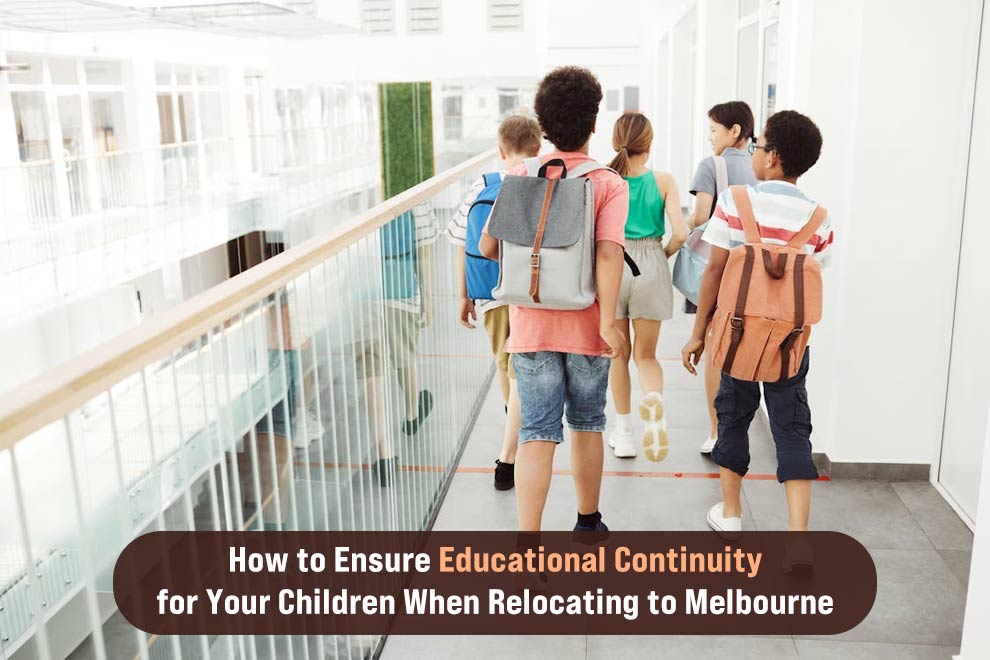
Relocating a family is so much more than relocating your boxes and forwarding your mail. It is a complicated mix of both logistics and emotions. For most parents, whether relocating is good for a family’s growth and development is their first question. Melbourne is considered Australia’s “education state” as it has a remarkably strong network from learning centers to world-class universities.
However, what it takes to handle the transitions that accompany different stages of life requires a plan that emphasizes routine. Children who are confident that their learning environment provides a certain degree of familiarity are less threatened by the challenges of adjusting to a new city.
Why Educational Continuity Matters During Family Relocation
Moving can be a pretty big shock to a child’s system. The Life Course Centre published a study that says too many moves can affect a child’s grades and ability to integrate if it is not handled carefully (Life Course Centre, 2020). It is more than just learning a specific set of things. It is about “the soft side of learning, friendships, relationships with teachers, and basics such as familiarity with a playground.”
A stable early education is very important. In the early years of development, it is beneficial for the individual to have continuity to solidify their foundations. A seamless transition that makes the new place just an extension of the old one will allow the individual to have a higher probability of succeeding in the new surroundings.
Planning Ahead for Early Childhood Education in a New City
If you are relocating with your little ones in tow, the early childhood education and care sector in Melbourne might appear a little different from what you are used to. The Australian government has a strong emphasis on the Early Years Learning Framework (EYLF) learning philosophy.
The reality is that because centres that are popular often have waiting lists that are months long, it is not only helpful to begin your search months before you arrive with your moving truck, with children in tow, but it is also imperative. You can determine how well your local centers rate against the NQs.
What to Look for When Choosing a Preschool After Moving
When you are touring facilities, it is important to look beyond the glitzy toys. Take a look at child-to-teacher ratio, as well as staff turnover. Seeing familiar faces is crucial to a child who has moved from a former neighbourhood in which they were familiar with everyone. A facility should consider its integration within a community.
For example, children and parents moving into the eastern suburbs are looking for not only schools but also a community-geared East Burwood preschool. In other words, kids’ ability to see one another around the local park on weekends helps for your new neighborhood to start to feel like home.
Supporting Children Through Educational Transitions
The transition does not simply occur on the first day of school. The transition continues to occur for many months. As a parent, it is your job to be the bridge between the old life and the new. Your child is receiving a taste of what “normal” is, even if your kitchen is still filled with boxes that have not even had a chance to be fully unpacked.
Helping Younger Children Adjust to New Learning Environments
Children under the age of six are extremely responsive to their parents’ energy levels. So if you are stressed out or anxious, they are going to pick up on that. Try to keep the same morning routine. That might mean having the same breakfast or leaving the same goodbye message. Children need the security of these things. Communication with the new educators is also important. Let them in on the ‘quirks’ of the child or any personal anxieties they may have voiced regarding the transition.
Addressing the Needs of Older Children and Teenagers
For teens, challenges tend to be very different, most likely connected with social identity issues and autonomy. A relocation during the secondary education period may appear to be a huge disruption in their independent lives. It is important to let them take part in decision-making. Whether it is selecting elective courses or coming to have a look at the new campus, letting them feel in control is very useful in reducing feelings of having their lives turned upside down.
Considering Education Pathways Beyond Preschool
Melbourne’s status as a global education capital can be observed most clearly at the tertiary level. Melbourne is known to have some of the top universities ranked globally, as stated by Universities Australia (2023).
But when it comes to moving with children of different ages, say preschool and college age, it becomes a whole different conversation. You’re no longer shopping based on finding a good elementary school district. You’re pondering the future of the whole family.
Planning for Secondary and Tertiary Education During Relocation
For parents with kids in their teens, moving into vocational college or university, the need is for independence. The layout of Melbourne’s CBD and its associated suburbs, such as Carlton and Clayton, is structured to accommodate students. Children, during this phase, are no longer thinking about “educational continuity” as it relates to mum and dad’s nurturing but rather about what suits them as an environment to thrive in.
A major aspect of this is selecting the right living option. Often, the best way for families to ensure their children have a conducive environment to undertake their studies is to find them student accommodation in Australia well in advance. This allows the student to concentrate on the program while remaining linked to the family unit even though they may not share the same dwelling space.
Practical Steps Families Can Take Before and After the Move
Success usually lies in the details. A “wait and see” approach rarely works when it comes to Australian education, particularly in high-demand metropolitan areas.
Pre-Move Education Checklist for Parents
- Documentation: Have copies of immunisation records, birth certificates, and previous school reports ready to go.
- Term Dates: Align your move with the Australian school year, which starts in late January, to avoid your child entering mid-term.
- Suburb Research: Use tools like My School to compare local options and check school catchment zones, as these can change periodically.
Settling In During the First 90 Days
The initial six months are the crucial adaptation stage. Observe how your child is sleeping and eating. Are they beginning to speak about new friendships? Are they averse to attending school when it is time to leave for school in the morning? Being in close touch with the teacher at this juncture will enable you to eliminate problems at a nascent stage that will act as impediments to the.child for a prolonged period.
Building Long-Term Stability Through Thoughtful Education Planning
Finally, the end result of working to ensure a smooth flow of education is that you are ensuring the well-being of your family. You are turning what could be a detrimental situation into a real positive.
Whether you are trying to figure out EYLF for a two-year-old or researching tertiary housing as a young adult, the point of it all stays the same. You are giving them a strong foundation to launch out from while they check out their new town. There is enough to see in Melbourne to keep them busy.
Also Read: Why More People Are Choosing Careers in Education