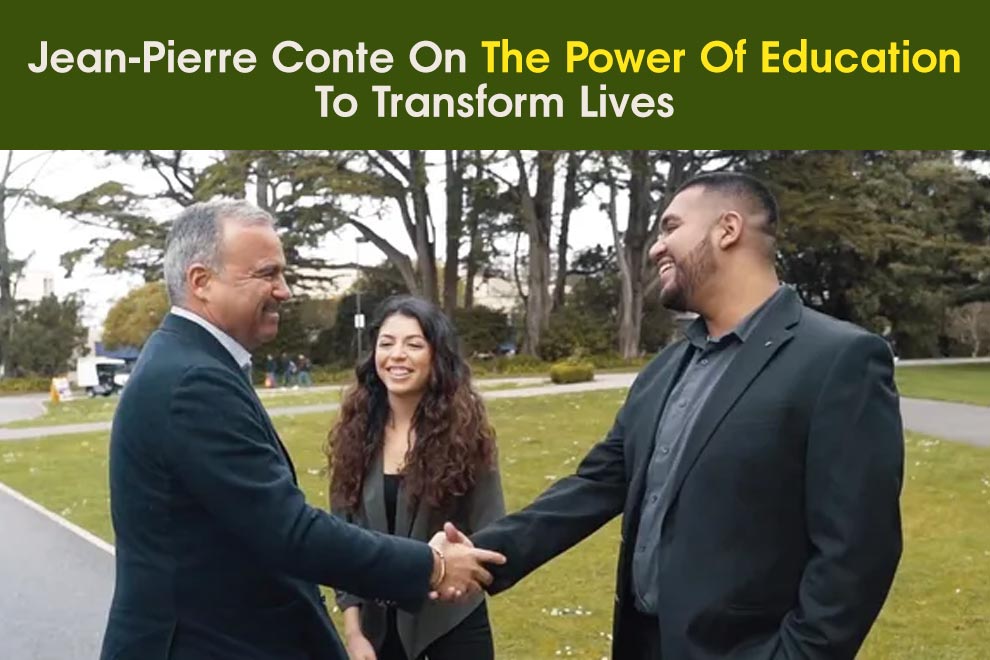
More than half of undergraduate students in America qualify as first-generation, meaning neither parent completed a four-year degree, yet their graduation rates trail significantly behind peers from college-educated families. Addressing this disparity could add 4.4 million college graduates and contribute $700 billion in economic value nationwide. For Jean-Pierre Conte, a managing partner who was himself the first in his family to attend college, addressing these challenges has become a central philanthropic focus.
“I grew up in a pretty modest household that had big dreams, big aspirations, and lots of love, but we didn’t have a lot of resources,” Conte shares. “We had a lot of love and a good family, and people helped me along the way.” His father, Pierre, fled France following the Nazi occupation, while his mother, Isabel, left Cuba to build a new life. Their determination to succeed shaped Conte’s understanding of opportunity and hard work.
Working as a waiter to fund his education, Conte attended Colgate University and later earned his MBA from Harvard Business School. His father’s work as a tailor and clothing salesman connected him with Wall Street professionals who offered mentorship and guidance. “They gave me internships, mentoring, good advice, and it really helped close the information gap, which exists when your parents don’t go to college or aren’t on that track,” he explains.
The Conte First Generation Fund
Jean-Pierre Conte established the Conte First Generation Fund in 2017 to support students facing similar challenges. The fund provides scholarships, mentorship, and resources to first-generation college students at 11 major universities, including his alma maters Colgate and Harvard. “When I was at Colgate, less than 5% of the population were first-gen students like me,” Conte notes. “I want to make sure those students are starting off from a place where they will succeed.”
National data from 2020 shows that nearly four in ten undergraduates had parents without bachelor’s degrees. These students often come from lower-income households and face significant financial pressures while pursuing their degrees.
Starting Early: Beyond College Support
Jean-Pierre Conte soon realized that intervention needed to begin before students reached university. “A light went off, and I said, ‘By the time the student gets to university, especially some of these universities, they’re now focused on the money issue,'” he recalls. “And I came to the conclusion that I need to start sooner, in high school or earlier, to really help change the trajectory.”
This insight led to partnerships with organizations like Sponsors for Educational Opportunity and 10,000 Degrees in San Francisco. These programs provide mentoring and academic preparation beginning as early as eighth grade. Sponsors for Educational Opportunity offers after-school programs, Saturday classes, and summer sessions to supplement public school education. Conte has been a long-time supporter, offering not only funding but also internships through his private equity firm. “I go to New York every year to give a presentation about private equity to SEO students, showing them that they, too, can have a future in this industry,” he shares.
First-generation students face distinct challenges beyond financial constraints. Degree completion rates for first-generation students hover around 26%, while students whose parents hold bachelor’s degrees graduate at rates exceeding 80%. Financial uncertainty remains the leading reason students leave school, with nearly 60% considering quitting due to financial stress.
Without parental guidance on managing financial aid, filing applications, or understanding academic expectations, many first-generation students struggle with what Conte calls “the information gap.” His philanthropic initiatives specifically target these knowledge barriers through comprehensive support systems that include mentorship, academic advising, and financial literacy programs.
Business Principles Applied to Philanthropy
Jean-Pierre Conte’s business background has deeply influenced his approach to educational philanthropy. As chairman of a private equity firm managing tens of billions in assets, he applies the same analytical rigor to nonprofit effectiveness. When faced with leadership challenges at Sponsors for Educational Opportunity, Conte’s recommendation to bring in new leadership resulted in dramatic expansion. “We multiplied the reach of SEO in the Bay Area by five to seven times,” Conte proudly notes.
“A lot of nonprofits aren’t run crisply,” he says, emphasizing that he evaluates them like businesses to create meaningful change. This results-oriented mindset ensures that every dollar invested generates measurable impact.
Creating Lasting Impact Through Strategic Giving
Higher education institutions received $58 billion in annual charitable donations in recent years, with giving to education reaching all-time highs even when adjusted for inflation. Jean-Pierre Conte’s contributions represent a focused approach within this broader philanthropic movement, targeting specific gaps in educational access.
His commitment extends beyond financial support to hands-on engagement with universities. Conte personally interviewed and visited each institution before establishing the Conte First Generation Fund. “I interviewed each school, visited each school, and learned that some of the schools were really good at it, good at providing resources, attracting that talent, and even mentoring that talent while they were at school,” he explains. “So they had the resources and the focus to do it. And other schools didn’t. They were either too small, didn’t have the resources, or both, and sometimes schools didn’t have the talent or the conviction to do it.”
Jean-Pierre Conte donated $25 million to Colgate University to fund a new campus social center, one of the largest single gifts in the university’s history. The Jean-Pierre L. Conte Social Center will serve as a hub for student life and community on campus, furthering his commitment to creating environments where all students can thrive.
Employment rates run 88% higher among degree holders, who also earn substantially more and participate in civic life at double the rate of those without college credentials. These statistics underscore the transformative potential of completing higher education, particularly for students who are first in their families to pursue college degrees.
“My dad came to the United States and he didn’t go to college,” Conte says. “But he always had a dream of his kids going to college and becoming anything they wanted to be.” This vision drives his continued investment in creating pathways for students facing similar circumstances.
Jean-Pierre Conte’s approach to educational philanthropy combines personal understanding of the challenges first-generation students face with strategic investment in proven programs. Through the Conte First Generation Fund, partnerships with organizations preparing students for college success, and major gifts to institutions, he works to ensure that talent and determination—rather than family background—determine educational outcomes. His initiatives address not just financial barriers but also the critical information and support gaps that can derail even the most promising students, creating sustainable pathways to success for future generations.
Also Read: Small Language Models: Efficient AI for Education & Research