Reported by The Education Magazine | 27 January 2026
For more than 40 years, school boundaries in Fairfax County remained largely unchanged.
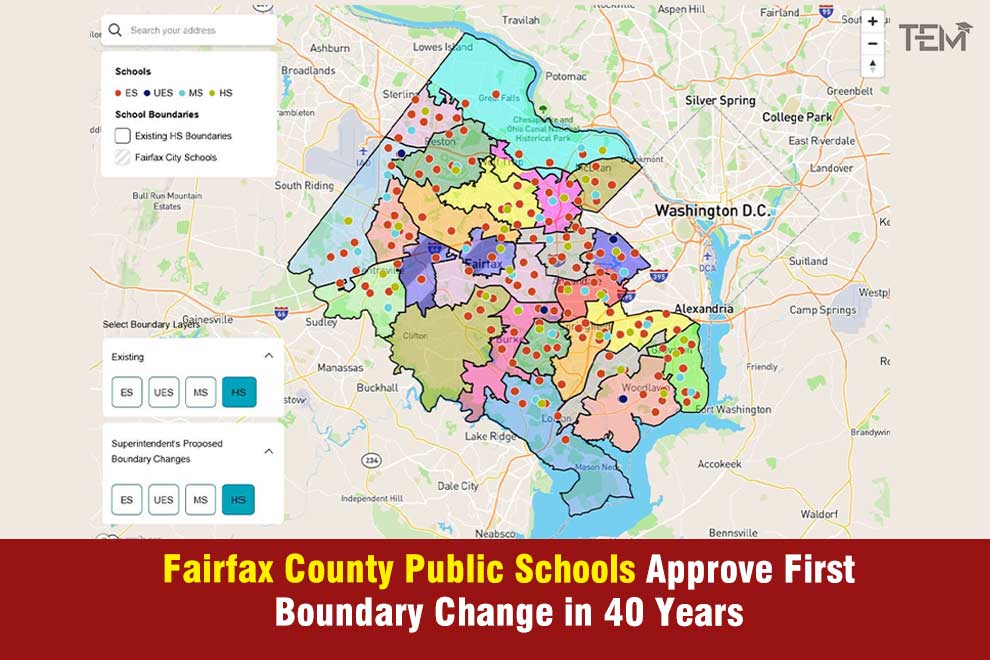
That long period of stability came to an end in January 2026, when the Fairfax County School Board approved a new school attendance boundary plan.
Beginning in the 2026–27 academic year, the decision will change how students are assigned to schools across parts of the district. While fewer than 2,000 students are expected to be affected, education planners say the move reflects a broader challenge facing school systems worldwide: how to adapt to shifting populations, housing growth, and uneven enrollment.
FCPS Boundary Change: What changed and why now
Fairfax County Public Schools (FCPS), one of the largest school districts in the United States, approved its first large-scale boundary update in more than four decades following an 18‑month review process.
The plan was approved through a formal School Board vote in January 2026, after months of public meetings, data analysis, and community feedback. According to the official FCPS announcement, the final version was revised to reduce student displacement and clarify long-standing attendance patterns.
Local reporting confirmed that the School Board voted 8–3 in favor of the updated boundary plan, reflecting both support and debate within the community.
The new boundaries will take effect in the 2026–27 school year, giving families time to prepare and allowing the district to finalize transportation and support services.
Why school boundaries shape how communities learn
School boundaries determine which school a student attends based on where they live. Over time, population growth, new housing developments, and migration can make these boundaries less effective.
In Fairfax County, some schools became overcrowded while others had unused capacity. In several neighborhoods, students from the same area were sent to different middle or high schools, creating confusion for families and challenges for long-term school planning.
According to district officials, the new boundary plan is designed to balance enrollment, reduce overcrowding, and simplify feeder patterns so students move more predictably from elementary to high school.
What this new plan will change for students
The approved boundary update focuses on long-term planning rather than short-term fixes.
- Balancing enrollment:
Students will be redistributed so that school capacity is used more evenly, easing pressure on overcrowded campuses.
- Clearer school pathways:
The plan aims to reduce split feeder patterns, creating more consistent school progressions for students and families.
- Regular future reviews:
FCPS has committed to reviewing school boundaries more frequently, preventing problems from building up over decades.
A local decision with global implications
While the boundary change applies to a single U.S. school district, the forces behind it are increasingly global.
As school systems respond to these changes, K-12 education planning worldwide is increasingly shaped by data, demographic shifts, and long-term infrastructure needs.
Cities around the world are growing and changing rapidly. Housing patterns shift, neighborhoods evolve, and student populations move faster than school infrastructure can adapt. As a result, school zoning and catchment reviews are becoming more common in countries such as the United Kingdom, Canada, and Australia.
Fairfax County’s decision reflects a broader shift toward data‑driven education planning and long-term system sustainability.
What education leaders can learn from Fairfax County?
The boundary review process offers several lessons for policymakers and education administrators:
- Delaying boundary updates for decades can lead to larger disruptions later
- Data‑driven planning helps reduce uncertainty and conflict
- Public consultation improves final outcomes
- Regular reviews support more stable and flexible education systems
These lessons apply to school systems experiencing growth, decline, or uneven enrollment.
What Happens Next
Fairfax County Public Schools is expected to release additional details on transportation, implementation timelines, and support for affected families before the new boundaries take effect in 2026.
As communities grow and student populations change, how schools draw their boundaries may become one of the most important and unavoidable education decisions of the coming decade.
FAQs
- Why don’t school districts change boundaries more often?
Boundary changes affect families, communities, and sometimes property values, making them politically sensitive. Many districts delay action to avoid conflict.
- Will more districts follow this approach?
Education experts say yes. As enrollment patterns continue to shift, more school systems are expected to revisit long-standing zoning policies.