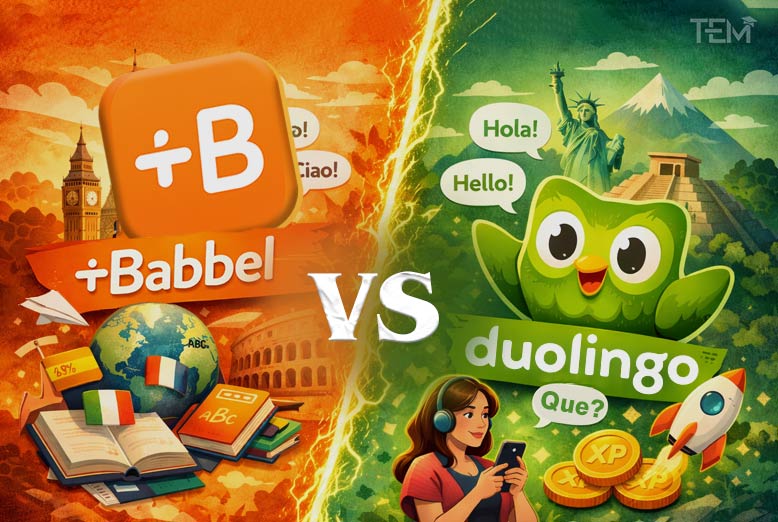
Choosing between Babbel and Duolingo isn’t just about picking a popular language app. It’s about choosing a learning method that actually works for your goals. This Duolingo vs Babbel comparison provides research-backed insights to help you select the best language app 2026 for your needs.
Both platforms dominate the language-learning market, are backed by research, and are used by millions of learners worldwide. Yet they take fundamentally different approaches to how languages should be taught, one prioritizing engagement and habit-building, the other focusing on structured, real-world communication.
Students, professionals, and educators often ask the same question: Is Babbel better than Duolingo, or vice versa? This language learning apps review examines where each platform excels and where it falls short.
The answer depends on what you want to achieve and how you plan to learn.
In this in-depth Babbel vs Duolingo comparison, we evaluate both apps using learning methods, language depth, pricing, user experience, and documented outcomes so you can make a confident, evidence-informed choice.
Babbel vs Duolingo: Quick Verdict
Babbel is ideal for learners seeking structured lessons, grammar clarity, and real-world speaking confidence.
Duolingo works best for beginners looking for a free, low-pressure daily learning habit. The best choice depends on your goals and learning style.
How We Evaluated Babbel vs Duolingo
This Babbel vs Duolingo comparison is based on an evidence-led evaluation framework used in education technology analysis.
This comparison was developed using instructional design principles commonly applied in higher education and adult language learning. The evaluation framework reflects findings from peer-reviewed research in second-language acquisition, mobile-assisted language learning, and communicative language teaching methodologies widely used in universities and professional language programs worldwide.
We assessed both platforms using criteria that matter in real learning outcomes:
- Instructional design and learning methodology
- Language depth and skill progression
- Alignment with adult learning principles
- Pricing structure and value over time
- Reported learning outcomes from academic and institutional evaluations
- User experience factors that impact retention and completion
Our goal was not to declare a “winner,” but to determine which app works better for specific learner needs, a distinction supported by education research.
Babbel vs Duolingo: Core Learning Approach (Quick Overview)
Before diving deep, this table summarizes the fundamental difference between the two platforms.
| Aspect | Duolingo | Babbel |
| Primary focus | Habit-building & engagement | Structured language mastery |
| Learning style | Gamified, repetition-based | Curriculum-driven, contextual |
| Best for | Beginners, casual learners | Goal-oriented adult learners |
| Teaching design | Algorithm-led | Linguist-designed |
This difference shapes everything else from lesson design to outcomes.
The contrast between algorithm-led engagement and curriculum-driven instruction mirrors broader trends seen in AI-powered LMS platforms, where personalization and pedagogical structure are balanced differently depending on learning goals.
Babbel vs Duolingo: Language Coverage and Depth
Language Availability
| Feature | Duolingo | Babbel |
| Number of languages | 40+ | ~14–15 |
| Niche languages | Yes | Limited |
| Course depth consistency | Varies by language | Consistent across languages |
Duolingo offers an unmatched variety, making it ideal for exploration.
Babbel, however, prioritizes depth and consistency, especially for major global languages.
Educational design research consistently shows that depth matters more than breadth for learners aiming beyond beginner levels.
Skill-by-Skill Comparison: Babbel vs Duolingo
How Each App Teaches Core Language Skills
| Skill | Duolingo | Babbel | Advantage |
| Vocabulary | Repetition & matching | Sentences & real contexts | Babbel |
| Grammar | Mostly implicit | Explicit explanations | Babbel |
| Speaking | Optional, limited | Integrated & contextual | Babbel |
| Listening | Short prompts | Real-life dialogues | Babbel |
| Reading | Strong at basics | Applied comprehension | Tie |
Key insight: Duolingo excels at exposure. Babbel excels at application.
Depth vs Accessibility: The Real Trade-Off
This is the heart of the Babbel vs Duolingo debate.
- Duolingo lowers the barrier to entry. Anyone can start, anytime.
- Babbel raises expectations but delivers clearer progress.
Learning research consistently shows:
- Gamification improves engagement
- Structured instruction improves proficiency
Neither is “better” universally, but they serve different learner intents.
Babbel vs Duolingo: Pricing, Subscriptions, and Value
Pricing plays a major role in the Babbel vs Duolingo decision, but cost alone doesn’t determine value. What matters is what you actually get for the time and money you invest.
1. Duolingo Pricing Explained
Duolingo follows a freemium model, which is a key reason for its massive global adoption.
Duolingo Free Plan
- Access to all languages
- Ad-supported experience
- Limited offline access
- Core learning features available
This model supports research-backed habit formation by allowing learners to start with zero financial commitment.
This approach aligns with patterns observed across other free-first language platforms, as discussed in our analysis of the best free language learning apps.
Duolingo Super (Paid Plan)
- Ad-free learning
- Offline lessons
- Progress tracking features
Important insight: Duolingo’s paid tier improves convenience, not instructional depth. The learning method remains the same across plans.
2. Babbel Pricing Explained
Babbel operates as a subscription-first platform, reflecting its structured academic design.
Babbel Subscription Model
- Monthly, quarterly, and annual plans
- No fully free version (limited trial lessons only)
- Full access requires payment
Babbel’s pricing supports:
- Professionally developed curricula
- Linguist-led lesson design
- Consistent updates based on learner outcomes
Adult learning studies indicate that paid, structured programs often result in higher course completion rates, especially for goal-driven learners.
Babbel vs Duolingo: Cost Comparison Table
| Factor | Duolingo | Babbel |
| Free version | Yes | No |
| Ads | Yes (free plan) | No |
| Paid access focus | Convenience | Instructional quality |
| Offline learning | Paid plan | Paid plans |
| Long-term value | High for casual use | High for serious learners |
Which App Offers Better Value for Money?
| Learner Type | Better Choice | Why |
| Budget-conscious learners | Duolingo | Free access, low risk |
| Casual learners | Duolingo | Easy entry, habit-driven |
| Students & professionals | Babbel | Faster practical progress |
| Goal-oriented adults | Babbel | Structured learning paths |
Babbel vs Duolingo: Learning Outcomes and Effectiveness
University-led evaluations and independent learning studies consistently show a clear pattern:
Duolingo produces its strongest gains in vocabulary recognition and reading comprehension at early proficiency levels, while Babbel users report faster improvement in grammar understanding, speaking confidence, and real-world communication skills when following its structured curriculum.
The real question in Babbel vs Duolingo isn’t which app is more fun; it’s which one helps learners actually use a new language.
To answer that, we look at outcomes evaluated through academic research, learner assessments, and mobile-assisted language learning studies used in formal language education.
Learning Outcomes: What Each App Does Well
1. Duolingo: Best for Early-Stage Learning
Research-backed evaluations of Duolingo show that it is effective for:
- Vocabulary acquisition
- Reading comprehension
- Beginner-level language exposure
Duolingo’s strengths are most visible at A1 to early A2 CEFR levels, where repetition and exposure are critical.
However, research also notes limitations:
- Minimal speaking output
- Limited grammar explanation
- Slower transition to conversational fluency without external practice
2. Babbel: Designed for Practical Use
Babbel’s outcomes are strongest in:
- Grammar comprehension
- Speaking confidence
- Real-life communication tasks
Its curriculum aligns with Communicative Language Teaching (CLT), a widely accepted methodology in adult language education that emphasizes meaning, context, and usability.
Babbel vs Duolingo: Effectiveness Comparison Table
| Outcome Area | Duolingo | Babbel | Stronger Choice |
| Beginner progress | Strong | Strong | Tie |
| Grammar mastery | Limited | Strong | Babbel |
| Speaking ability | Limited | Strong | Babbel |
| Long-term retention | Moderate | Strong | Babbel |
| Habit consistency | Very strong | Moderate | Duolingo |
Retention, Completion, and Time Efficiency
Learning science draws an important distinction:
- Engagement keeps learners active
- Structure drives progress
| Metric | Duolingo | Babbel |
| Daily engagement | High | Moderate |
| Course completion | Lower | Higher |
| Progress per hour | Moderate | Higher |
This explains why many learners practice longer with Duolingo but advance faster with Babbel.
Who Learns Better With Each App?
| Learner Goal | Recommended App |
| Casual practice | Duolingo |
| Structured study | Babbel |
| Conversational fluency | Babbel |
| Habit building | Duolingo |
| Academic or professional use | Babbel |
Babbel vs Duolingo: User Experience, Motivation, and Ease of Use
Even the best learning content fails if users don’t stick with it. In Babbel vs Duolingo, user experience and motivation strategies strongly influence long-term success.
1. Duolingo User Experience
Duolingo is built around behavioral engagement design, a pattern widely discussed in educational technology research and supported by large-scale sentiment analysis of language-learning app user reviews.
What Duolingo Does Well
- Short, low-effort lessons
- Streaks, points, and rewards
- Mobile-first design
- Fast feedback loops
This approach reduces friction and encourages daily use, especially for beginners.
Where Duolingo Falls Short
- Repetition can feel shallow over time
- Limited learner control over lesson paths
- Motivation relies heavily on external rewards
Learning research cautions that extrinsic motivation alone does not sustain mastery.
2. Babbel User Experience
Babbel takes a focus-first approach, borrowing from formal adult education principles.
What Babbel Does Well
- Clear lesson goals
- Logical progression paths
- Minimal distractions
- Emphasis on comprehension and usage
Babbel’s UX supports deep learning, even if lessons require more effort.
Where Babbel Feels Demanding
- Less gamification
- Higher cognitive load per lesson
- Slower sense of instant reward
Practical signal: Babbel lessons require more focus per session, while Duolingo’s short, gamified exercises make daily learning easier to maintain over time.
However, instructional design research shows that effortful learning improves retention and transfer.
Babbel vs Duolingo: UX Comparison Table
| UX Factor | Duolingo | Babbel | Better For |
| Ease of starting | Very easy | Moderate | Duolingo |
| Daily motivation | High | Moderate | Duolingo |
| Focus & clarity | Moderate | High | Babbel |
| Learning efficiency | Moderate | High | Babbel |
| Long-term mastery | Limited | Strong | Babbel |
Motivation Styles: Fun vs Purpose
- Duolingo motivates through fun, streaks, and competition
- Babbel motivates through progress, clarity, and real-world use
Adult learning research consistently supports purpose-driven motivation for learners with specific goals.
So, Babbel vs Duolingo: Which Language App Should You Choose?
By now, the Babbel vs Duolingo difference should be clear: these apps are built for different kinds of learners, not for direct replacement.
Choose Duolingo if you:
- Are new to language learning
- Want a free, low-pressure way to start
- Prefer short, gamified lessons
- Value consistency over speed
Duolingo’s research-backed engagement design makes it one of the best tools for building a daily learning habit, especially at the beginner level.
Choose Babbel if you:
- Have a clear learning goal
- Want structured lessons with grammar clarity
- Need speaking confidence for real situations
- Prefer progress you can measure
Babbel’s linguist-designed curriculum reflects how languages are taught in formal education and how adults learn best.
Our Recommendation for Students and Educators
Start with Duolingo to build momentum and familiarity.
Move to Babbel when your goal shifts from practice to practical use.
This combination approach is commonly recommended by educators because it balances motivation with mastery.
Make the Smarter Choice and Share It Forward
If this Babbel vs Duolingo comparison helped you decide, share it with a student, educator, or professional navigating the same choice.
Clear guidance leads to better learning and better outcomes.
FAQs
1. Is Babbel better than Duolingo?
Babbel is better than Duolingo for learners who want structured lessons, clear grammar explanations, and practical speaking skills. Duolingo is better for beginners who want a free, low-pressure way to build a daily learning habit. Research shows both apps are effective, but they serve different learning goals rather than competing for the same outcomes.
2. Is Babbel worth paying for?
Babbel is worth paying for if your goal is real-world language use rather than casual practice. Its paid subscription supports structured courses designed by language experts, explicit grammar instruction, and CEFR-aligned progression. Studies on adult language learning consistently show that guided instruction leads to faster functional proficiency than unguided repetition alone.
3. Can Duolingo make you fluent?
Duolingo alone is unlikely to make most learners fluent. Research indicates it is highly effective for beginner-level vocabulary and reading comprehension, especially at A1–A2 levels. However, fluency typically requires speaking practice, explicit grammar instruction, and real-world interaction beyond what Duolingo currently provides.
4. Which app do language teachers recommend?
Language teachers often recommend Duolingo for habit-building and beginner exposure, and Babbel for structured learning and speaking development. Many educators suggest starting with Duolingo to build consistency and transitioning to Babbel when learners are ready for deeper understanding and practical language use.