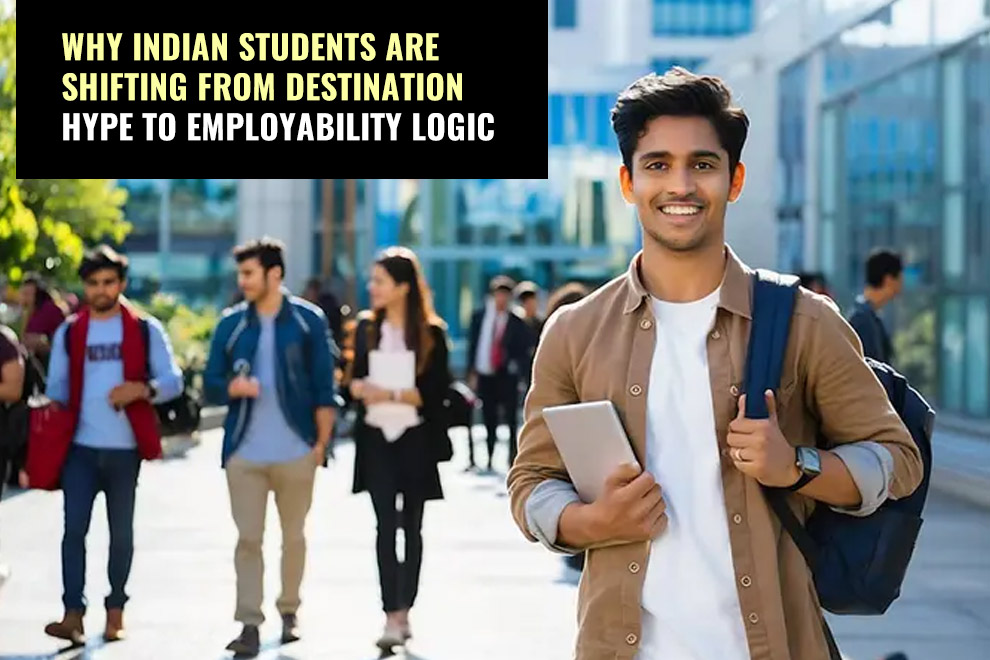
There is a visible change in the Indian study-abroad market. For years, choosing a destination has relied on country prestige, social media trends, peer decisions, campus glamour. According to AOEC India consultants, that pattern is changing. Indian students are shifting from the hype of destination to employability logic. This is not a minor behavioural modification. It reflects a greater maturity that students have towards education abroad.
The End of the “Brand-First” Era
Until recently, many applicants chose countries first and careers second. The destination was the goal often the degree was secondary. If a country was perceived as being “popular,” students assumed that opportunities would automatically follow.
That assumption is outdated.
The questions that are being asked by today’s students are much tougher and results-driven:
- What are the job roles that this program really leads to?
- What will be the skills that I graduate with?
- How does this degree meet the demand of the industry?
- What is the feasible time frame to break even financially?
- Will this choice still make sense five years down the line?
In short, students are no longer purchasing the destination story alone – they want to check the career outcome and employment opportunities.
Why This Shift Happened Now
Several factors have been pushing this transition along.
1) Higher financial stakes
Families are increasingly making larger and more considered investments into international education. With tuition, living expenses and currency fluctuations the margin for error is less. This has driven decision making from aspiration- to analysis-led.
2) Visa and policy uncertainty
Greater global policy changes have made students more cautious. Instead of pursuing the loudest destination story, they now focus on countries and systems that look like they have structure, predictability and friendly.
3) Information availability
Students today have access to more information on alumni experiences, job market information and comparative data than ever before.
4) Decision frameworks within the family have changed
Parents are not asking anymore, “How famous is this university?” They now ask, “What is the employability path, what is the ROI?”.
What “Employability Logic” really Means
Employability logic is not “get any job after graduation”. It is a more strategic framework in which students are making evaluations of:
- Program-to-role fit: Does the curriculum map to real jobs?
- Skill relevance: are the tools, competencies and projects industry-usable?
- Market alignment: Is the market demand likely to be good in that sector?
- Execution: does the student have clear pathway from study to work?
- Risk balance: if one plan fails, are there alternatives?
This change has revolutionised the counselling conversation. Students increasingly are starting from career intent and working backwards to select destination, institution, and intake.
The New Student Mindset: “Fit” Not Fame
A major result of this trend is that “best country” is being replaced by “best fit.”
In practice, this means:
- A student interested in applied analytics is looking for great project depth rather than a big-name campus.
- A management aspirant judges relevance of internship and integration with the industry, and not merely brochure rankings.
- A design student seeks out portfolio rather than destination prestige alone as well as industry exposure.
The most successful applicants are now crafting a coherent narrative: why this program, why now, and how this degree helps one meet a defined career goal.
How This Is Changing the Consultant and Institutional Roles
This change in transition also alters the role of education consultants and institutions.
Consulting is shifting from “admission facilitation” to “career aligned planning.” Advisors are expected to talk with students about:
- sector trends,
- profile suitability,
- skill gaps,
- realistic plans of progression,
- not just paperwork of applications
Institutions, meanwhile, are being judged more on curriculum relevance, practical exposure and graduate pathways than on branding alone.
Common Errors Students Should be Aware of
Despite this positive change, a lot of students fall into old patterns. The most common errors to make are:
Choosing trends over fit: Selecting programs because they are “in demand” with no checking of personal aptitude and long-term alignment.
Starting Career Planning Too Late: Trying to define goals after the application, rather than before it.
Weak profile building: Submitting applications with no clear and credible statement of career direction
Ignoring skill readiness: Assuming admission is a guarantee of employability without being invested in the acquisition of role-specific skills.
No contingency planning: Building on One Pathway and Panicking When Timelines Change
What Smart Applicants Are Doing Differently in 2026.
Students who are winning in this environment usually use a disciplined approach:
- A target career cluster should be defined first.
- Shortlist programs that sincerely support that cluster.
- Build profile depth (projects, internships, certifications, language where relevant).
- Prepare a consistent story across SOP, interview and documentation
- Plan finances with real buffers and stages
- Working with AOEC India advisors who are outcome focused not volume based.
This is what employability logic looks like in action: strategic choices, early planning and execution discipline.
The Bigger Signal for India’s Study-Abroad Ecosystem
The shift from hype to employability is good for the sector.
It helps to improve the quality of decisions, decreases mismatch in enrolments, and makes students more accountable. It is also the push stakeholders (consultants, institution) offer better guidance rather than generic destination marketing.
Most importantly, it allows the students to take possession over their own future. When the question changes from “Where is everybody going?” to “What outcome am I building up?”, quality of choices is dramatically improved.
Indian students are not getting less ambitious. They are becoming increasingly strategic.
Also Read: Delphian School on Why Community Service Matters in Student Life