Artificial intelligence is no longer an abstract idea discussed only in research labs or policy papers. It is already embedded in classrooms, learning platforms, and academic decision-making systems across the world. From personalized learning paths to faster feedback and smarter administrative processes, AI is quietly reshaping how education works.
Yet, as adoption accelerates, one critical question continues to surface among educators, parents, and institutions alike: What are the real benefits of AI in education, and do they genuinely improve learning outcomes?
This guide explores that question with clarity and evidence. Grounded in verified research, global education data, and real-world examples, it explains how AI supports students, empowers teachers, and enables institutions to make better decisions without losing the human core of education.
This is not a technical manual or a promotional article. It is a practical, research-backed examination of where AI adds measurable value in education today, where its limits lie, and how it can be used responsibly to create better learning experiences for all.
How AI Is Used in Education Today
Artificial intelligence is already operating behind the scenes in many educational environments, often without learners even realizing it. Rather than replacing traditional teaching, AI is being used to enhance existing systems and solve long-standing challenges in learning and administration.
One of the most common uses of AI in education is adaptive learning. These systems analyze how a student interacts with content and adjust lessons in real time, allowing learners to move at their own pace instead of following a rigid, one-size-fits-all model.
AI is also widely used in assessment and feedback. Automated grading tools can evaluate assignments, quizzes, and even open-ended responses more efficiently, giving students faster feedback while reducing repetitive workload for teachers.
Beyond the classroom, educational institutions use AI for predictive analytics, identifying students who may be at risk of falling behind, optimizing course schedules, and improving enrollment and retention strategies.
Importantly, adoption is no longer experimental. A majority of educators globally report using some form of AI-enabled tool, particularly for content support, information retrieval, and classroom management. This signals a shift from curiosity to practical reliance, marking AI as a foundational layer in modern education systems.
Key Benefits of AI in Education for Students
At its core, education is about meeting learners where they are. One of the strongest benefits of AI in education is its ability to recognize that no two students learn in the same way or at the same pace.
By analyzing learning patterns, responses, and engagement levels, AI enables more responsive and inclusive learning experiences for students across age groups and abilities.
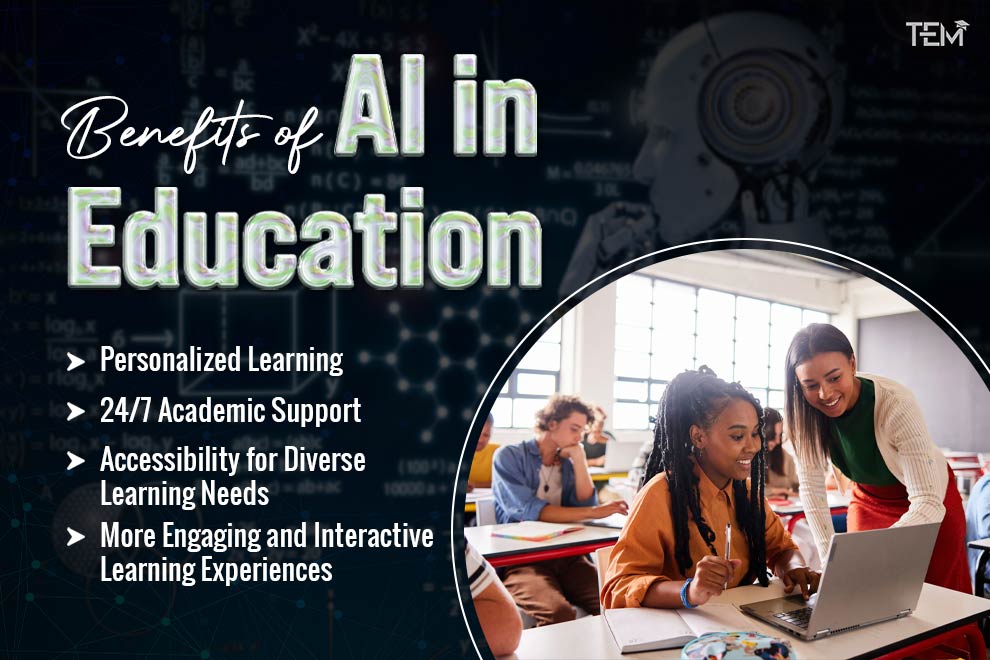
1. Personalized Learning That Adapts to Every Student
Traditional classrooms often move at a fixed pace, leaving some students behind while others remain unchallenged. AI-powered adaptive learning platforms change this dynamic by adjusting content difficulty, format, and progression based on individual performance.
This leads to measurable improvements in subject mastery, particularly in areas like mathematics and language learning. Instead of forcing students to adapt to the system, AI allows learning experiences to better align with individual needs and progress.
2. 24/7 Academic Support Beyond the Classroom
Learning does not stop when the school day ends, but access to help often does. AI-powered tutors and chatbots are filling this gap by providing on-demand academic support outside of classroom hours.
Students can ask questions, clarify concepts, or receive guided explanations at any time, without waiting for the next class or office hour. This continuous access is especially valuable for students in different time zones, those balancing school with work, or learners who need repeated explanations to build confidence.
Importantly, these tools are designed to supplement, not replace, teacher support, ensuring students feel guided rather than isolated.
3. Improving Accessibility for Diverse Learning Needs
One of the most meaningful advantages of AI in education lies in accessibility. For students with learning differences or disabilities, AI-powered tools can remove barriers that have historically limited participation.
Speech-to-text, text-to-speech, real-time translation, and reading assistance tools help students with dyslexia, visual impairments, or language challenges engage with content more independently. By personalizing how information is delivered, AI supports equity in learning without lowering academic standards.
This shift is not about special treatment; it is about fair access to learning opportunities.
4. More Engaging and Interactive Learning Experiences
AI is also reshaping how students engage with educational content. Through interactive simulations, intelligent feedback, and gamified learning environments, students are encouraged to participate actively rather than passively consume information.
In subjects that are traditionally abstract or difficult to visualize, AI-enhanced tools can turn concepts into immersive experiences, making learning more intuitive and memorable. Higher engagement often leads to better retention, improved motivation, and a stronger connection to the learning process.
Research Highlight: Research on adaptive learning platforms such as DreamBox Learning found that students who engaged with the software tended to show measurable gains in achievement, though results vary with usage and context.
How AI Is Helping Teachers Teach Better
Teaching has always required balancing instructional quality with administrative responsibility. One of the most practical benefits of AI in education is its ability to reduce this burden, allowing educators to focus more on what matters most: guiding, mentoring, and supporting students.
Rather than replacing teachers, AI acts as a support system that enhances efficiency, insight, and instructional design.
1. Reducing Time Spent on Grading and Administration
Grading assignments, tracking attendance, and managing routine administrative tasks consume a significant portion of an educator’s time. AI-powered assessment tools can automate large parts of this process while maintaining consistency and accuracy.
By handling objective assessments and providing structured feedback, these tools significantly reduce repetitive workload. Studies show that educators using AI for grading and administrative tasks save several hours each week, time that can be reinvested into lesson planning, student engagement, and individualized support.
This shift does not diminish the teacher’s role; it strengthens it by freeing educators from tasks that do not require human judgment.
2. Smarter Lesson Planning and Content Creation
AI is also changing how teachers design and deliver lessons. Intelligent content creation tools can assist educators in generating lesson outlines, quizzes, presentations, and discussion prompts aligned with learning objectives.
Instead of starting from scratch, teachers can refine, customize, and contextualize AI-generated content based on their classroom needs. This speeds up preparation while preserving instructional quality and creativity.
The result is not standardized teaching, but more time for thoughtful instruction and adaptive teaching strategies.
3. Early Identification of Learning Gaps
One of the most impactful ways AI supports teachers is through early instructional insight. By analyzing student performance data over time, AI systems can identify patterns that suggest a learner may need additional support within the classroom.
This allows teachers to intervene earlier, adjust instruction proactively, and provide targeted guidance before challenges escalate. Used responsibly, these insights help educators make informed decisions while keeping human judgment at the center of the learning process.
Traditional Classroom vs AI-Enabled Learning
| Traditional Classroom | AI-Enabled Learning |
| One-size-fits-all instruction | Personalized learning paths |
| Manual grading and feedback | Automated, real-time assessment |
| Limited accessibility support | Built-in assistive technologies |
| Reactive student intervention | Predictive learning insights |
Research Highlight: A Gallup-Walton Family Foundation study found that teachers who use AI tools weekly save an average of nearly 6 hours per week.
Strategic Benefits for Institutions and Administration
While much of the discussion around AI in education focuses on classrooms, its impact at the institutional level is equally significant. Schools, colleges, and universities operate within complex systems that require careful coordination of resources, people, and data.
1. Data-Driven Decision Making
Educational institutions generate vast amounts of data from attendance records and assessment results to enrollment trends and student engagement metrics. AI systems can analyze this data at scale, uncovering patterns that would be difficult to detect manually.
These insights support informed decisions around curriculum design, resource allocation, and academic planning. Leaders can evaluate program performance, institutional capacity, and policy impact more effectively.
2. Improving Student Retention and Outcomes
Student retention remains a major concern for many institutions. AI-powered predictive analytics help address this by identifying students who may be at risk of disengagement or dropout at the institutional level.
By analyzing trends across academic performance, attendance, and engagement indicators, AI systems can surface early warning signals that inform advising strategies and support services. This proactive approach improves retention while strengthening institutional stability.
3. Operational Efficiency and Cost Optimization
Beyond academics, AI plays a growing role in streamlining administrative operations. Tasks such as scheduling, enrollment management, and internal communication can be automated or optimized using intelligent systems.
This improves efficiency, reduces operational costs, and supports sustainable institutional growth.
The Horizon: AI’s Long-Term Impact on Education
Artificial intelligence in education is moving beyond basic automation toward systems that support long-term planning, deeper insight, and responsible governance.
1. Agentic AI in Classrooms
Agentic AI will increasingly operate within defined boundaries to coordinate learning pathways, recommend interventions, and connect academic support services across platforms.
2. Emotion-Aware Learning Systems
Future systems will help educators recognize signals of confusion, overload, or disengagement through behavioral data, while interpretation and response remain human-led.
3. Continuous Assessment Without Exams
AI-driven skill mapping will reduce reliance on traditional exams by evaluating learning progress through ongoing coursework, projects, and interaction data.
4. Global Access and Lifelong Learning
AI-powered platforms will support multilingual, flexible learning models that expand access to education across geographies and life stages.
5. Responsible Innovation and Governance
As AI adoption grows, stronger frameworks around transparency, fairness, and accountability will guide responsible implementation.
The future of AI in education is not about removing teachers; it is about providing clearer insight, earlier signals, and better tools to support every learner.
Real-World Examples of AI Tools in Education
The table below maps common educational challenges to AI tools already in use.
| Educational Challenge | AI-Powered Solution | Practical Impact |
| Time-consuming grading | Automated grading tools | Faster feedback and reduced teacher workload |
| One-size-fits-all instruction | Adaptive learning platforms | Personalized learning paths |
| Low student engagement | Gamified learning systems | Increased motivation |
| Lesson preparation time | AI content tools | Structured planning |
| Student support outside class | AI tutors | Continuous assistance |
Challenges and Ethical Considerations of AI in Education
While the benefits of AI in education are substantial, responsible adoption requires a clear understanding of its challenges. Technology alone does not guarantee better learning outcomes.
How AI is designed, implemented, and governed plays a decisive role in whether it strengthens or weakens educational experiences.
Addressing ethical and practical concerns is essential for building trust among educators, students, and institutions.
1. Data Privacy and Student Protection
Educational AI systems rely on large volumes of student data. Institutions must ensure compliance with privacy regulations and transparent data governance practices.
2. Addressing Bias and Fairness in AI Systems
AI systems may reflect biases present in training data. Continuous evaluation and human oversight are essential to prevent unfair outcomes.
3. Preserving the Human Connection in Learning
Learning remains a deeply human process shaped by empathy and mentorship. AI should support, not replace, meaningful teacher–student relationships.
Research Highlight: UNESCO’s Recommendation on the Ethics of Artificial Intelligence highlights core values like transparency, fairness, and human oversight that are essential for ethical AI use, including in education.
Final Thoughts: The Real Benefits of AI in Education Start With Human Intent
The benefits of AI in education extend far beyond automation or efficiency gains. At its best, artificial intelligence supports more inclusive, responsive, and human-centered learning environments.
When implemented responsibly, AI strengthens, not replaces, the educational experience by giving educators clearer insight and students better support.
If you found this guide valuable, share it with educators, administrators, and policymakers shaping the future of learning.
FAQs
- What are the main benefits of AI in education?
The main benefits of AI in education include personalized learning, faster feedback, improved student engagement, and reduced administrative workload for teachers. AI systems analyze how students learn and adapt content to their needs, helping learners progress at their own pace while allowing educators to focus on teaching rather than repetitive tasks.
- How is AI used in classrooms today?
AI is already used in classrooms through adaptive learning platforms, AI tutors, automated grading tools, plagiarism detection software, and learning analytics dashboards. These tools help teachers track student progress, identify learning gaps early, and deliver more targeted support.
- Can AI replace teachers in education?
No. AI cannot replace teachers. While AI can assist with content delivery and administrative tasks, education relies heavily on human judgment, emotional intelligence, creativity, and mentorship. The most effective education models use AI to support teachers, not replace them.
- Is AI in education safe for students?
AI in education can be safe when used responsibly. Institutions must follow strict data privacy policies, ensure transparency in AI systems, and prevent bias in algorithms. When implemented ethically, AI improves learning outcomes while protecting student data and trust.