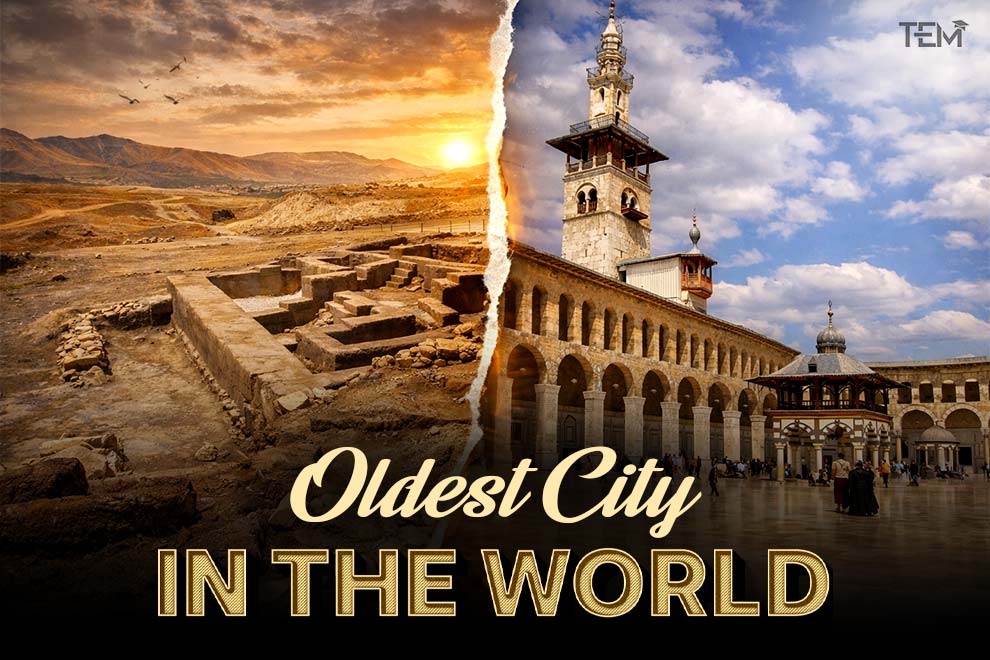
The oldest city in the world is widely considered to be Jericho, located in the West Bank, with archaeological evidence dating back to around 9000 BCE. However, Damascus in Syria is often described as the oldest continuously inhabited city due to its uninterrupted urban history spanning over 3,000 years.
Long before Rome built its empire or Athens shaped democracy, humanity was already learning how to live together in organized communities. The story of civilization does not begin in the classical world; it begins nearly 11,000 years ago.
When people search for the oldest city in the world, one name appears repeatedly: Jericho. Yet others argue that Damascus deserves the title because of its continuous habitation. The debate is not just about age. It is about how historians define a “city,” how archaeology measures time, and what uninterrupted human presence truly means.
These ancient places are not ruins lost to time. Many are still alive today, layered with thousands of years of history beneath modern streets.
So which city is truly the oldest? The answer depends on evidence, definitions, and a deeper understanding of how civilization began.
What Is the Oldest City in the World?
Most archaeologists identify Jericho as the oldest known city in the world, with evidence of settlement dating back to around 9000 BCE. Excavations at Tell es-Sultan reveal stone structures, fortifications, and organized habitation from the Neolithic period.
However, some historians argue that Damascus may be the oldest continuously inhabited city, with evidence of urban life emerging around the third millennium BCE.
The distinction depends on one key question: Are we measuring the first settlement, or uninterrupted urban life?
Jericho vs Damascus Side-by-Side Comparison
| Criteria | Jericho | Damascus |
| Earliest Settlement | ~9000 BCE | ~3000 BCE (urban phase) |
| Continuous Habitation | Debated | Strong claim |
| UNESCO Recognition | Yes (Tell es-Sultan, 2023) | Yes (Ancient City of Damascus) |
| Common Title | Oldest Known City | Oldest Continuously Inhabited City |
How Do Historians Decide Which City Is Oldest?
Determining the world’s oldest city is more complex than checking a date on a timeline. Scholars rely on multiple forms of evidence.
1. Archaeological Layers (Stratigraphy)
Cities that have been inhabited for thousands of years contain layered settlements. Each layer represents a different era of occupation.
2. Carbon Dating
Organic materials such as wood, seeds, and bones are tested to estimate age.
3. Urban Characteristics
A settlement becomes a city when it shows:
- Permanent structures
- Organized streets or planning
- Defensive walls
- Social or religious institutions
4. Continuous Habitation
Some cities were abandoned and later resettled. Others have never been fully deserted. This distinction is central to the Jericho–Damascus debate.
It is also important to clarify that sites like Göbekli Tepe, though older than Jericho, are ceremonial complexes, not cities with permanent urban populations.
According to archaeological research referenced by Encyclopaedia Britannica and UNESCO, Jericho’s early defensive wall represents one of the earliest examples of communal construction in human history.
While Jericho holds the record for the first urban center, it is part of a broader era of prehistoric construction. For a deeper look at the specific structures that paved the way for organized life, you can explore the oldest buildings in the world, which detail the world’s first temples and stone monuments.
Understanding these criteria helps explain why multiple cities compete for the same title.
The Great Debate: Jericho vs Damascus
The question of the oldest city in the world often narrows down to two historic contenders: Jericho and Damascus. Both are ancient. Both are culturally significant. But they represent different interpretations of what “oldest” truly means.
Jericho: The Earliest Known Urban Settlement
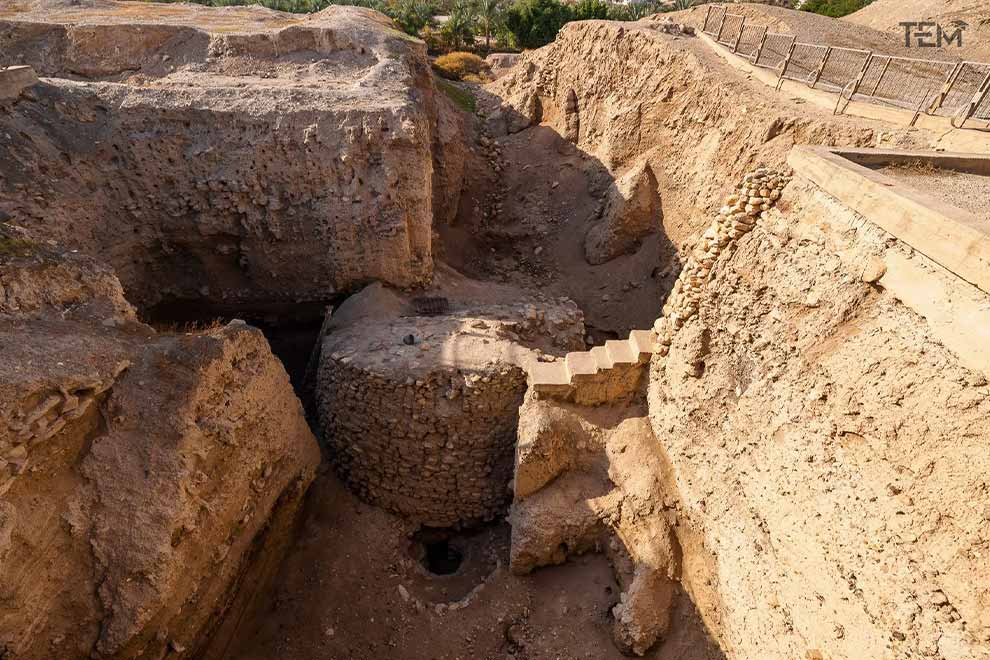
Located in the West Bank near the Jordan River, Jericho is widely regarded by archaeologists as the earliest known city in human history.
Excavations at Tell es-Sultan reveal settlement layers dating back to approximately 9000 BCE, during the Pre-Pottery Neolithic period. What makes Jericho remarkable is not just its age, but its sophistication.
Archaeologists have uncovered:
- A massive stone wall
- A 23-foot stone tower
- Permanent dwellings
- Evidence of agriculture
These findings indicate organized community life nearly 11,000 years ago, long before the rise of Mesopotamian civilizations.
In 2023, Tell es-Sultan was inscribed as a UNESCO World Heritage Site, further recognizing its global archaeological importance.
From a purely chronological standpoint, Jericho currently holds the strongest claim as the oldest known city.
Damascus: The Oldest Continuously Inhabited City?

Damascus, the capital of modern-day Syria, presents a different kind of claim.
Archaeological evidence suggests that the area has been inhabited since at least the third millennium BCE. While this is younger than Jericho’s earliest settlement layers, Damascus is often described as the oldest continuously inhabited city in the world.
Historical records show Damascus as:
- A major trade center
- A capital under multiple empires
- A key city in Roman, Byzantine, and Islamic history
Unlike many ancient settlements that were abandoned and later rediscovered, Damascus has remained an active urban center for thousands of years.
This continuity strengthens its claim not as the earliest settlement, but as the longest continuously functioning city.
So, Which One Is Truly the Oldest?
The answer depends on the definition.
If we define “oldest city” as the earliest known large, organized settlement with urban characteristics, Jericho leads based on archaeological evidence.
If we define it as the oldest continuously inhabited urban center, Damascus becomes a strong contender.
Most archaeologists today credit Jericho as the oldest known city by origin date, while Damascus is often cited as the oldest continuously inhabited city.
Both claims can be valid depending on the criteria used.
Top 10 Oldest Cities in the World (Ranked by Age)
Civilization did not emerge in one place. It appeared across regions that today span the Middle East, Europe, South Asia, and North Africa. Below is a research-backed list of some of the oldest known cities, ranked by earliest known settlement dates.
| City | Region | Estimated Origin | Known For | Still Inhabited? |
| Jericho | West Bank | ~9000 BCE | Neolithic walls, stone tower | Yes |
| Byblos | Lebanon | ~7000 BCE | Phoenician trade, alphabet roots | Yes |
| Aleppo | Syria | ~6000 BCE | Silk Road Trade Center | Yes |
| Damascus | Syria | ~3000 BCE (urban phase) | Continuous habitation | Yes |
| Susa | Iran | ~4200 BCE | Elamite civilization | Yes |
| Faiyum | Egypt | ~4000 BCE | Ancient Egyptian settlement | Yes |
| Sidon | Lebanon | ~4000 BCE | Phoenician maritime hub | Yes |
| Athens | Greece | ~3000 BCE | Classical civilization | Yes |
| Plovdiv | Bulgaria | ~4000 BCE | Thracian origins | Yes |
| Varanasi | India | ~1200 BCE (archaeological evidence) | Sacred Hindu city | Yes |
Let’s briefly understand why each matters.
1. Jericho
Often called the cradle of urban life, Jericho’s Neolithic settlement predates pottery, writing, and metal tools. Its defensive wall is one of the earliest known examples of urban architecture.
2. Byblos
Located in modern-day Lebanon, Byblos became a key Phoenician port. It played a significant role in spreading early alphabetic systems across the Mediterranean.
3. Aleppo
Strategically positioned along ancient trade routes, Aleppo became a commercial bridge between Asia and the Mediterranean. Its long habitation history strengthens its claim among the world’s oldest cities.
4. Damascus
While not as old as Jericho in origin date, Damascus is frequently cited as the oldest continuously inhabited city, with uninterrupted urban life across millennia.
5. Susa
An important center of the Elamite civilization, Susa later became part of the Persian Empire. Archaeological evidence confirms settlement dating back over 6,000 years.
6. Faiyum
One of Egypt’s oldest settlements, Faiyum, shows early agricultural development tied to Nile irrigation systems.
7. Sidon
A powerful Phoenician maritime city, Sidon contributed significantly to Mediterranean trade networks and early shipbuilding.
8. Athens
While younger than Near Eastern cities, Athens stands as one of Europe’s oldest continuously inhabited cities and remains the oldest capital in Europe.
9. Plovdiv
Plovdiv’s history stretches back to Thracian settlements before Greek and Roman influence shaped the city.
10. Varanasi
Often described as one of the world’s oldest living cities, Varanasi holds immense religious importance. However, archaeological findings suggest organized urban settlement dates back to around 1200 BCE, making it ancient though younger than Mesopotamian cities.
What Is the Oldest Capital City in the World?
When discussing capitals, the debate narrows further.
Damascus is often cited as the oldest continuously inhabited capital city. It has served as a political center under multiple empires, including the Umayyad Caliphate.
In Europe, Athens holds the distinction of being the oldest capital still functioning today.
The distinction matters: not every ancient city was a capital, and not every capital maintained continuous political status.
Beyond Living Cities: Even Older Sites
Some places predate cities altogether but do not qualify as urban settlements.
1. Pavlopetri
Off the southern coast of Greece lies Pavlopetri, one of the world’s oldest known submerged cities. Dating back roughly 5,000 years, its underwater grid-like layout reveals advanced planning for its time.
Unlike Jericho or Damascus, Pavlopetri is no longer inhabited, but it offers rare insight into early urban design.
2. Göbekli Tepe
Located in southeastern Turkey, Göbekli Tepe dates back to around 9500 BCE, older than Jericho.
However, it is considered a ritual or ceremonial complex rather than a city. There is no evidence of permanent residential structures or urban planning. Its importance lies in reshaping our understanding of early human organization before cities even formed.
Is Varanasi the Oldest City in India?
Varanasi is frequently described as the oldest living city in India and one of the oldest continuously inhabited cities in the world.
Religious texts place their origins far earlier, but archaeological evidence supports urban settlement around the early first millennium BCE.
This distinction between textual tradition and archaeological evidence is important. Varanasi is unquestionably ancient and culturally significant, but it does not predate Jericho or Mesopotamian settlements based on current archaeological data.
Why the World’s Oldest Cities Still Matter Today
The debate over the oldest city in the world is not just about numbers on a timeline. It is about understanding how human societies first organized themselves, built defenses, cultivated land, and created shared spaces.
Jericho teaches us that structured community life began far earlier than once believed. Damascus reminds us that resilience and continuity can define greatness just as much as age.
These cities have survived climate shifts, invasions, and cultural transformations. Beneath modern streets lie thousands of years of human ambition, adaptation, and learning.
They are living classrooms.
Understanding them gives us perspective on progress, on civilization, and on the responsibility we carry into the future.
If this exploration reshaped how you see human history, share it with someone who is curious about where civilization truly began.
FAQs
- Which is older: Jericho or Damascus?
Jericho is older based on archaeological evidence. Settlement layers at Tell es-Sultan date back to around 9000 BCE. Damascus shows evidence of urban development from around the third millennium BCE. However, Damascus is often described as the oldest continuously inhabited city.
- What is the oldest continuously inhabited city in the world?
Damascus is frequently cited as the oldest continuously inhabited city. Unlike many ancient settlements that were abandoned, Damascus has maintained urban life for thousands of years.
- What is the oldest capital city in the world?
Damascus is widely recognized as the oldest continuously inhabited capital city. In Europe, Athens holds the distinction of being the oldest functioning capital.
- Why isn’t Göbekli Tepe considered the oldest city?
Göbekli Tepe dates back to around 9500 BCE, making it older than Jericho. However, it is considered a ceremonial site rather than a city because there is no evidence of permanent residential settlement or urban planning.
- Is Varanasi the oldest city in the world?
Varanasi is one of the oldest continuously inhabited cities in India. Archaeological evidence suggests urban settlement from around 1200 BCE. While deeply ancient and culturally significant, it does not predate Jericho based on current archaeological findings.