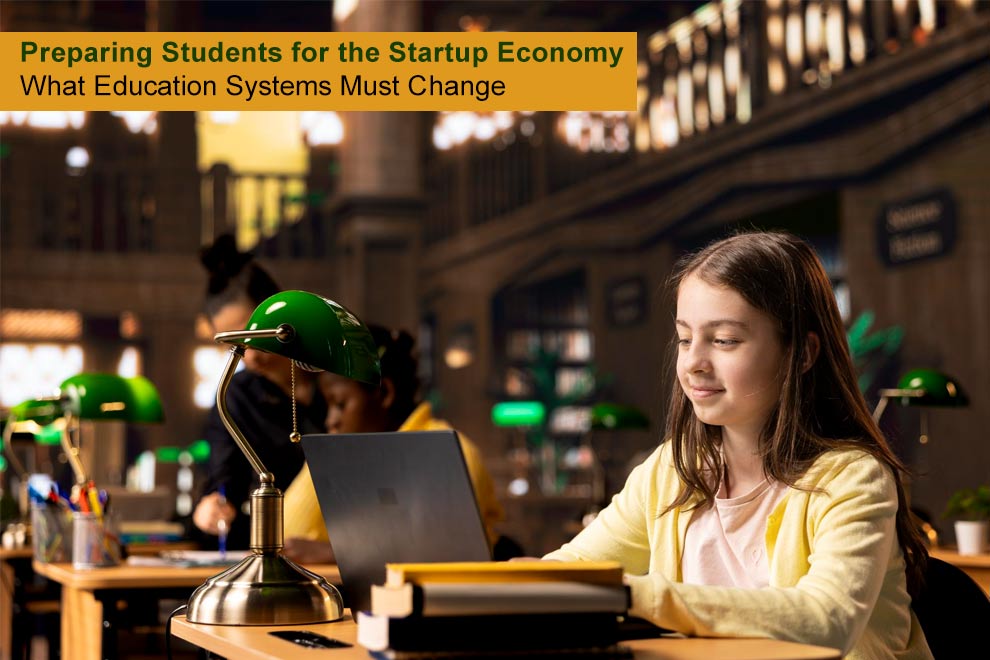
The global economy is undergoing a structural shift. Traditional, linear career paths are no longer the default for graduates. Instead, startups, freelancing, digital services, and small ventures are becoming realistic — and often necessary — career options. This transition has created a growing gap between what education systems teach and what students actually need to thrive in a startup-driven economy. To remain relevant, education must evolve beyond theory and credentials and focus on practical readiness.
The Changing Nature of Work
The startup economy is not limited to technology founders or venture-backed companies. It includes small online businesses, consultants, creators, service providers, and micro-enterprises operating across borders. Many students will work in environments where adaptability, problem-solving, and independent decision-making matter more than rigid job descriptions.
However, most education systems are still designed around preparing students for stable employment within large organizations. While foundational knowledge remains essential, it is no longer sufficient on its own. Graduates increasingly face a reality where they must create opportunities rather than wait for them.
The Gap Between Education and Execution
One of the biggest challenges is the disconnect between academic learning and real-world execution. Students may graduate with strong theoretical understanding but little exposure to how ideas turn into functioning organizations. Concepts like validating an idea, managing risk, understanding basic compliance, or operating within regulatory frameworks are often missing or treated as optional extras.
This gap becomes especially visible when graduates attempt to launch small ventures or join early-stage startups. Without practical exposure, they are forced to learn critical lessons through trial and error — often at high personal or financial cost.
Entrepreneurship Education Needs a Broader Definition
Entrepreneurship education is frequently misunderstood as being only about starting a company. In reality, it is about cultivating a mindset: initiative, resilience, accountability, and the ability to operate under uncertainty. These skills are valuable even for students who never become founders.
Education systems should move away from treating entrepreneurship as a niche subject and instead embed entrepreneurial thinking across disciplines. Engineers, designers, marketers, and even social science students benefit from understanding how value is created, sustained, and scaled.
Practical Skills Must Complement Theory
To prepare students for the startup economy, education must balance theory with application. This does not mean turning universities into incubators, but it does require integrating practical components into curricula.
Project-based learning, real-world case studies, simulations, and interdisciplinary collaboration can expose students to the complexities of building and sustaining initiatives. Even a basic understanding of how organizations are structured and governed helps students see the bigger picture beyond their immediate role.
At a conceptual level, students should also be introduced to how ventures are formally established and recognized, an area where services like Your Company Formations are relevant as examples of how legal and administrative processes support entrepreneurship.
Financial and Legal Awareness as Core Literacy
Another major gap in current education systems is financial and legal literacy. Many graduates enter the workforce — or attempt self-employment — without understanding cash flow, contracts, tax responsibilities, or regulatory obligations. These are not advanced topics; they are essential life skills in the startup economy.
Incorporating basic financial and legal awareness into education does not require professional-level training. Instead, it requires framing these topics as part of responsible participation in the economy. When students understand the consequences of decisions, they are better equipped to manage risk and avoid costly mistakes.
Learning to Navigate Uncertainty
Startups operate in environments defined by uncertainty. Unlike traditional employment, there is no guaranteed structure, timeline, or outcome. Education systems, however, often reward certainty: correct answers, standardized testing, and predictable paths.
To prepare students for modern realities, education must normalize ambiguity. Encouraging experimentation, reflection, and iterative learning helps students become comfortable with uncertainty. Failure, when treated as a learning process rather than a stigma, becomes a powerful educational tool.
The Role of Institutions and Educators
Educational institutions play a critical role in shaping how students perceive careers and success. When success is measured only by grades or job placement, students may overlook alternative paths that better suit their skills and ambitions.
Educators can help by exposing students to diverse career narratives, including small business owners, independent professionals, and startup employees. This broader perspective allows students to see entrepreneurship not as a risky exception, but as one of many valid career trajectories.
Preparing for a Flexible Future
The startup economy is not a temporary trend. It reflects deeper changes in technology, globalization, and labor markets. As these forces continue to evolve, adaptability will become one of the most valuable skills a graduate can possess.
Education systems must respond by equipping students with transferable skills, practical awareness, and the confidence to navigate non-traditional paths. This does not diminish the value of academic knowledge; it strengthens it by making it usable in real-world contexts.
Conclusion
Preparing students for the startup economy requires more than adding a few elective courses. It demands a shift in how education defines readiness, success, and relevance. By integrating practical skills, entrepreneurial thinking, and real-world awareness into mainstream education, institutions can empower students to participate meaningfully in an economy where creating opportunities is just as important as finding them.
In doing so, education systems will not only serve future founders, but also produce more capable, informed, and resilient graduates — regardless of the paths they choose.
Also Read: The Future of Online Education: Trends in Learning Management Systems