Research is entering a new phase, and understanding how AI agents will change research is becoming increasingly important as digital tools move beyond speeding up tasks to reshaping how research itself happens.
For years, technology helped researchers search faster, analyze data more efficiently, and publish with greater ease. Now, the shift is deeper.
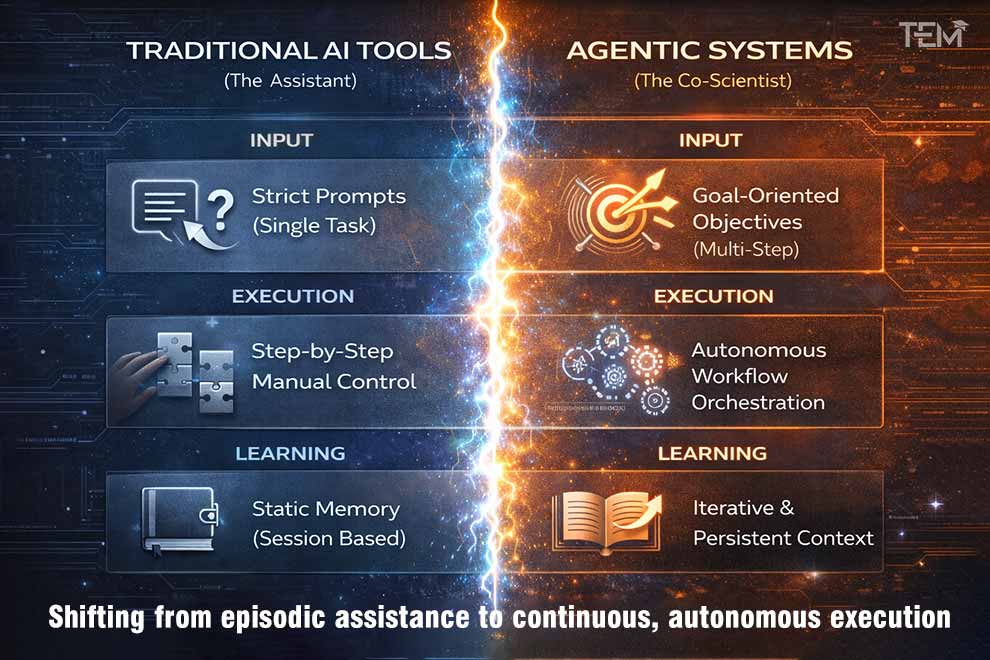
Unlike traditional AI tools that respond to prompts, AI agents can plan tasks, execute multi-step workflows, collaborate with other systems, and improve results over time.
Universities, research labs, and industry teams are already testing environments in which AI agents scan the literature, generate hypotheses, design experiments, and support peer review.
AI agents change research by turning workflows into goal-driven systems rather than manual sequences.
What Are AI Agents
AI agents are AI systems that can take actions, not just generate responses. Instead of waiting for instructions step by step, they can plan a sequence of tasks, use tools, store context, and refine outputs until a goal is achieved.
Research is rarely a single task. It is a chain of activities reviewing literature, forming hypotheses, designing experiments, analyzing data, and communicating results.
This capability is important because research is rarely a single task. It is a chain of activities reviewing literature, forming hypotheses, designing experiments, analyzing data, and communicating results.
AI agents fit naturally into this chain.
Rather than replacing researchers, they extend the researcher’s capacity. Tasks that once required hours of searching and organizing information can now be coordinated automatically, allowing researchers to focus on interpretation, methodology, and decision-making.
Leading research labs are already noting that AI is transitioning from a tool to a teammate that actively joins the scientific discovery process.
The Shift: From Research Assistance to Research Execution
For more than a decade, research technology focused on assistance. Tools helped researchers find papers faster, manage citations, or run statistical analysis. The researcher still controlled every step.
AI agents introduce a different model: execution.
Instead of supporting isolated tasks, agents can coordinate entire workflows. A researcher can define a goal, for example, mapping recent literature on a topic, and the agent can plan how to achieve it, gather sources, summarize findings, and highlight gaps.
This shift is often described as moving from passive retrieval to agentic execution.
In practice, it means research becomes more continuous. Agents can monitor new publications, update literature reviews, test variations of hypotheses, and maintain evolving research maps over time.
The researcher’s role moves upward from performing tasks to supervising direction, validating outputs, and making critical decisions.
AI Tools vs AI Agents in Research
| Aspect | Traditional AI Tools | AI Agents |
| Interaction | Prompt → response | Goal → execution |
| Workflow | Single task support | Multi-step coordination |
| Autonomy | Limited | Higher within defined boundaries |
| Memory | Session-based | Persistent context and iteration |
| Research role | Assistance | Workflow orchestration |
Traditional tools accelerate tasks. AI agents reshape how tasks connect across the research lifecycle, enabling continuous rather than episodic workflows.
Research Workflows That Will Change First
The first impact of AI agents is visible in repetitive, time-intensive stages of research. These are the stages where structured information, pattern recognition, and iteration matter most.
1. Literature Reviews and Synthesis
AI agents can scan large volumes of publications, group themes, detect contradictions, and generate structured summaries. Instead of static literature reviews, researchers can maintain living reviews that update continuously.
2. Hypothesis Generation
By analyzing trends across datasets and publications, agents can suggest potential research questions. Researchers still decide which ideas are meaningful, but ideation becomes faster and broader.
3. Experiment Design Support
Agents can compare methodologies used in previous studies and propose experimental variations. This does not replace methodological expertise but expands the design space researchers can explore.
4. Data Analysis and Interpretation
Agents can automate preprocessing, test multiple analytical approaches, and surface unexpected patterns. Researchers then validate significance and interpret implications.
5. Drafting and Knowledge Synthesis
AI agents can assemble structured first drafts, connect evidence across sources, and maintain consistency across sections.
Examples of AI agent use in research
- Living literature reviews that update automatically
- Continuous monitoring of new publications
- Hypothesis suggestion based on trend detection
- Experiment simulation before physical testing
- Automated evidence mapping across disciplines
- Digital peer-review support for consistency checks
Multi-Agent Research Teams: The Rise of Digital Co-Scientists
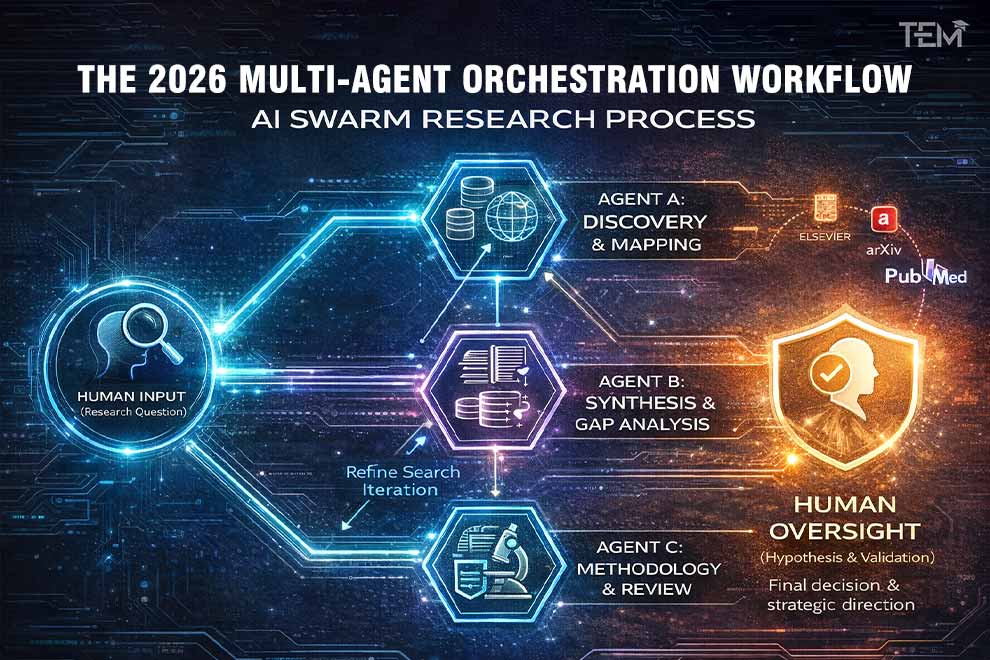
Research rarely happens in isolation. Most projects involve multiple roles: reviewing literature, designing experiments, analyzing data, and interpreting results. AI agents mirror this structure by working as coordinated systems rather than single tools.
In a multi-agent environment, different agents can take on specialized responsibilities. One agent may focus on discovery and literature mapping, another on analysis, and another on synthesis and reporting. A coordinating agent manages the workflow, ensuring each step connects logically.
This model introduces the idea of digital co-scientists. Instead of acting as assistants that wait for instructions, agents collaborate within defined boundaries, continuously improving outputs as new information appears.
Researchers remain central to the process. They set direction, evaluate quality, and make final decisions. The difference is scale. Tasks that previously required weeks of coordination can be explored in parallel, allowing research teams to move faster without reducing rigor.
Agentic Frameworks & Architectures
A new ecosystem of frameworks is shaping how agent-based research systems are built.
Notable 2026 directions include:
- Model Context Protocol (MCP) → standardized context sharing between agents
- Scientific RAG architectures → grounded hypothesis generation
- Persona-based research agents (e.g., PersonaAI style architectures)
- Validator agents for citation verification
- Memory-centric orchestration layers
- Multi-agent coordination frameworks
These frameworks move research infrastructure from “tool stacks” to agent ecosystems. This shift is increasingly powered by the rise of small language models for research, which allow for efficient, localized processing of sensitive academic data within agentic workflows.
Real AI Agent Platforms Used in Research
Research organizations are beginning to experiment with agent-based environments that coordinate discovery, analysis, and synthesis across complex workflows.
Work in research orchestration environments emerging from Microsoft explores agents that manage literature mapping and analytical workflows across complex datasets.
Frameworks developed by OpenAI demonstrate tool-using agents capable of multi-step reasoning, retrieval, and structured research synthesis.
Scientific discovery systems explored by Google DeepMind highlight how agent approaches can support hypothesis exploration and simulation-driven research.
Academic publishing ecosystems, including workflow integrations across Elsevier, are also testing agent capabilities for literature discovery, review support, and knowledge organization.
How AI Agents Will Transform Academic Research
The impact of AI agents is especially significant in universities, where research workflows are complex, time-intensive, and collaborative. This transformation is part of the broader benefits of AI in education, which are reshaping how institutions handle everything from personalized learning paths to complex data orchestration.
For PhD students, early stages such as literature exploration and gap identification may become more dynamic. Instead of static reading lists, students can work with continuously updated research maps that reveal emerging themes and unanswered questions.
For faculty and research teams, agents can support long-term projects by monitoring new publications, comparing methodologies across fields, and identifying interdisciplinary opportunities.
Institutional research offices may also benefit. Using agentic AI frameworks for academia, agents can assist with grant discovery, proposal preparation support, and impact tracking, helping institutions coordinate research strategy more effectively.
Research does not become easier; it becomes more strategic. Researchers spend less time gathering information and more time shaping questions, validating evidence, and interpreting meaning.
Skills such as critical thinking, methodological reasoning, and algorithmic literacy become more important, not less.
Research Disciplines Where AI Agents Are Advancing Fast
1. Life sciences
AI agents support literature synthesis, biomarker discovery exploration, and candidate prioritization.
2. Materials science
Simulation-driven workflows allow agents to explore combinations, compare results, and surface promising directions for experimental validation.
3. Social sciences
Agents assist with large-scale evidence mapping, thematic clustering, and cross-study comparison.
4. Education research
Researchers can track policy changes, emerging methodologies, and intervention outcomes across global literature.
5. Climate and simulation research
Agent coordination helps integrate datasets, models, and scenario analysis, supporting long-term research questions that require continuous updates.
From the Lab: Observations on Agentic Drift
Early experimental deployments reveal subtle but important behaviors:
- Agentic drift: workflows slowly diverge from original research intent
- Non-deterministic outputs: repeated runs may produce different hypotheses
- Citation hallucination in mapping layers, especially in dense literature domains
- Over-optimization toward easily measurable metrics
- Hidden dependency chains between agents
Teams are introducing validator agents, audit trails, and human checkpoints to manage these risks.
This is emerging as a core governance layer in agent-supported research environments.
Governance, Integrity, and the New “AI Validator” Role
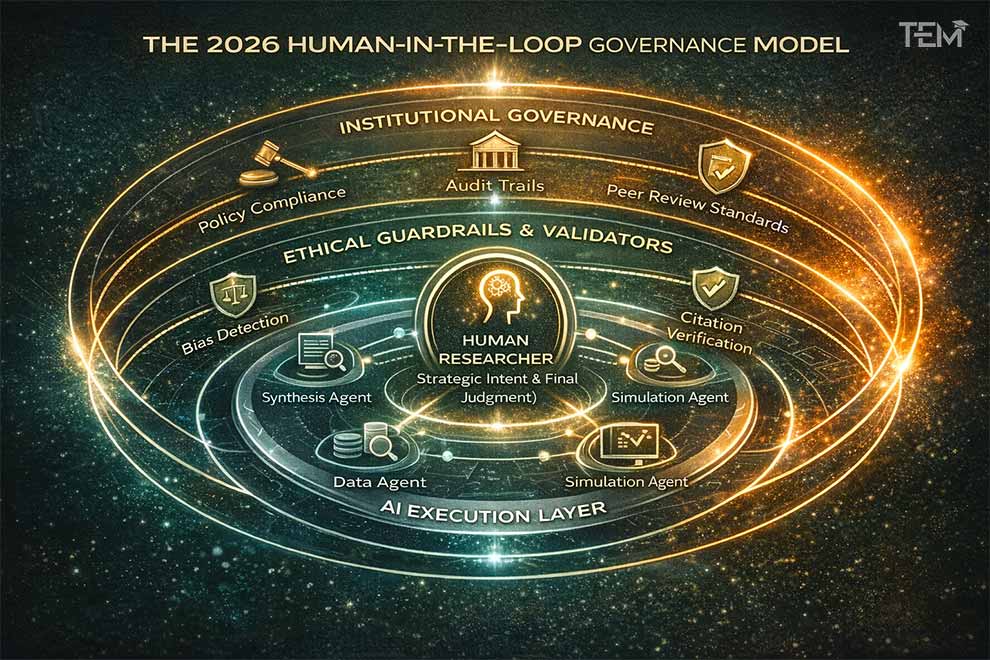
As AI agents take on more responsibility in research workflows, questions of integrity become central. Research depends on trust, reproducibility, and transparent methodology.
AI agents can introduce new risks. These include inaccurate synthesis, hidden bias, unclear attribution, and over-reliance on automated outputs. Because agents can operate across multiple steps, small errors can propagate through an entire workflow.
This is why many institutions are beginning to define oversight roles often described as AI validators or AI guarantors. These roles focus on verifying outputs, documenting how AI systems were used, and ensuring methodological transparency.
Human-in-the-loop oversight becomes a core principle. Agents can accelerate discovery, but researchers remain responsible for validation, interpretation, and ethical use.
Real 2026 Use Cases Already Emerging
In scientific discovery, agents are being used to map complex literature landscapes, helping researchers understand how ideas evolve across disciplines. This allows teams to identify connections that would be difficult to detect manually.
In drug and materials research, agent-driven pipelines can propose candidate combinations, simulate outcomes, and prioritize experiments for human review.
Research teams are also experimenting with autonomous research pipelines that monitor new publications, update knowledge bases, and generate periodic summaries.
Another emerging use case is digital peer-review support. Agents can check references and compare claims with cited evidence.
The Future: How AI Agents Will Change Research Infrastructure
The next stage is not about more powerful tools. It is infrastructure.
As AI agents become more reliable, they move from supporting individual tasks to coordinating entire research environments. Instead of researchers manually connecting databases, analysis tools, and writing workflows, agents can orchestrate these elements as a unified system.
This shift changes how research projects evolve. Literature reviews become continuously updated knowledge layers. Experiments can be simulated and refined before physical testing. Research becomes more iterative and adaptive.
The long-term implication is structural. AI agents move from assistants to a foundational layer of research operations.
What Researchers Should Do Now
The transition toward agent-supported research does not require immediate transformation, but it does require preparation.
Researchers can begin by experimenting with narrow use cases such as literature synthesis, structured summarization, or workflow automation. Starting small helps teams understand strengths and limitations without over-reliance.
Building new skills is equally important. Researchers benefit from understanding how AI systems reason, where errors occur, and how outputs should be validated. Methodological thinking becomes the anchor that ensures quality remains high.
Institutions can support this shift by defining usage guidelines, encouraging responsible experimentation, and investing in shared research infrastructure rather than isolated tools.
The most effective approach is collaborative adoption researchers, technologists, and research leaders working together to shape how agents are integrated into everyday workflows.
The Research Era Shaped by Intelligent Collaboration
Understanding how AI agents will change research is ultimately about understanding how the role of the researcher evolves. The future is not defined by automation replacing expertise. It is defined by intelligent collaboration.
As AI agents handle coordination, synthesis, and monitoring, researchers gain more space for conceptual thinking, methodological rigor, and creative problem solving.
Research will not become automated science. It will become orchestrated science, where humans guide direction, and AI expands capacity.
If this perspective clarified how AI agents will change research, share this article with your research team or academic network to start the conversation.
FAQs
- What are AI agents in research?
AI agents are systems that can plan tasks, use tools, analyze information, and execute multi-step workflows. In research, they help automate literature reviews, support experiment design, and synthesize findings while researchers validate results.
- How will AI agents change research workflows?
Understanding how AI agents will change research starts with workflow transformation. Instead of manually performing each step, researchers can define goals while AI agents coordinate searching, synthesis, analysis, and continuous updates across the research lifecycle.
- Will AI agents replace researchers?
No. AI agents are designed to augment researchers, not replace them. Human expertise remains essential for defining questions, validating outputs, interpreting results, and ensuring research integrity.
- What are the risks of using AI agents in research?
Key risks include inaccurate synthesis, bias, lack of transparency, and over-reliance on automated outputs. This is why human oversight, documentation, and emerging roles such as AI validation are becoming important in research teams.