Walk into any kindergarten classroom, and you will see more than small chairs and colorful walls. You will see the foundation of a child’s academic and emotional journey. Yet not every classroom feels the same. Some spaces are calm and purposeful. Others feel cluttered and reactive.
The difference is rarely the budget. It is the design.
Research in early childhood education shows that classroom layout, learning zones, and daily routines directly influence independence, engagement, and even early math and language development. A well-designed environment reduces behavioral disruptions, strengthens focus, and builds confidence in young learners.
This guide walks you through how to set up an early childhood space that truly works, grounded in research, built for real classrooms, and updated for 2026.
The Science Behind an Effective Kindergarten Classroom
It is not simply arranged. It is engineered for development.
The National Association for the Education of Young Children (NAEYC) emphasizes that classroom environments must align with Developmentally Appropriate Practice (DAP). This means every design choice, from where you place the reading nook to how you label shelves, should reflect how five- and six-year-olds actually grow and process information.
Three research-backed elements shape every effective early childhood space:
1. Space: Children need clearly defined areas for different types of learning. When quiet spaces are separated from active zones, students move and focus more easily.
2. Time: Predictable routines create psychological safety. When children know what comes next, anxiety decreases, and engagement rises.
3. Social Interaction: Seating arrangements shape collaboration. Round tables support small-group learning. Floor meeting areas build community. Calm corners allow emotional reset.
Environmental psychology research also confirms that cluttered or overstimulating classrooms increase cognitive overload in young children. Simplicity and intentional organization are not aesthetic choices; they are learning tools.
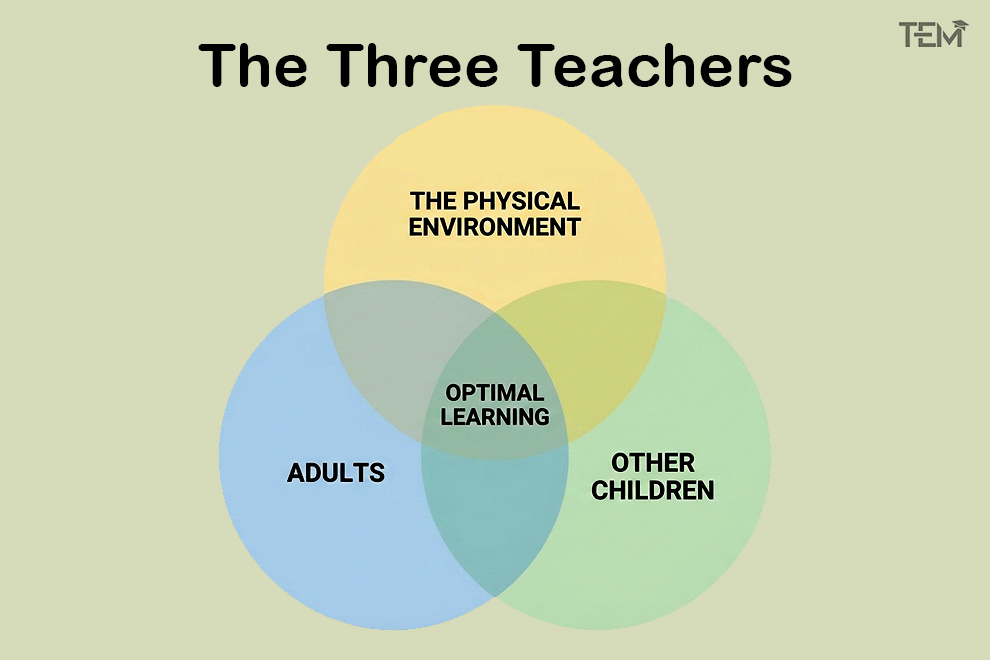
“There are three teachers of children: adults, other children, and their physical environment.” – Loris Malaguzzi, founder of the Reggio Emilia approach
Designing the Ideal Classroom Layout
A strong kindergarten classroom layout answers one central question: How can this space help children become independent learners?
1. Creating Purposeful Learning Zones
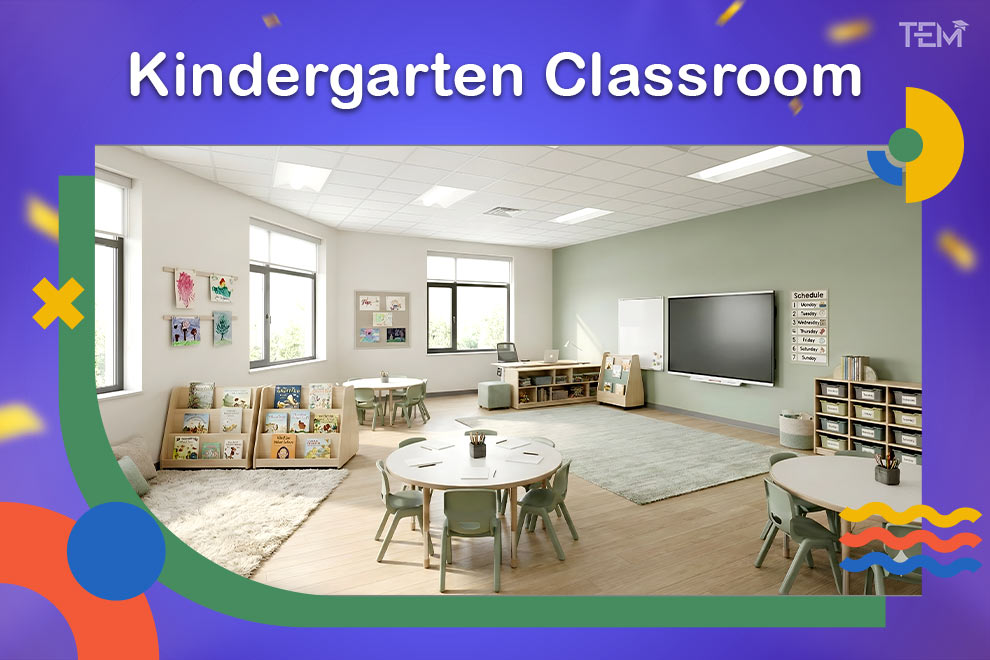
High-quality early learning spaces are divided into intentional learning zones. These zones allow children to explore different skills without confusion or distraction.
The University of Salford’s HEAD Project (Holistic Evidence and Design) analyzed 153 classrooms across 27 primary schools and found that classroom design factors explained 16% of the variation in pupils’ learning progress over a single year, a finding comparable in scale to the effect of teacher quality.
Essential zones include:
- Literacy Nook: A quiet reading corner with accessible books and soft seating.
- Math and Manipulative Center: Hands-on materials for counting, sorting, and building.
- Curiosity or Science Corner: Simple investigation tools that encourage questioning.
- Writing and Art Station: Space for creativity and fine motor development.
- Calm or Regulation Area: A small space for emotional reset and self-regulation.
Materials placed at child height increase autonomy and reduce teacher interruptions throughout the day.
2. Classroom Arrangement for Kindergarten
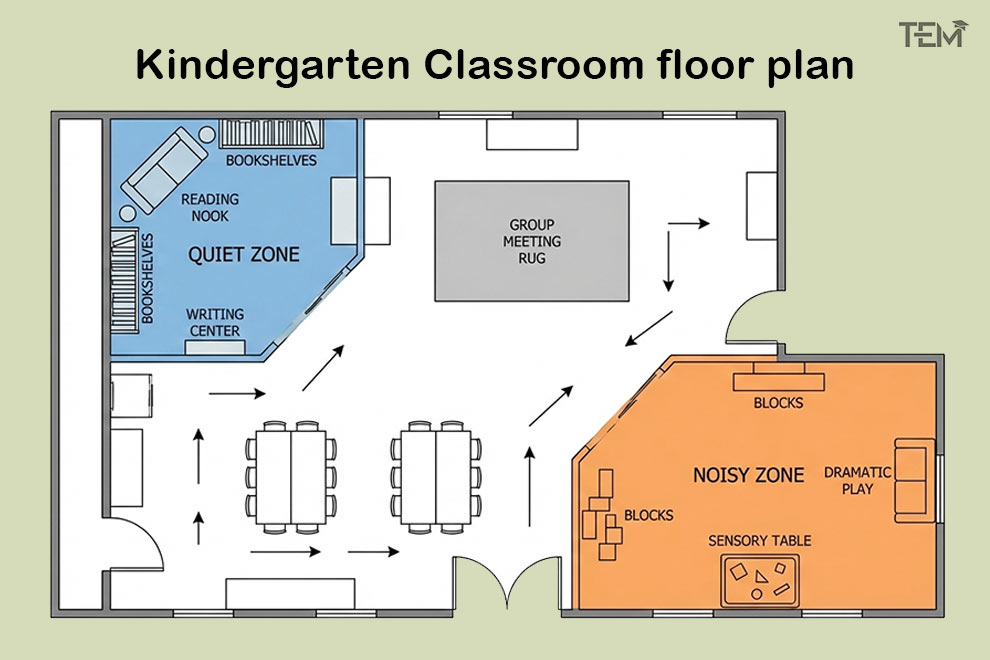
Effective arrangement is not about aesthetics. It is about function. Follow these proven principles:
- Maintain clear teacher sightlines across the entire room
- Keep pathways wide enough for smooth movement during transitions
- Label all storage clearly at the child’s eye level, in both pictures and words
- Separate noisy zones (blocks, dramatic play) from quiet ones (reading, writing)
3. Minimalist vs. Themed Classrooms
Many teachers feel pressure to create visually dramatic classrooms.
Research tells a different story.
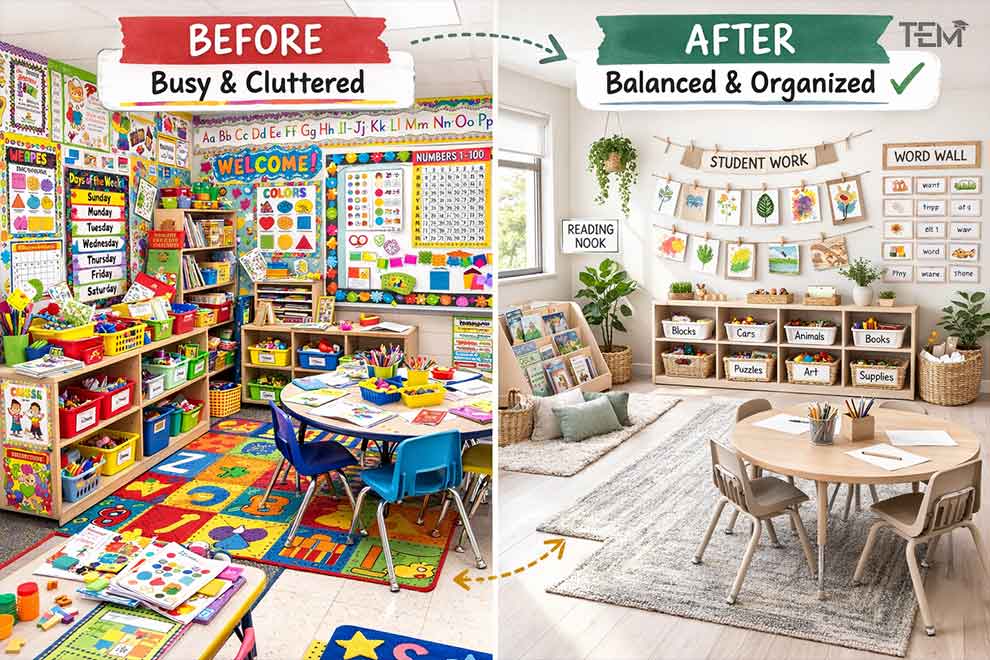
A 2014 study published in Psychological Science by researchers at Carnegie Mellon University found that children in heavily decorated classrooms spent more time off-task (38.6% of the time) than those in simpler ones (28.4%), and scored lower on learning assessments. The researchers noted that excessive or irrelevant displays compete for children’s attention during instruction.
Modern kindergarten classrooms use neutral backgrounds with intentional, student-generated displays. The goal is clarity, not clutter. Purpose should always guide aesthetics.
Guided Play vs Direct Instruction: Finding the Balance
Research from Harvard University and the University of Cambridge now supports a clear finding: the most effective early learning environments are neither pure instruction nor free play.
They use guided play and structured exploration with a clear learning goal.
In guided play, the teacher designs the environment and materials intentionally, then allows children to discover within those boundaries.
The classroom layout makes this possible:
- A math center with pattern blocks encourages spatial reasoning through exploration.
- A literacy nook with puppets supports vocabulary and oral storytelling.
- A science corner with magnifying tools promotes natural inquiry habits.
When the physical environment is designed to guide discovery, children stay engaged while still meeting academic benchmarks. This is the core philosophy behind a high-performing kindergarten classroom in 2026.
Learning Centers That Drive Real Growth
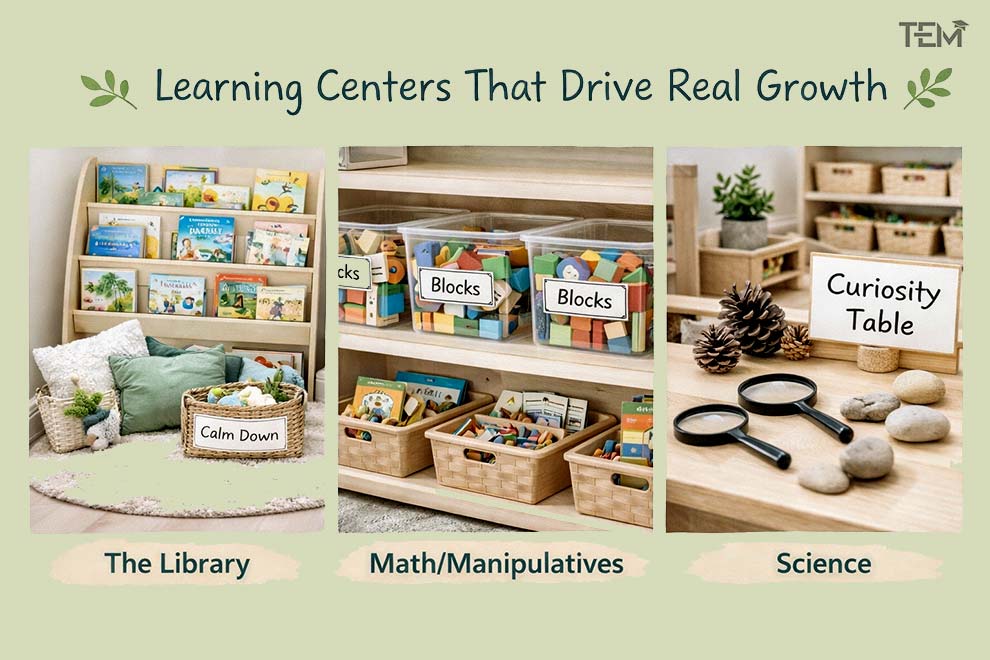
Centers are not just activity stations. They are micro-environments that build specific skills. A well-designed kindergarten classroom includes at least four to six intentional centers.
1. Reading and Classroom Library
A strong classroom library should offer culturally diverse books, clear labels with visual cues, and comfortable seating.
Research from the Scholastic Kids and Family Reading Report found that among 6–8-year-olds, children with access to a robust classroom library are significantly more likely to be frequent readers than those without one. Keep books at the child’s eye level so that literacy feels inviting, not formal.
2. Writing Center
This station builds fine motor development, early sentence formation, and the drawing-to-writing transition. Provide varied tools, pencils, markers, crayons, alongside a simple word wall. When children have a choice in how they write, they write more.
3. Math and Manipulative Center
Physical manipulation strengthens number sense more effectively than worksheets alone. Counting bears, pattern blocks, number cards, and linking cubes give children the hands-on experience their developing brains need to make math concrete and real.
4. Science and Curiosity Zone
Rotate simple materials, such as magnets, leaves, water tools, and rocks, every two to three weeks. Young children are natural investigators. A predictable, safe space to explore builds the observation and questioning habits that support STEM learning for years.
5. Listening and Technology Station
Provide a dedicated physical space with noise-canceling headphones and accessible tablets. Children can record oral stories, illustrate science observations using drawing apps, or use simple coding tools that build sequencing skills.
Classroom Management That Starts with Design
Many behavior challenges are environmental, not personal.
A predictable and structured classroom reduces disruption before it begins.
1. The Greeting at the Door
A 2018 study by Cook and colleagues, published in the Journal of Positive Behavior Interventions, found that when teachers greeted students individually at the classroom door, academic engagement increased by 20 percentage points and disruptive behavior decreased by 9 percentage points, equivalent to adding roughly an extra hour of productive learning across a five-hour school day.
2. Relationship-Repair Practices
In kindergarten, discipline must build skills, not fear. Brief relationship-repair conversations help children understand the impact and rebuild the connection. These conversations are far more effective than punitive responses at this developmental stage.
3. Managing Kindergarten Behavior with Structure
When expectations are embedded in the environment, not just spoken aloud, children can self-regulate more effectively. Practical tools include:
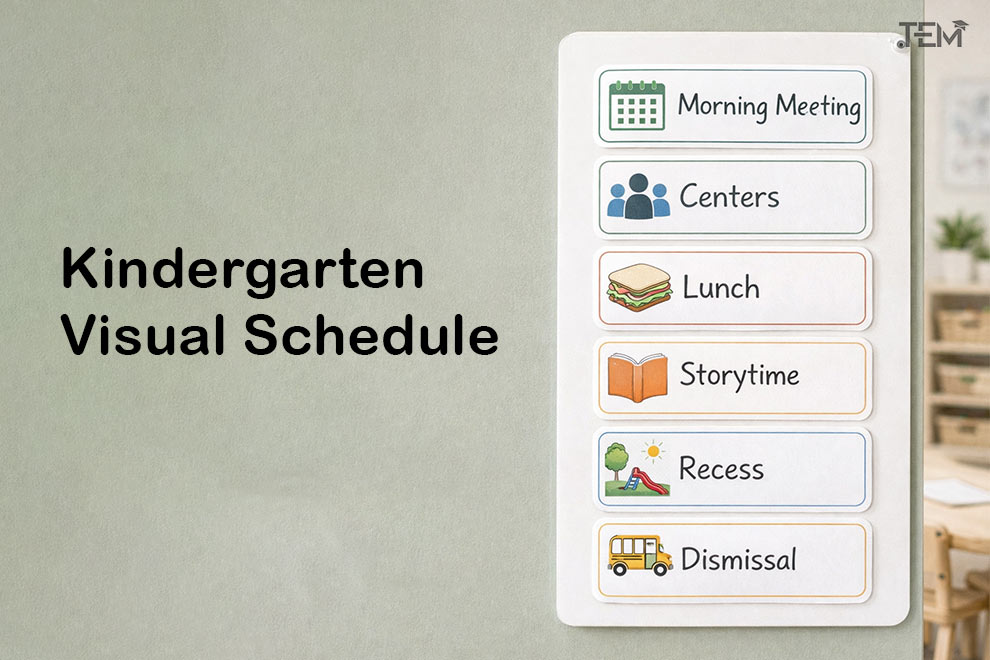
- Visual schedules displayed at child height
- Clear transition signals such as a chime, song, or countdown timer
- Classroom jobs that rotate weekly and build responsibility
- A defined calm-down area stocked with sensory tools and visual coping cards
Building an Inclusive and Neurodiverse-Friendly Classroom
An effective kindergarten classroom works for every child, not just the average learner.
Universal Design for Learning (UDL) encourages teachers to offer multiple ways to engage, understand, and express learning from the very start.
In practice, this means:
- Pairing visual instructions with verbal directions.
- Offering flexible seating, wobble stools, floor cushions, and standing options.
- Keeping visual clutter minimal for children sensitive to overstimulation.
- Using multilingual labels and culturally responsive books for bilingual learners.
- Building structured movement breaks into the daily schedule.
For children with autism or ADHD, environmental predictability is especially critical. Calm-down corners, consistent routines, and sensory-aware design reduce anxiety before it escalates into behavior.
An inclusive classroom does not separate. It anticipates diverse needs and removes barriers before they appear.
Integrating Technology with Purpose
Technology in kindergarten should empower, not distract.
The International Society for Technology in Education (ISTE) emphasizes creation over consumption. Young learners benefit most when technology allows them to build, record, design, or communicate ideas.
In your classroom, this might include:
- Recording and replaying oral storytelling
- Using drawing apps to illustrate a science observation
- Simple coding tools that teach sequencing
- Digital portfolios that showcase student work
Screens should not replace hands-on learning. They should extend it.
Technology becomes powerful when it amplifies curiosity rather than limits it.
Supporting Kindergarten Transitions and Closing Equity Gaps
The move into kindergarten is one of the most significant transitions in a child’s life.
Research shows this transition can widen opportunity gaps if not handled carefully. Children from different socioeconomic backgrounds may arrive with varying exposure to structured routines, print-rich environments, and academic vocabulary.
Classroom design can help bridge that gap from day one. Effective transition supports include:
- Visual daily schedules that reduce uncertainty
- Community-building morning meetings that establish belonging
- Structured arrival routines with independent engagement activities
- Culturally inclusive materials that reflect every child in the room
Equity is not an abstract policy. It begins with how a classroom feels on the first day.
A Sample Day in a Well-Designed Kindergarten Classroom
Predictable flow creates security. Security creates confidence. Here is what a balanced day looks like:
| Time | Block |
| Morning Arrival | Greeting at the door, independent table activity |
| Morning Meeting | Community circle, calendar, and phonics warm-up |
| Literacy Block | Small-group instruction, independent reading, or center rotations |
| Math and Centers | Guided play rotations with teacher-led math mini-lesson |
| Outdoor Play | Gross motor development and natural social interaction |
| Closing | Storytime, quick share, or gratitude circle |
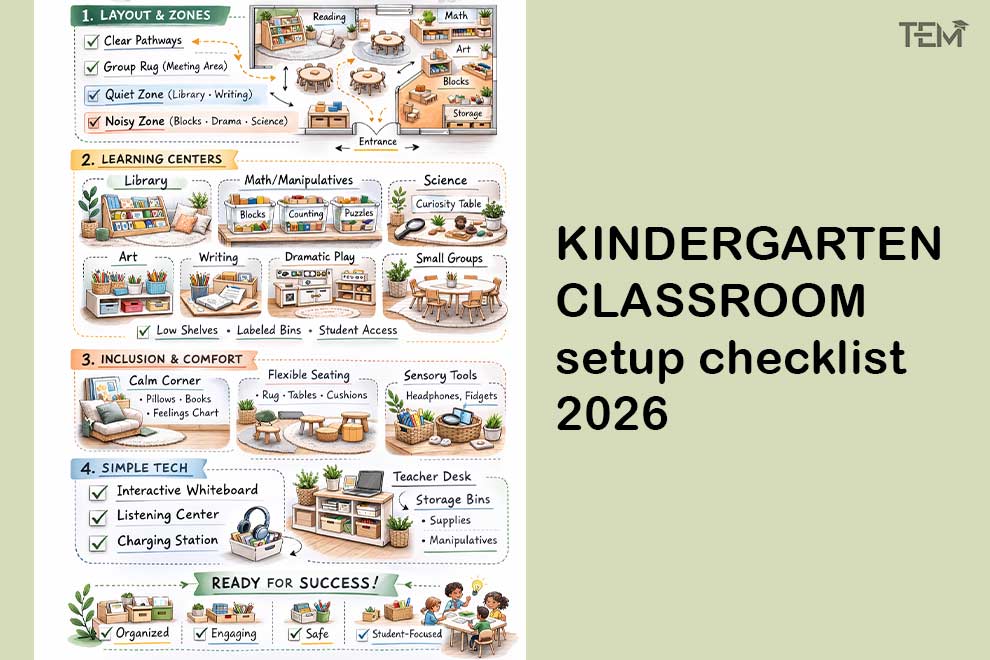
2026 Kindergarten Classroom Setup Checklist
Use this as a starting blueprint:
Layout
- Defined learning zones with clear purposes
- Wide, unobstructed pathways throughout
- Dedicated calm regulation space
Learning Centers
- Classroom library with diverse, accessible books
- Math manipulatives stocked and labeled
- Writing and art supplies at the child’s height
- Rotating science materials updated monthly
Classroom Management
- Visual daily schedule at the child’s eye level
- Classroom jobs system with weekly rotation
- Clear transition signals were established from day one
Inclusion and Equity
- Flexible seating options for diverse needs
- Multilingual labels and culturally responsive materials
- Sensory-aware design with reduced visual clutter
Technology
- Creation-based tools: recording, drawing, basic coding
- Clear usage boundaries and purposeful integration
Intentional setup reduces stress for both teachers and students.
Designing a Classroom That Changes Futures
A kindergarten classroom is more than a room. It is a child’s first experience of belonging within structured learning. When design is guided by research rather than trends, the results extend beyond decoration.
Children gain independence. They build confidence. They learn how to learn.
The strongest classrooms in 2026 are not the loudest or the most themed. They are the most intentional. Every corner, every label, every center serves a purpose.
If this guide helped you rethink your classroom strategy, share it with fellow educators and school leaders. The right environment can shape more than a school year; it can shape a lifetime.
FAQs
- What size should a kindergarten classroom be?
NAEYC guidelines recommend a minimum of 35 square feet of usable indoor space per child. Many state licensing bodies recommend up to 50 square feet per child to allow comfortable circulation, center activities, and flexible instruction. Adequate space reduces behavioral issues and supports diverse grouping arrangements throughout the day.
- How many learning centers should a kindergarten classroom have?
Most well-run classrooms include 4 to 6 structured learning centers. These typically cover literacy, math, writing, science or discovery, and creative arts. The number may vary depending on room size and class enrollment, but each center should serve a clear academic or developmental purpose.
- What is the best seating arrangement for kindergarten students?
Flexible seating arrangements work best in kindergarten. Small-group tables encourage collaboration, while floor meeting areas support whole-class instruction. Seating should allow easy teacher visibility and smooth transitions. Rotating seating during the day also supports engagement and focus.
- How can you make a kindergarten classroom safe and welcoming?
A safe and welcoming space includes predictable routines, clear visual cues, accessible materials, and culturally inclusive displays. Greeting students daily, maintaining organized spaces, and creating calm regulation areas help children feel secure and ready to learn.