The global market for virtual reality in education is projected to grow from $4.40 billion in 2023 to $28.70 billion by 2030. As of 2026, traditional teaching methods are no longer the sole standard as classrooms pivot toward digital-first, experiential models. Modern education now utilizes a combination of Artificial Intelligence (AI) and Virtual Reality (VR) to move beyond passive observation into active participation.
This article explores how these technologies are reshaping the learning experience and why this shift is essential for student success in a digital-aged society.
What is Immersive Learning?
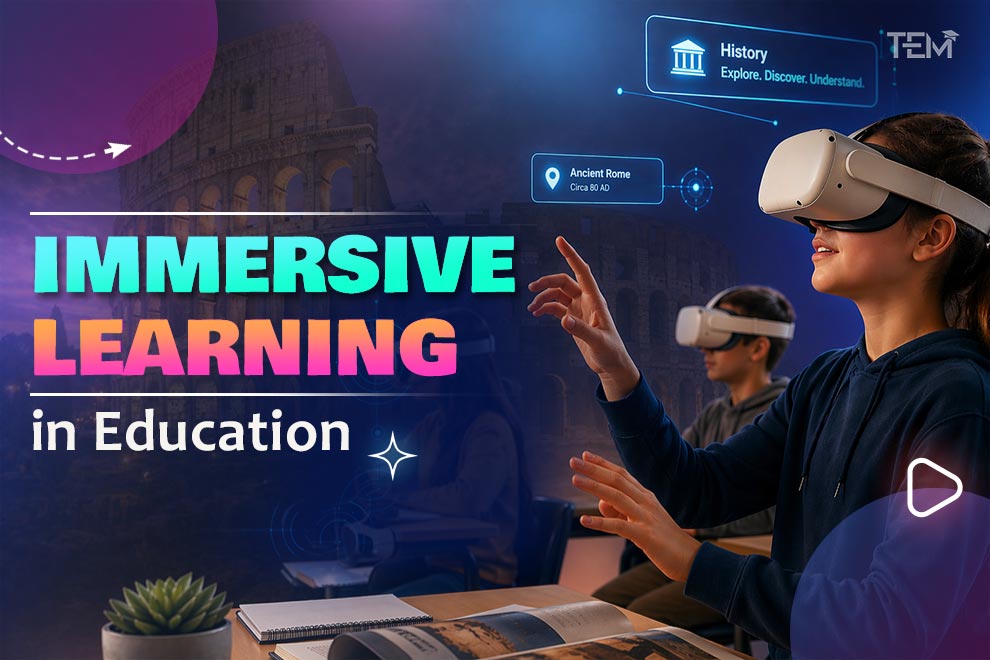
Immersive learning is an educational technique that uses simulated or artificial environments to completely involve students in their subjects. By integrating Virtual Reality (VR), Augmented Reality (AR), and AI-driven simulations, it allows learners to interact with 3D content as if it were physically present.
Traditional Learning vs. Immersive Learning
While traditional learning focuses on listening and reading, often leading to passive engagement, immersive learning prioritizes “doing.”
| Feature | Traditional Learning | Immersive Learning |
| Primary Focus | Listening and reading (Passive) | Experiential “Doing” (Active) |
| Mediums Used | Textbooks, 2D images, and lectures | 360-degree environments and simulations |
| Student Role | Observer | Active Participant |
| Effectiveness | Standard baseline | 76% increase in learning effectiveness |
| Training Speed | Standard classroom pace | Up to 4 times faster than traditional methods |
Immersive Learning Examples for K-12 Students
The application of these Immersive Learning tools varies across subjects, making school more exciting for younger learners.
| Subject | Immersive Example | Core Benefit |
| History | Virtual field trips to Ancient Rome or the Cold War era. | Moving from memorizing dates to “living” the history. |
| Geography | Exploring the Taj Mahal or Antarctic icebergs via photogrammetry. | Building empathy and cultural understanding through “travel”. |
| Language | Simulations of foreign markets to practice vocabulary. | Building confidence and improving pronunciation in a natural context. |
| Math | Using 3D manipulatives to visualize complex geometry. | Supporting learners who struggle with abstract spatial reasoning. |
How AI and VR Are Transforming Classrooms in 2026
By 2026, the synergy between AI and VR has moved from a novelty to a critical piece of school infrastructure. This transformation is driven by several key technological advancements.
AI-Powered Personalized Learning
AI algorithms now analyze student performance in real time within virtual environments. If a student struggles with a specific concept, the AI instantly adjusts the difficulty level or provides alternative explanations. This “personalized Learning beyond imagination” ensures that no student is left behind due to a rigid curriculum pace.
VR-Based Virtual Classrooms
Virtual classrooms allow students from around the globe to gather in a shared digital space. These are not simple video calls; they are hyper-immersive learning environments where students and teachers interact via digital avatars. This bridges the gap for remote learners, providing the social and collaborative benefits of an in-person school from any location.
Real-Time Feedback and Adaptive Systems
In 2026, students don’t have to wait days for a graded paper. While a student performs a virtual chemistry experiment, AI monitors every action. If a mistake is made, the system provides instant feedback, allowing the student to learn from the error immediately rather than repeating it.
Top VR Learning Tools for Schools in the USA (2026)
Several platforms have become the gold standard for American schools in 2026.
- ClassVR: A complete VR/AR system designed specifically for the classroom, including headsets and a central teacher management portal.
- Labster: Provides advanced virtual lab simulations for chemistry, biology, and physics, starting at roughly $69 per month for a full STEM package.
- zSpace: Combines AR and VR elements into a laptop or desktop format, allowing students to “pull” 3D objects out of the screen using a stylus.
- ENGAGE VR: A professional-grade corporate and education platform for holding massive virtual events and persistent virtual classrooms.
- Google StreetView / Wander: Affordable tools that allow students to explore global landmarks for as little as $9.99.
Immersive Learning in STEM Education
STEM (Science, Technology, Engineering, and Math) fields benefit the most from immersion because these subjects often involve abstract or dangerous concepts.
- Virtual Labs: Schools without physical labs can now provide “virtual labs” for physics and chemistry at a fraction of the cost.
- Medical Precision: Surgeons trained in VR make 40% fewer mistakes than those who use traditional methods.
- Engineering: VR allows for a 10% reduction in time to market for engineering projects by allowing designers to build and test prototypes in a digital twin environment.
- Robotics: AI integration allows students to code robots in a virtual space and see the physical laws of motion applied instantly without needing expensive hardware.
Benefits of Immersive Learning in Education (2026 Update)
The shift toward these Immersive Learning technologies is backed by significant data regarding student outcomes and emotional connection to the material.
- Better Student Engagement: VR immerses users so deeply that distractions are almost entirely removed. VR-trained learners are 1.5 times more focused than classroom learners.
- Improved Knowledge Retention: Immersive experiences engage multiple senses, making learning memorable. Students report feeling 3.75 times more emotionally connected to VR content than traditional classroom material.
- Safe Experiential Learning: Students can practice high-risk tasks, such as handling volatile chemicals or performing surgery, in a risk-free environment.
- Increased Confidence: Learners who use VR demonstrate up to a 275% increase in confidence to apply what they have learned in real-world scenarios.
- Accessibility: AI can convert text to audio or provide detailed descriptions for visually impaired students, making the “classroom of the future” more inclusive than ever.
Benefits of Immersive Learning in Classrooms
Beyond individual statistics, the classroom dynamic itself changes when AI and VR are introduced.
1. Improved Teacher-Student Interaction
Teachers are no longer just lecturers; they become facilitators and guides. By using Mixed Reality, a teacher can project a 3D model of a human heart above a desk, leading a group discussion where every student can see and interact with the same hologram.
2. Collaborative Learning Environments
Virtual spaces foster a “stronger peer collaboration” where students work together to solve complex problems in 3D environments. Collaborative Learning develops essential soft skills like communication and teamwork, with 95% of participants stating VR helped them prepare for real-world social interactions.
Challenges of Immersive Learning
While the technology is transformative, Immersive Learning is not without hurdles.
- High Hardware Costs: High-end headsets remain expensive, though costs are dropping. Some schools use “immersion carts” to share a single set of devices across multiple classes.
- Teacher Training: Educators must be trained not just on how to use the goggles, but on how to integrate them into a pedagogical framework.
- Physical Concerns: Issues like motion sickness and the need for frequent sanitization of shared equipment remain an ongoing management task.
- Connectivity: Under-resourced districts may struggle with the Wi-Fi bandwidth required to stream high-quality 3D content.
Future of Immersive Learning
Looking toward 2030, the metaverse will likely become the standard for global education. We will see “personalized AI mentors” that stay with a student throughout their entire K-12 journey, adapting to their evolving learning style. As Mark Zuckerberg has emphasized, the metaverse is about creating a sense of “presence”, where users feel like they are truly inside an experience. This concept is now being applied to education through immersive learning.
Headsets will continue to become lighter, more comfortable, and eventually as common as tablets are today.
Conclusion
The integration of How AI and VR Are Transforming Classrooms in 2026 marks a permanent shift in the educational landscape. By prioritizing experience over observation, immersive learning is solving long-standing issues of student disengagement and knowledge gaps. While challenges like cost and teacher training remain, the data is clear: students learn faster, remember longer, and feel more connected to their education when they are part of the story. As these tools become more affordable and AI becomes more intuitive, the classroom of the future will be limited only by our imagination.
FAQ
- What is immersive learning in education?
Immersive learning in education is a method that uses VR, AR, and AI to place students inside a digital environment where they can interact with the subject matter directly.
- How does VR help students learn better?
VR helps students learn better by removing distractions, increasing emotional connection to the content, and allowing for “hands-on” practice of complex or dangerous tasks safely.
- What are examples of immersive learning?
Common examples of immersive learning include virtual field trips to historical sites, virtual science labs, and language learning simulations.
- Is immersive learning effective for K-12 students?
Immersive learning has been effective for K-12 students been shown to increase confidence by up to 275% and significantly improve retention and engagement in younger learners.