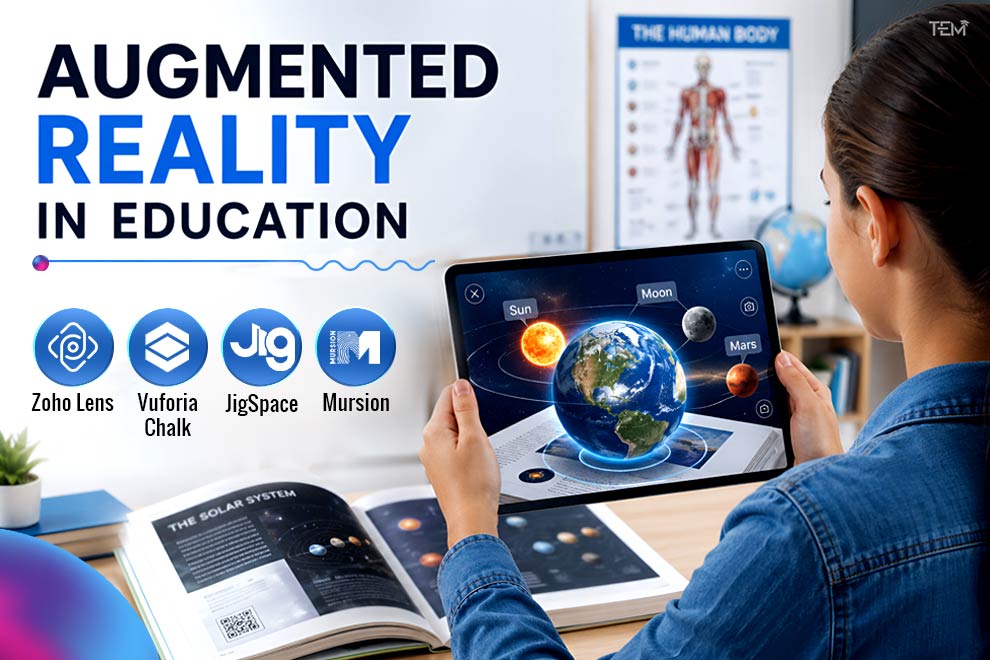
By 2026, the global market for augmented reality in education and training is projected to reach a staggering $78.76 billion, growing at an annual rate of nearly 49%. This explosive growth signals a permanent shift in how we learn, moving away from static textbooks toward dynamic, interactive environments. Digital overlays are no longer just “cool” additions to a lesson; they are essential tools that bridge the gap between theoretical study and real-world application.
This article provides a comprehensive look at the state of augmented reality in education today. We will define how this technology differs from virtual reality, explore its most significant benefits, such as a 90% improvement in vocabulary retention for young learners, and review the industry-leading tools currently used in schools and corporations. From K-12 interactive flashcards to high-stakes surgical simulations, you will see how AR is transforming classrooms into “living” labs where every student has a front-row seat to the invisible world.
What is Augmented Reality?
At its simplest, augmented reality (AR) is a technology that overlays digital information such as images, sounds, or 3D models onto the real world through a camera lens. Unlike technologies that create a completely fake environment, AR keeps you grounded in your actual surroundings while adding helpful digital “layers” to it.
In a learning context, AR works by using a device like a smartphone, tablet, or smart glasses to scan a specific trigger, such as a page in a textbook. The device then displays a 3D animation or video on top of that page.
Augmented Reality in Education: An Overview
The integration of augmented reality in education and training has become a cornerstone of modern teaching. In 2026, teachers use AR to make abstract concepts tangible. Instead of just reading about the solar system, students use mobile apps to “place” planets on their desks to see the relative scale and orbit in real-time.
This technology is rarely used in isolation. augmented reality in education now integrates seamlessly with AI to provide personalized feedback and connects with IoT devices in smart classrooms. Whether it is K-12 students using AR flashcards or professionals practicing high-stakes repairs in a factory, AR provides a safe, repeatable, and highly engaging way to master new skills.
Augmented Reality vs Virtual Reality in Education
While often grouped together as immersive tech, augmented reality vs virtual reality offers two very different experiences.
| Feature | Augmented Reality (AR) | Virtual Reality (VR) |
| Immersion | Blends digital items with the real world. | Completely shuts out the real world. |
| Hardware | Smartphones, tablets, or AR glasses. | Specialized headsets like Meta Quest. |
| Cost | Generally lower; works on existing devices. | Higher; requires expensive headsets and PCs. |
| Accessibility | High; easy to use in standard classrooms. | Moderate; requires dedicated space and setup. |
| Best Use Case | Interactive textbooks, anatomy, and field trips. | Flight sims, deep-sea diving, space travel. |
The choice of augmented and virtual reality in education usually comes down to whether you want to enhance the real world (AR) or leave it entirely (VR).
Benefits of Augmented Reality in Education
The advantages of augmented reality in education go beyond the “cool” factor. Educators see measurable improvements in how students process information.
1. Improved Student Engagement
AR turns passive observers into active participants. When lessons come to life in 3D, students stay focused longer and feel more motivated to explore the subject.
2. Visualization of Complex Concepts
3D models help students grasp spatial relationships in biology, chemistry, and engineering that flat 2D images in a book simply cannot show.
3. Interactive Learning Experience
Students can manipulate virtual objects. They can “take apart” a virtual engine or “dissect” a digital frog, leading to learning by doing rather than just listening.
4. Increased Retention Rates
Immersive experiences create stronger mental “hooks.” Students are more likely to remember a historical event if they “saw” it happen in their own classroom via AR.
5. Safe Practical Training
In vocational fields, AR allows students to practice dangerous tasks, like high-voltage electrical wiring, without any physical risk of injury.
Real-World Augmented Reality Examples in Education
To understand the impact, look at these examples of augmented reality in education across different sectors:
1. K-12 Education
In primary and secondary schools, AR removes the “flatness” of traditional learning materials. Research into AR-based flashcards for early readers shows a 90% feasibility and effectiveness rate in improving science literacy and reading skills among elementary students.
- Interactive Textbooks: Students scan a history book to see a 3D battle map or a science book to watch a volcano erupt.
- AR Flashcards: Young learners use cards that come to life with talking animals or 3D letters to improve phonics and vocabulary.
2. Higher Education
In universities, augmented and virtual reality in education allow students to practice expensive or dangerous tasks without real-world consequences.
- Medical Training: Pre-med students use tablets to perform virtual dissections or study the nervous system in 3D without needing a cadaver.
- Engineering Simulations: Students can view the internal workings of a jet engine or a bridge structure virtually to identify stress points.
3. Corporate Training
In the professional world, augmented reality in education and training is used to speed up the onboarding process and reduce costly mistakes on the job.
- Skill-Based Modules: Companies like Boeing use AR to guide technicians through complex aircraft wiring, reducing errors by 50%.
- Remote Assistance: Tools like Zoho Lens allow experts to draw digital instructions directly onto a trainee’s view via a smartphone camera.
Real-Life Case Study: The “Magic” of the Merge Cube
A popular real-life example in schools today is the Merge Cube. This is a physical, foam cube that, when viewed through an AR app on a smartphone, transforms into any object imaginable.
The Example: In a biology class, instead of looking at a picture of a human brain, each student holds a Merge Cube. Through their screens, the cube “becomes” a pulsating 3D brain. Students can rotate it in their hands, peel back layers to see the cerebellum, and click on different regions to read about their functions. This turns a complex, abstract organ into a tangible object they can literally hold, leading to much higher engagement and 91% higher media validation scores from teachers.
Popular Augmented Reality Tools for Education (2026)
As we move through 2026, several platforms have emerged as leaders in the EdTech space. These tools focus on ease of use and curriculum alignment, helping institutions manage a market that is now growing at a staggering rate of 48.6% annually. With the industry projected to reach a value of $78.76 billion this year, these platforms are shifting from “experimental” to “essential.”
1. Zoho Lens
Zoho Lens is a top choice for vocational training and technical education. It allows for real-time AR annotations and collaborative brainstorming between teachers and students. A remote expert or teacher can view a student’s live camera feed and draw digital arrows or text directly onto physical equipment to guide them through a repair.
- Free Version: The free version is limited to one user and stores session recordings for only seven days.
- Paid version: The paid version costs approximately $6 to $10 per user per month. This plan unlocks unlimited recording storage and custom branding, making it suitable for departments and vocational colleges.
2. Vuforia Chalk
Great for technical education and engineering, Vuforia Chalk combines live video with “digital ink.” It lets instructors “draw” instructions in a student’s physical space remotely using a smartphone or tablet. The unique part is that the digital marks “stick” to the physical object even if the student moves their camera away and back again.
- Free Version: Vuforia offers a Basic Plan for free, but it is intended primarily for prototyping and lacks the “Multi-Expert” and desktop collaboration features.
- Paid version: While educational pricing is often quote-based, commercial plans for similar remote assistance tools typically start around $20 to $25 per user per month. Higher-tier “Premium” licenses are required for students to use hands-free devices like RealWear glasses.
3. JigSpace
JigSpace is a powerful tool for creating and sharing 3D, step-by-step augmented reality presentations called “Jigs.” It is widely used for school homework, professional training, and engineering. It allows students to “deconstruct” complex structures, such as a jet engine or a virus, by viewing them from all sides in their physical space.
- Free Version: The free version allows users to create 1 Jig at a time, with a maximum of 3 steps viewable to others. It also restricts access to the full object library and advanced creator tools.
- Paid version: Paid plans unlock unlimited Jigs and steps. While enterprise pricing is customized, individual Starter plans in 2026 generally begin at $10 to $15 per month, offering expanded object libraries and password protection for shared content.
4. Mursion
Mursion is a unique platform that helps new teachers practice classroom management by using AR avatars that act like students in a simulation. These simulations are so effective that 94% of users report they feel relevant and authentic to real-world challenges. It allows educators to practice difficult conversations or classroom disruptions in a 100% safe, virtual space.
- Free Version: Mursion does not have a public “forever free” tier for individuals. It is built for institutional use and usually requires a scheduled demo or pilot program.
- Paid version: A typical entry-level package for teacher candidates starts at $149 to $169 per learner, which includes private practice sessions and access to a library of over 100 field-tested scenarios.
Challenges of Augmented Reality in Education
Despite its potential, implementation is not always easy. Schools still face several hurdles that prevent AR from being everywhere:
- Cost of Implementation: While software is getting cheaper, high-end AR glasses still range from $600 to $3,000 per unit.
- Device Dependency: Not every student has a high-end smartphone capable of running smooth AR, which creates an “equity gap”.
- Teacher Training: Many educators feel overwhelmed by the tech and need professional development to use it effectively in a lesson plan.
- Content Limitations: Creating high-quality 3D models is time-consuming and expensive, leading to a shortage of AR content for specific subjects.
Future Trends of Augmented Reality in Education (2026 & Beyond)
The future of learning is becoming increasingly “blended,” where the physical classroom and digital data exist in the same space. Microsoft CEO Satya Nadella has long championed this vision. During a high-profile 2017 visit to India, he spoke at a tech event in Bangalore about the intersection of AI and mixed reality. During his talk, Nadella famously remarked, “I feel that Augmented reality is perhaps the ultimate computer”.
He explained that as the technology matures, the “ultimate computer” will allow users to switch seamlessly between a clear view of the real world and a fully immersive experience. Fast forward to January 2026, Nadella expanded on this in a new personal blog post titled “Looking Ahead to 2026,” where he noted that we have moved past the “novelty phase” and into a phase of “widespread diffusion”.
- AI + AR Integration: AI assistants will live inside AR glasses, providing real-time hints to students as they solve math problems or conduct chemistry experiments.
- Wearable AR Devices: As glasses become as light as traditional frames, the concept of a “device” will fade, and digital info will be part of our natural vision.
- Metaverse Learning: Students from across the globe will meet in persistent AR “hubs” to collaborate on 3D projects in a shared digital space.
- Emotion-Aware Assistants: AR avatars will soon recognize when a student is frustrated and adjust the difficulty of a task automatically.
Conclusion
Augmented reality in education has evolved from a flashy gimmick into a powerful tool for deep, experiential learning. By 2026, it will have become clear that being able to visualize the invisible, whether it is a microscopic cell or a distant galaxy, changes how we retain knowledge. While challenges like cost and training remain, the move toward immersive, AI-powered classrooms is inevitable.
As Tim Cook noted during that session, AR will happen in a big way, and once it does, “we will wonder… how we ever lived without it,” much like how we wonder today how we lived without our smartphones. More recently, in March 2026, Cook reiterated during an interview at New York’s Grand Central Terminal that while the iPhone remains central to our lives, the integration of AR and AI-driven experiences is the new frontier for how we work and learn.
FAQs
- Is augmented reality in education expensive to start?
Augmented reality in education is not necessarily expensive to start. While high-end glasses are pricey, many schools start with free or low-cost apps that run on existing tablets and smartphones.
- Can augmented reality replace teachers?
No. Augmented reality can’t replace teachers a tool meant to complement the curriculum. It works best when a teacher guides the experience and provides context for the digital overlays.
- Does augmented reality work for remote learning?
Yes. Augmented reality works for remote learning because it allows students to conduct “lab work” or view 3D models at home using their own mobile devices.
- What is the difference between AR and VR?
The difference between AR and VR, AR adds digital elements to your real-world view, while VR replaces the real world with a simulated environment.