Future engineering careers in smart factories involve integrating engineering knowledge with automation, robotics, digital manufacturing, data, and quality systems. The factory floor is no longer only a place of manual machines and paper checklists. It is becoming a connected environment where sensors detect problems, robots perform repetitive tasks, and engineers use real-time data to improve production.
This change matters for students because manufacturing is becoming more technical, more digital, and more connected. The International Federation of Robotics reported that 542,000 industrial robots were installed in 2024, bringing the worldwide total to 4.66 million units. That growth shows how quickly factories are changing.
Students do not need to master every technology at once. But they should understand the main systems shaping modern industry: smart factories, CNC machines, motion control, robotics, sensors, production data, and quality control.
What Is a Smart Factory?
A smart factory is a manufacturing environment where machines, software, sensors, people, and production data work together to improve speed, quality, safety, and decision-making. It is important for engineering students because it shows how modern factories combine physical equipment with digital systems.
The main idea behind a smart factory is connection. Machines collect information. Sensors measure activity. Software organizes the data. Engineers use that data to make better decisions about production, maintenance, quality, and efficiency.
A smart factory is not a factory without people. It still needs engineers, technicians, quality specialists, automation experts, and managers. The difference is that these people work with smarter tools.
Main features of a smart factory include:
- Connected machines that share production information
- Industrial sensors that monitor equipment and materials
- Robotics and automation that handle repeated tasks
- Real-time production data that supports faster decisions
- Quality control systems that reduce defects
- Predictive maintenance that helps prevent machine failure
- Digital planning tools that connect design and production
Why Should Engineering Students Care About Smart Factories?
Engineering students should care about smart factories because many future jobs in manufacturing, robotics, automation, industrial software, and quality control will depend on them. Traditional engineering knowledge remains valuable, but employers increasingly seek graduates who can understand both machines and digital systems.
A mechanical engineering student may need to understand materials, tolerances, and machine design. An electrical engineering student may need to understand motors, controls, and sensors. An industrial engineering student may need to understand process flow, safety, productivity, and waste reduction.
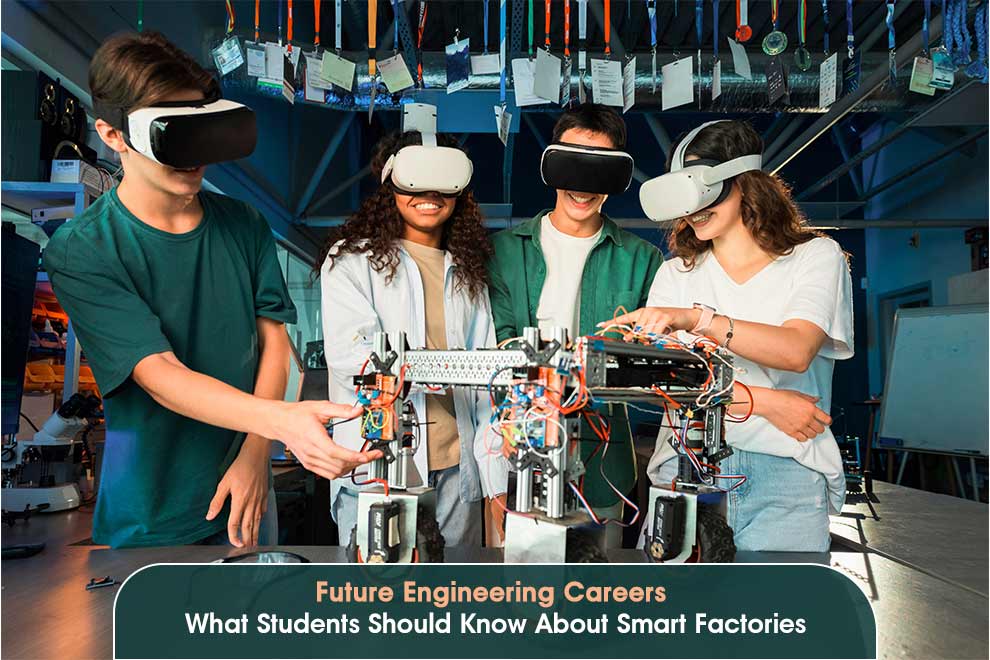
Smart factories bring all of these skills together. A modern production line might include a robot arm, a CNC machine, a conveyor system, a vision inspection camera, and a dashboard showing live factory data. Students who understand how these systems connect can become more valuable in the job market.
What Technologies Are Used in Smart Factories?
Smart factory technologies are tools and systems that help factories collect data, automate work, control machines, inspect products, and improve production. These technologies matter because they form the base of many future engineering careers.
A smart factory is not built around one machine. It is a system. A robot may move a part. A sensor may confirm that the part is in the right place. A controller may send motion commands. A quality system may record whether the finished part passed inspection.
Important smart factory technologies include:
- Industrial robots, which perform repeated production tasks with speed and accuracy
- CNC machines, which use computer instructions to cut, bend, drill, mill, or shape materials
- Motion control systems, which control speed, position, torque, and movement
- Industrial sensors, which measure pressure, temperature, vibration, motion, and part presence
- IoT platforms, which connect machines to shared data systems
- Artificial intelligence, which helps predict failures and improve decisions
- Quality inspection systems, which check whether products meet required standards
CNC Machines
CNC machines are computer-controlled machines that follow programmed instructions to cut, bend, mill, drill, punch, or shape materials. They are useful in smart factories because they turn digital designs into physical parts with repeatable accuracy.
The working principle is simple: a program tells the machine where to move, how fast to move, and what action to perform. Students may see CNC technology in milling machines, turning centers, laser cutters, punching machines, and press brakes.
In sheet metal production, CNC press brake machines help factories bend metal parts with controlled force, angle, and repeatability. This makes CNC knowledge useful for students interested in mechanical design, manufacturing engineering, automation, and production management.
Motion Control Systems
Motion control is a technology that controls how machines move, including their speed, position, torque, timing, and acceleration. It is important in smart factories because automated equipment depends on precise movement.
The working principle is based on command-and-feedback. A controller sends instructions to a drive. The drive powers a motor. A sensor or encoder reports movement back to the system. The system then adjusts the motor so the machine moves correctly.
Students who want to understand robotics, conveyors, packaging systems, CNC equipment, and automated machinery should study what is motion control. Motion control knowledge can support careers in robotics, machine building, aerospace systems, factory automation, and advanced equipment design.
Which Engineering Careers Are Growing Because of Smart Factories?
Smart factory careers are engineering and technical roles focused on designing, operating, improving, maintaining, and managing connected manufacturing systems. These careers matter because students often hear about automation without knowing what jobs it creates.
Some roles are close to machines. Others are closer to data, software, process improvement, or quality. The strongest students often become the ones who can move between these areas. They can talk to a technician about a machine fault, read a production chart, understand a robot cell, and explain how downtime affects cost.
Common smart factory career paths include:
- Automation engineer who designs and improves automated systems
- A robotics engineer who works with industrial robots and robotic cells
- Manufacturing engineer who improves equipment, methods, and workflows
- Mechatronics engineer who combines mechanical, electrical, and software knowledge
- A quality engineer who makes sure products meet standards
- An industrial data analyst who studies factory data to improve decisions
- Maintenance and reliability engineer who prevents machine failures
- Process engineer who improves how materials, machines, and workers move through production
What Skills Do Students Need for Smart Factory Careers?
Smart factory skills are the technical and practical abilities students need to work with modern manufacturing systems. A student who understands machines but avoids data may struggle. A student who understands software but ignores motors, materials, tools, and tolerances may also struggle.
The best preparation combines hard skills and soft skills. Hard skills help students understand equipment, controls, inspection, and production systems. Soft skills help them explain problems clearly and work with people from different departments.
Students should build these skills:
- Learn the mechanical basics, including machines, tools, materials, tolerances, and production equipment.
- Study the basics of electrical and control systems, including motors, sensors, drives, panels, and safety circuits.
- Practice programming or data analysis with beginner-friendly tools
- Understand manufacturing processes, including cutting, forming, assembly, testing, and inspection.
- Develop knowledge of quality control, including standards, reports, sampling, and corrective actions.
- Build problem-solving experience through labs, internships, clubs, and personal projects.
- Communicate clearly with engineers, technicians, suppliers, operators, and managers.
Quality Control Skills
Quality control is the process of checking whether products, parts, suppliers, and production steps meet required standards. It is important in smart factories because fast production is only valuable when the final product is reliable.
The working principles of quality control include measurement, inspection, documentation, testing, sampling, supplier review, and corrective action. In a connected factory, quality data can show patterns that humans may not notice immediately. For example, a defect may appear only after a tool begins to wear or after a machine setting drifts.
Students who understand inspection reports, tolerances, supplier checks, and factory audits can become more useful in manufacturing teams. A quality control expert can also help companies understand product inspections, supplier reviews, and factory audit processes when production involves outside manufacturers.
Smart Factory Careers vs Traditional Factory Careers
Smart factory careers focus more on connected systems, automation, data, and continuous improvement, while traditional factory careers focus more on manual operation, isolated machines, and experience-based troubleshooting. Both still matter.
In a traditional factory, an operator may notice a problem by sound, feel, or visual inspection. In a smart factory, that same issue may also appear as a vibration alert, dashboard warning, or quality trend. Human skill is not removed. It is supported by better information.
| Factor | Traditional Factory Career | Smart Factory Career |
| Main focus | Operating machines | Improving connected systems |
| Machines | Isolated equipment | Connected CNC machines, robots, and sensors |
| Data use | Manual records | Real-time production data |
| Skills | Mechanical experience | Mechanical, electrical, software, and data skills |
| Problem-solving | Observation and experience | Observation, experience, and data |
| Career growth | Skilled trades | Hybrid technical roles |
What Are the Benefits of Smart Factory Careers for Students?
Smart factory careers offer job relevance, transferable skills, technical growth, and stronger problem-solving experience. These benefits matter because students are not only choosing a first job. They are building a foundation for long-term career movement.
There are six main benefits of smart factory careers for students:
- Open access to high-demand jobs in manufacturing, robotics, automation, and industrial systems
- Build transferable skills across automotive, aerospace, electronics, energy, logistics, and medical devices.
- Increase earning potential by specializing in controls, robotics, and quality systems.
- Improve problem-solving by working with real machines, real limits, and real production data.
- Support safer workplaces by reducing repetitive or risky manual tasks.
- Create niche opportunities in motion control, industrial inspection, predictive maintenance, and smart equipment design.
What Are the Challenges of Preparing for Smart Factory Careers?
Preparing for a smart factory can be difficult because students must learn across several fields and connect theory with practice. The opportunity is real, but it is not effortless. These careers sit at the intersection of mechanics, electronics, software, data, quality, and human decision-making.
There are five main challenges students should expect:
- Require learning across multiple fields rather than just one subject.
- Create pressure to understand both hardware and software.
- Demand practical experience that may not always be available in classrooms
- Limit beginners who study theory without hands-on projects
- Confuses students because automation, mechatronics, manufacturing, and industrial data roles often overlap.
How Can Students Prepare for Smart Factory Jobs?
Students can prepare for smart factory jobs by learning manufacturing basics, studying automation, practicing data skills, building projects, and connecting classroom theory with real production problems. The process should be practical and steady, not overwhelming.
There are seven steps students can follow:
- Study the basics of manufacturing, including materials, machines, tools, tolerances, and production flow.
- Learn the fundamentals of automation, including sensors, motors, controllers, robotics, safety systems, and machine communication.
- Practice programming or data analysis through simple projects.
- Build hands-on experience through labs, student clubs, internships, capstone projects, or personal experiments.
- Learn how quality control works through inspection reports, sampling, supplier evaluation, and corrective action.
- Follow industry examples involving CNC machinery, motion control, robotics, predictive maintenance, and inspection systems.
- Create a small portfolio that shows projects, diagrams, results, lessons learned, and problems solved.
Conclusion
Smart factories are changing engineering careers by integrating machines, data, automation, robotics, quality control, and human judgment into a single production environment. For students, this change should feel less like a threat and more like a roadmap.
The future engineer will not only design parts or maintain machines, but also develop new technologies. The future engineer will understand how machines communicate, how production data reveals problems, how inspection protects quality, and how people still make the system work.
Students can start with the basics. Learn how machines operate. Study sensors and motion. Understand CNC equipment. Practice simple data skills. Pay attention to quality control. Then connect those skills through projects and internships.
Smart factories need people who can think clearly, learn quickly, and solve real problems. That is exactly the kind of engineer students can become.