A college degree is no longer the only path to financial success. Today, employers across technology, skilled trades, healthcare support, transportation, and digital services increasingly hire based on skills, certifications, portfolios, and real-world experience. Whether you’re entering the workforce, changing careers, or looking to increase your income without returning to college, there are more opportunities than ever before.
Choosing a vocational, tech, or specialized route allows you to avoid massive student loan debt while building a career in a high-demand sector.
What are the highest-paying jobs without a degree?
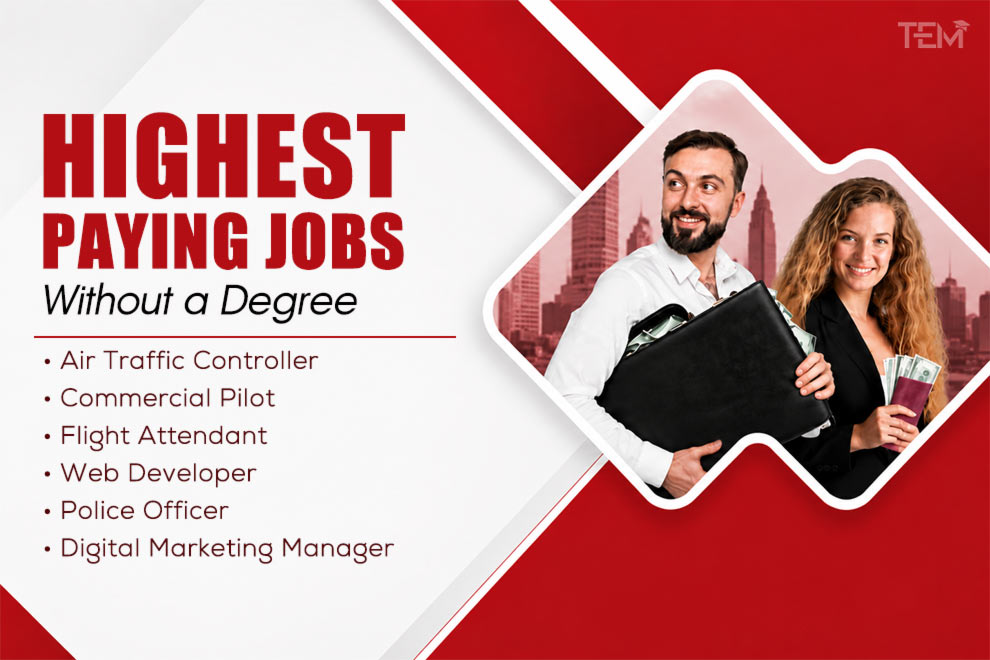
The most lucrative careers accessible without a four-year college degree include:
- Elevator and Escalator Installer & Repair
- Electrical Power-Line Installer & Repairer
- Air Traffic Controller
- Commercial Pilot / Flight Attendant
- Digital Marketing Manager / Web Developer
- Detective & Criminal Investigator / Police Officer
Note: While a university diploma isn’t necessary, these premium-paying careers are not “unskilled.” Most require professional certifications, structured apprenticeships, state licenses, or extensive hands-on experience rather than simply a high school diploma.
Key Takeaways
- Skills Over Stamps: Many six-figure careers completely bypass the traditional bachelor’s degree requirement.
- Credential Substitution: Industry-recognized certifications and vocational licenses frequently replace years of formal college education.
- Resilient Sectors: Skilled trades and practical technical fields remain among the highest-paying, most stable industries in the modern economy.
- Proof over Paper: Real-world portfolios and verifiable experience usually matter significantly more to prospective employers than a diploma.
Can You Really Earn Six Figures Without College?
The short answer is yes, but it is vital to separate myth from reality.
- The Myth: You can walk into a high-paying corporate office fresh out of high school with zero training and immediately secure a six-figure salary.
- The Reality: Earning potential without a degree scales rapidly, but it requires significant personal effort. Instead of investing four years into a university lecture hall, you invest that time into targeted professional certifications, rigorous paid apprenticeships, or specialized employer-sponsored training programs.
For instance, an elevator mechanic or an electrical line repairer can easily clear $100,000 annually, but their high compensation reflects the technical mastery, hazardous environments, and years of on-the-job training they completed to master their craft.
What Makes These Jobs Pay So Well?
If a job does not require an expensive degree, why does it command a premium salary? High compensation in these fields is driven by specific economic and operational factors:
- Supply and Demand: Industries like the skilled trades are facing massive workforce shortages due to generational retirements, driving wages skyward.
- Specialized Technical Skills: Operating an air traffic control tower or coding complex web infrastructure requires precise knowledge that cannot be easily replicated.
- Physical Risk and Environmental Conditions: Higher risk variables (e.g., working with high-voltage electricity or heights) command a hazard premium.
- Operational Responsibility: Positions managing multimillion-dollar construction sites or ensuring public safety carry heavy responsibilities.
- Rigorous Licensing & Compliance: Strict federal or state regulations require passing difficult testing benchmarks (such as FAA or state law enforcement boards).
Premium Career Profiles & Industry Breakdown
To maximize clarity and satisfy specific search intents, the top careers are categorized below by industry sector.
Comparative Market Overview
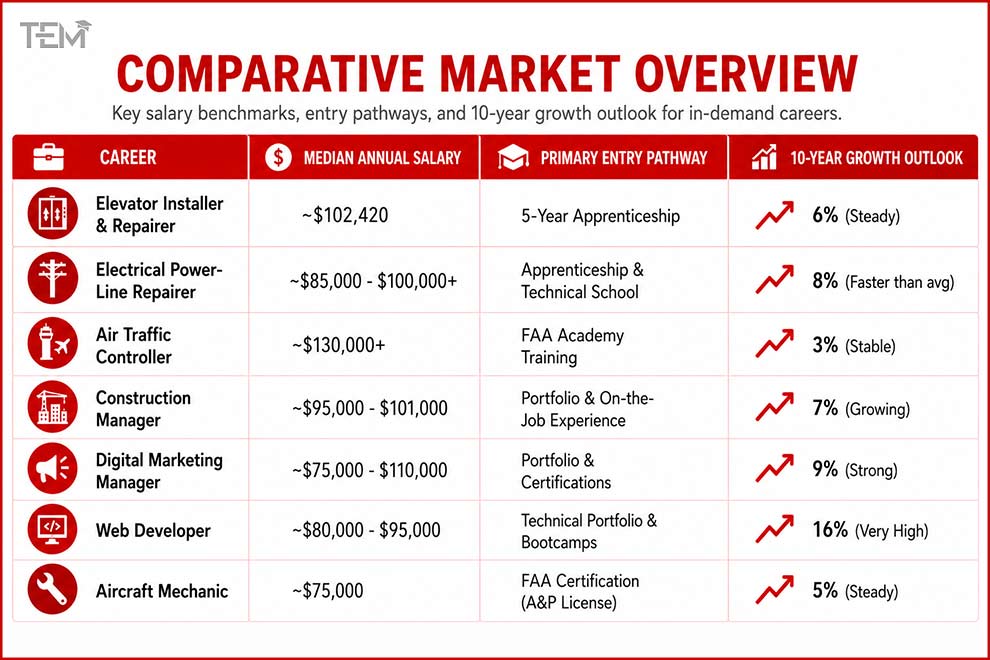
1. Skilled Trades & Industrial Infrastructure
Elevator and Escalator Installer and Repairer
- Typical Entry Requirements: High school diploma or equivalent, mechanical aptitude, and basic algebraic skills.
- Required Training: A structured, four-to-five-year employer-sponsored or union apprenticeship program.
- Future Demand: Robust, driven by urban vertical expansion and the modernization of older smart-building infrastructures.
- Daily Responsibilities: Reading architectural blueprints, installing electronic control systems, troubleshooting complex mechanical failures, and executing rigorous preventative safety audits.
- Who This Career Is Best For: Analytical thinkers who enjoy highly precise, hands-on mechanical problem-solving and are entirely comfortable working in enclosed spaces or at significant heights.
- Pros: Top-tier blue-collar compensation, paid “earn-while-you-learn” apprenticeship structures, and exceptional union benefits.
- Challenges: Highly physical work environment; requires lifting heavy components and strict adherence to dangerous safety protocols.
- Career Growth: Upward mobility into field inspection, safety consulting, project management, or regional maintenance supervisors.
Electrical Power-Line Installer & Repairer
- Typical Entry Requirements: High school diploma, exceptional physical fitness, and a clean commercial driving record.
- Required Training: Specialized vocational school programs combined with a multi-year technical apprenticeship.
- Future Demand: Highly stable, fueled by the ongoing modernization of municipal electrical grids and the integration of new renewable energy networks.
- Daily Responsibilities: Climbing utility poles or operating hydraulic bucket trucks, stringing high-voltage lines, replacing commercial transformers, and responding immediately to emergency storm outages.
- Who This Career Is Best For: Outdoor enthusiasts who maintain cool focus during high-pressure situations and are willing to work in severe weather.
- Pros: Premium earning potential augmented by substantial overtime opportunities; virtually recession-proof job security.
- Challenges: Demanding on-call schedules and exposure to high-risk technical environments that require absolute focus.
2. Technology & Digital Services
Web Developer
- Typical Entry Requirements: A demonstrable, high-quality digital portfolio showcasing functional code and clean design.
- Required Training: Self-directed online learning tracks, targeted coding bootcamps, or technical micro-credentials.
- Future Demand: Rapidly expanding as corporate commerce and interactive mobile interfaces dominate global business operations.
- Daily Responsibilities: Writing clean code using modern languages (HTML, CSS, JavaScript, Python), building responsive front-end user experiences, and maintaining back-end database structures.
- Who This Career Is Best For: Logical problem solvers, independent researchers, and creatives who thrive on continuous, rapid self-education.
Many successful web developers never stepped foot inside a computer science department. Instead, they built personal apps, contributed to open-source communities, and proved their execution through a real-world digital portfolio, an asset that contemporary tech companies prioritize over formal degrees.
- Pros: High flexibility with widespread remote work options and a seamless pathway toward lucrative independent freelancing.
- Challenges: Requires extensive desk time and a constant commitment to learning shifting software frameworks.
Digital Marketing Manager
- Typical Entry Requirements: A verifiable track record of driving online conversions, managing digital ad spend, or scaling web traffic.
- Required Training: Industry-validated specialized pathways (such as Google Career Certificates, HubSpot Academy, or Meta Blueprint certifications).
- Future Demand: Highly competitive and growing as media budgets shift entirely toward data-driven digital ad ecosystems.
- Daily Responsibilities: Overseeing multi-channel Search Engine Optimization (SEO) campaigns, configuring paid advertising funnels, analyzing user behavior metrics, and executing content deployment models.
- Who This Career Is Best For: Individuals who strike a balance between creative content production and quantitative data analysis.
- Pros: Fast-paced upward mobility inside corporate marketing departments or digital advertising agencies.
- Challenges: Adapting dynamically to constantly shifting algorithmic changes across search engines and social platforms.
Skills That Matter More Than Degrees
To excel in a non-degree pathway, you must build a verifiable competitive advantage. Employers evaluate candidates on core functional competencies rather than academic credentials:
- Technical Agility & AI Literacy: The ability to navigate specialized software platforms, utilize automated tooling, and use modern AI tools to streamline operational workflows.
- Systems Problem-Solving: Independently diagnosing mechanical flaws, code bugs, structural bottlenecks, or logistics failures without waiting for explicit supervision.
- Professional Communication: The cross-functional skill to translate complex, technical data into clear, actionable updates for clients, team members, or executives.
- A Definitive Portfolio: A live repository of your work, whether that means functioning codebases, documented construction project logs, or verified digital ad campaign case studies.
Micro-Credentials and Certifications That Replace College
You can bypass the university system by completing hyper-focused industry credentials that instantly communicate authority to a hiring manager:
- Technology & IT Support: CompTIA Security+, AWS Certified Solutions Architect, Cisco CCNA, or Google Data Analytics Certificates.
- Skilled Trades & Maintenance: HVAC Excellence Certification, State Journeyman Licensing, or American Welding Society (AWS) credentials.
- Logistics, Real Estate, & Sales: Commercial Driver’s License (CDL Class A) or a State-Approved Real Estate Broker License.
Entry-Level Pathways & Remote Career Options
High-Earning Jobs for Absolute Beginners
If you have zero prior field experience, these sectors offer accessible entry timelines along with clear paths to upward income mobility:
- IT Helpdesk / Technical Support: Serves as an exceptional foundational springboard into enterprise corporate technology ecosystems.
- B2B Sales Representative: Uncapped commission models allow high drive, persuasive communication, and consistency to dictate your ultimate earnings.
- Apprentice Plumber / Electrician: Allows you to access an immediate “earn-while-you-learn” framework where your hourly rate automatically scales with your experience.
High-Paying Remote Opportunities
If you prefer to build a career from a home office, focus on these non-degree digital options:
- Customer Success Specialist: Managing corporate accounts, onboarding corporate clients, and ensuring software platform retention.
- Corporate Bookkeeper: Organizing accounting ledgers, reconciling business expenses, and preparing essential financial summaries.
- Executive Virtual Assistant: Providing streamlined administrative, calendar, and operational support to busy remote corporate leadership teams.
Strategic Career Progression Roadmaps
Visualizing your career arc clarifies how to transition from an entry-level position to a lucrative leadership tier.
1. The Digital Marketing Career Pathway
To make it big in digital marketing, you start by learning basics like SEO and how to write ads. Next, practice what you learn by building a personal website or helping a local charity so you have real work to show employers. This portfolio helps you land your first job at a marketing agency or company team. As you get better and help businesses grow, you’ll move up to senior roles, and eventually, you can run the whole department as a Marketing Director.
2. The Skilled Trades Career Pathway
The journey in trades starts with basic vocational school or a prep course. This helps you land a paid apprenticeship where you earn money while learning on the job from pros. Once you finish your training hours, you take a state test to get your Journeyman License so you can work on your own. After a few years of hands-on experience, you can pass one final exam to get your Master Contractor License and launch your own successful business.
Realistic Salary Growth Timelines
Earnings in non-degree careers vary based on geographic location, individual specialization, and economic demand. The typical career timeline below illustrates how compensation scales through experience and continuous specialization:
Technology Pathways (e.g., Software Development / IT Operations)
- Starting Out: $45,000 – $60,000 (Entry-level support roles or junior portfolio work)
- 5 Years of Experience: $75,000 – $95,000 (Mastery of specialized tech stacks or cloud system architecture)
- 10+ Years / Senior Tier: $120,000+ (System Architects, Lead Engineers, or Technical Operations Managers)
Infrastructure Pathways (e.g., Electrical Trades / Industrial Maintenance)
- Starting Out: $35,000 – $50,000 (Paid entry-level apprentice scales)
- 5 Years of Experience: $75,000 – $100,000 (Achieving licensed Journeyman or Master technician status)
- 10+ Years / Senior Tier: $115,000+ (Master Contractors, Site Superintendents, or Independent Business Owners)
AI-Resistant, Future-Proof Careers
As automated machine learning models and digital workflows transform desk-bound corporate tasks, careers requiring physical dexterity, dynamic problem-solving, or human accountability remain resilient.
Professionals whose daily tasks rely on complex physical navigation or real-world situational judgment enjoy excellent long-term career security:
- Electricians, Plumbers, and HVAC Engineers: Unpredictable, physical environments are highly complex, making them incredibly difficult for robotics or digital software to replicate.
- Commercial Pilots & Air Traffic Controllers: Public safety systems require a layer of absolute human accountability, keeping these positions firmly insulated from full automation.
- Healthcare Support Specialists & Dental Hygienists: High-touch patient diagnostics, empathetic bedside care, and physical, precise clinical operations require human execution.
Critical Labor Market Trends
Employers today are focusing less on college degrees and more on practical skills. If you can demonstrate your abilities through certifications, portfolios, or hands-on experience, you’ll often be just as competitive as applicants with traditional degrees.
- The Skills-First Hiring Wave: Major tech employers, financial entities, and state governments are actively scrubbing traditional four-year college requirements from their recruitment guidelines, shifting focus toward direct competency testing.
- The Trade Labor Shortage: A significant, ongoing deficit of skilled infrastructure professionals has shifted market leverage to technicians, forcing firms to offer highly competitive compensation packages and signing bonuses.
- Continuous Micro-Credentialing: Rather than leaning on one static piece of academic paper, modern non-degree professionals maintain agility by stacking hyper-targeted certifications every 18 to 24 months to align with real-time market needs.
One common mistake professionals make is choosing an alternative career pathway based solely on the baseline salary numbers. Strong long-term earnings do not depend on a static diploma; they are unlocked through continuous credential building, strong interpersonal communication, and an agile willingness to adapt as your industry evolves.
Final Thoughts
Building a successful career without a college degree is not about avoiding an education; it is simply about choosing a more direct, practical form of education. Whether you choose to specialize through technical certifications, structured field apprenticeships, hands-on self-directed portfolios, or professional licensing, thousands of professionals build highly secure, six-figure careers every day.
Identify the sector that aligns with your natural problem-solving strengths, commit to obtaining your first actionable industry credential, and let your proven work speak for itself.
FAQ
1. What is the highest-paying job without a degree?
An air traffic controller is one of the highest-paying jobs that typically doesn’t require a bachelor’s degree, though specialized training and certification are required.
2. Can you make $100,000 a year without a college degree?
Yes, many careers in skilled trades, technology, aviation, sales, and real estate can pay over $100,000 with experience and relevant certifications.
3. What certifications can help you get a high-paying job without a degree?
Certifications like CompTIA, AWS, Cisco CCNA, Google Career Certificates, CDL, HVAC, electrician licenses, and real estate licenses can lead to high-paying careers without a degree.