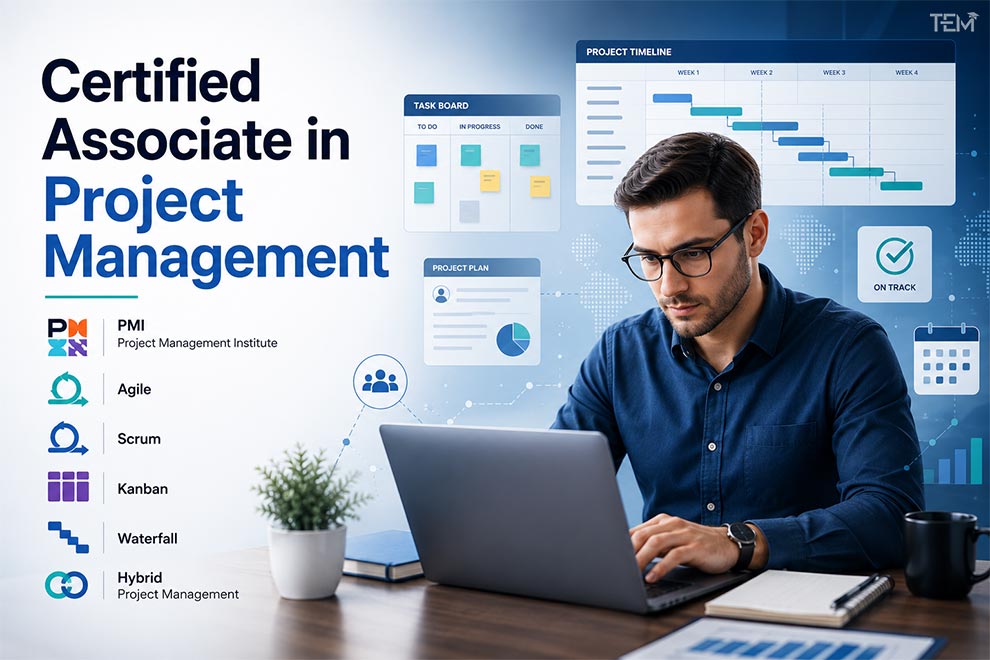
Imagine you have started applying for project coordinator jobs. Most positions ask for project management knowledge, but you do not yet have the experience required for certifications like PMP. This is exactly where the Certified Associate in Project Management can bridge the gap.
This guide will help you decide whether CAPM is the right certification for your career goals and explain how to get started.
In Short
- Best certification for beginners who want to enter the industry.
- No prior project experience required to qualify for the exam.
- Offered by PMI, making it a globally recognized credential.
- Good stepping stone toward earning your PMP later in your career.
What Is the Certified Associate in Project Management (CAPM)?
The Certified Associate in Project Management is a foundational, entry-level project management certification. It is offered by the Project Management Institute (PMI) and is designed specifically for beginners who lack extensive field experience. This global credential is highly valuable because it proves your understanding of fundamental project management practices, terminologies, and methodologies.
Key Takeaways Box
- Entry-level project management certification
- Offered by PMI
- Designed for beginners
- Recognized globally
- Builds foundational project management knowledge
CAPM Certification at a Glance
At the time of writing, the key details of this entry-level project management certification include the following structural elements:
| Feature | Details |
| Certification Provider | Project Management Institute (PMI) |
| Best For | Entry-level project managers, students, and career changers |
| Experience Required | None |
| Exam Format | According to PMI’s current certification policies, the exam consists of 150 questions over a 3-hour window. |
| Validity | Valid for a set period specified by PMI policies. |
| Renewal | Requires earning professional development units or passing a renewal process based on active PMI guidelines. |
Is CAPM Right for You? A Decision Guide
Before diving into the coursework, use this simple decision framework to see if this credential fits your current career stage:
Want your first PM job?
↓
YES
↓
Have project experience?
↓
NO
↓
Choose CAPM
Who Should Choose This Project Management Credential?
The entry-level project management certification appeals to a diverse group of professionals and students eager to validate their skills.
College Students & Recent Graduates
Current students and fresh graduates can position themselves as promising candidates. Having a PMI certification on your resume shows dedication to learning global standards early on, which helps balance a lack of practical experience.
Career Changers
Professionals from non-project backgrounds often struggle to prove they can handle structured tasks. Earning this project management credential provides a clear path to show recruiters that your skills translate perfectly into project-focused roles.
Entry-Level Professionals & Team Leads
If you are already working as a team lead or a junior team member, this training refines your day-to-day operations. It gives you the confidence to manage smaller projects independently and communicate effectively with senior managers.
Why Employers Value CAPM
Organizations do not just look for experience. They look for standardized knowledge. Employers highly value the PMI CAPM for three main reasons:
- Standardized project management terminology: It ensures everyone on the team speaks the same professional language.
- Demonstrates commitment to learning: Passing a rigorous exam shows you are dedicated to personal and professional growth.
- Familiarity with PMI practices: It proves you understand predictive, agile, and hybrid frameworks right out of the gate.
Why Beginners Choose This Entry-Level Project Management Certification
Choosing this credential provides practical, real-world outcomes that accelerate your career development.
- Learn project management fundamentals: You master the mechanics of scoping, budgeting, and scheduling.
- Improve employability: Certified individuals stand out in crowded applicant pools.
- Prepare for future certifications: The training hours can count toward advanced credentials like the PMP later on.
Consider the journey of a marketing assistant who wants to transition into technical project delivery. By earning this credential, they bridge the knowledge gap and secure a role as a project coordinator, eventually climbing to a senior project manager position.
Real Career Journey & Learning Roadmap
Your career path does not stop after one exam. This roadmap illustrates how professionals typically scale their careers:
College Student / Changer ➔ Earn CAPM ➔ Work on Small Projects ➔ Project Coordinator ➔ Lead Complex Projects ➔ Earn PMP
CAPM Eligibility Requirements & Checklist
According to PMI’s current certification policies, the CAPM certification requirements are intentionally accessible to ensure beginners can apply easily.
- Education: You must hold a secondary degree, such as a high school diploma, an associate degree, or its global equivalent.
- Project Management Education: At the time of writing, you must complete 23 contact hours of formal project management education before you take the exam.
CAPM Checklist
- High school diploma or equivalent
- Required 23 hours of project management education
- Active PMI account
- Exam registration submitted
- 4-week study plan prepared
- Practice exams scheduled
What Will You Learn Through This PMI Certification?
The learning domains focus heavily on practical skills that you can apply to everyday business operations.
Project Planning & Scheduling
You will learn how to build accurate timelines, define project scopes, and calculate schedule variances. This ensures your team hits milestones without missing critical deadlines.
Risk & Stakeholder Management
Imagine you are coordinating a software development project. Understanding risk and stakeholder management helps you communicate effectively with developers, clients, and executives so everyone stays perfectly aligned throughout the project lifecycle.
Agile Fundamentals
Modern teams rely heavily on flexible environments. You will study adaptive tracking methods and iteration planning, which allows you to pivot smoothly when project requirements change.
Skills Employers Expect After CAPM
| Skill | Why It Matters |
| Planning | Organizes project work logically from start to finish. |
| Communication | Coordinates diverse teams and keeps stakeholders updated. |
| Risk Management | Identifies potential bottlenecks and reduces project issues. |
| Scheduling | Keeps timelines on track and monitors project health. |
| Stakeholder Management | Aligns executive expectations with team deliverables. |
CAPM vs PMP: Which Certification Should Beginners Choose?
It is vital to compare these options to ensure you do not spend time and money on an exam you are not yet qualified to take.
| Feature | CAPM | PMP |
| Experience Required | None | 36 to 60 months of leading projects |
| Best For | Entry-level professionals | Experienced project managers |
| Difficulty | Foundational | Advanced and highly complex |
| Salary Potential | Competitive starting packages | Historically higher due to leadership tenure |
Which Should You Choose?
- Choose CAPM if: You have no formal experience leading projects, you are changing careers, or you are a recent graduate looking for a foot in the door.
- Choose PMP if: You already lead projects professionally, meet the multi-year experience criteria, and want to secure senior executive roles.
How to Earn the Certification (Step-by-Step)
- Verify your qualifications: Match your background against the official CAPM eligibility criteria.
- Complete your training: Enroll in a structured CAPM course to earn your 23 contact hours.
- Submit the application: Create an account on the PMI platform and fill out your application.
- Pay the fees: At the time of writing, the CAPM certification cost sits at $225 for PMI members and $300 for non-members, though you should check the official PMI site for updates.
- Begin your CAPM exam preparation: Use a targeted CAPM study guide and practice exams to build confidence.
- Pass the exam: Complete the 150-question test to earn your official project management credential.
Structured 4-Week Study Plan
A disciplined approach to your CAPM exam preparation ensures you pass on your first attempt.
- Week 1: Core Fundamentals. Read the official PMI materials and understand the foundational project environments.
- Week 2: Predictive Methodologies. Focus heavily on scope, scheduling, budgeting, and quality controls.
- Week 3: Agile and Hybrid Frameworks. Study Scrum, adaptive planning, and tools used in fast-paced industries.
- Week 4: Mock Tests and Review. Take full-length practice exams to master your pacing for the 3-hour testing window.
Is CAPM Worth It in 2026?
Investing in this certification remains highly rewarding for entry-level professionals. The global demand for organized talent continues to grow across major economic sectors. It builds immediate credibility, helps you bypass strict automated resume filters, and sets up a clear path for rapid professional advancement.
Industries That Hire CAPM Professionals
Project management is not restricted to a single sector. You can apply these methodologies across numerous fields:
- Technology and Software Development
- Healthcare and Pharmaceuticals
- Construction and Civil Engineering
- Finance and Banking
- Manufacturing and Logistics
- Government and Education
Career Opportunities and Role Deep Dives
Earning this credential makes you a strong candidate for several distinct career paths.
Project Coordinator
- Daily Responsibilities: Scheduling meetings, updating project trackers, and coordinating communication between teams.
- Salary & Progression: Offers competitive entry-level pay, progressing naturally into a junior project manager role.
- Industries Hiring: Technology, healthcare, and creative agencies.
Project Analyst
- Daily Responsibilities: Tracking project budgets, analyzing performance metrics, and flagging potential cost overruns.
- Salary & Progression: Varies by location and experience, leading toward a strategic PMO analyst role.
- Industries Hiring: Finance, manufacturing, and logistics.
Junior Project Manager
- Daily Responsibilities: Leading small-scale projects or managing specific sub-sections of massive enterprise initiatives.
- Salary & Progression: Highly competitive for beginners, setting the stage for full PMP certification.
- Industries Hiring: Construction, energy, and corporate consultancy.
Biggest Myths About the Exam
- Myth 1: CAPM guarantees a high-paying job immediately. ❌ Reality: It opens doors and gets your resume noticed, but you must still interview well and showcase soft skills.
- Myth 2: It is only useful for IT professionals. ❌ Reality: The frameworks apply to construction, healthcare, education, and finance equally.
- Myth 3: It replaces the need for actual fieldwork. ❌ Reality: The certification provides the theory, which you must then put into action on the job.
How to Prepare for the Exam
To maximize your chances of success, pair your reading with standard Project Management Skills development. Focus your energy on official PMI guides, use interactive flashcards for terms, and practice your Time Management strategies during mock tests. You can also explore our broader pillar pages covering Project Management Certifications and PMP Exam Preparation to understand how your current studies align with long-term career goals.
Final Thoughts
The Certified Associate in Project Management is a strong starting point for anyone looking to build a career in project management. While it will not replace hands-on experience, it demonstrates your commitment to learning project management principles and can help you stand out as you begin your professional journey. By understanding the rules, mastering the core terminology, and preparing diligently, you can confidently take this step to advance your career goals.
FAQ
- Is CAPM good for beginners?
Yes. The CAPM is specifically built as an entry-level project management certification, making it ideal for those without field experience.
- Is CAPM recognized internationally?
Yes. Because it is administered by PMI, this certification is respected and recognized by global organizations.
- How difficult is the CAPM exam?
It is thorough and requires dedicated study, but it remains highly achievable if you follow a structured 4-week study plan.
- Can students earn CAPM certification?
Yes. It is an excellent way for college students and recent graduates to boost their resumes before entering the job market.
- Is CAPM worth it without experience?
Absolutely. It acts as verified proof that you understand professional workflows, helping you secure your very first project role.