Quran recitation is not simply about reading Arabic words correctly — it is about honoring the exact way the words of Allah were revealed and transmitted, sound by sound, across fourteen centuries. This precision is called Tajweed, and the highest formal recognition a student can earn in this discipline is known as an Ijazah. For students, teachers, and parents exploring Quranic education today, understanding what an Ijazah truly represents — and why it still matters in a digital learning era — is essential.
What Is Tajweed?
Tajweed is the set of rules governing how the Quran should be pronounced. It covers the correct articulation points (makharij) of Arabic letters, rules of elongation (madd), nasalization (ghunnah), merging of sounds (idgham), and dozens of other subtle rules that ensure the Quran is recited exactly as it was revealed to the Prophet Muhammad (peace be upon him). Without Tajweed, even a fluent Arabic reader can unintentionally alter the meaning of a verse through mispronunciation.
Muslims are taught from a young age that reciting the Quran “beautifully and correctly” is not optional — it is considered an act of worship in itself. This is why the Online Tajweed Course has remained a core part of Islamic learning traditions for over a thousand years, and why interest in structured, certified Tajweed programs continues to grow globally, especially among adult learners and the Muslim diaspora seeking authentic instruction outside traditional madrasah settings.
What Does “Ijazah” Actually Mean?
The word Ijazah literally translates to “permission” or “authorization.” In the context of Quranic sciences, an Ijazah is a formal certificate granted by a qualified teacher (an Ustadh or Ustadha) to a student, confirming that the student has:
- Mastered the rules of Tajweed in both theory and application
- Recited the complete Quran (or a designated portion) directly to the teacher, with the teacher listening and correcting in real time
- Demonstrated a level of proficiency worthy of being authorized to recite — and in many cases, to teach — Tajweed to others
What makes an Ijazah unique compared to a standard course completion certificate is the chain of transmission, or isnad. Every certified teacher can trace their own Ijazah back through a continuous chain of teachers, generation after generation, ultimately connecting to the Prophet Muhammad himself. When a student receives an Ijazah, they are not just being told “you read well” — they are being formally linked into this unbroken oral tradition that has preserved the Quran’s recitation with remarkable consistency across centuries and continents.
Why an Ijazah Is Different From a Regular Tajweed Course
Many online platforms offer introductory Tajweed classes, and these are valuable for beginners learning the basics of Arabic pronunciation. However, an Ijazah-track program is structured differently:
- One-on-one recitation with a certified teacher — Ijazah cannot be earned through video lectures or self-study alone. It requires live, verified recitation.
- Rigorous assessment standards — Teachers evaluate not just accuracy but consistency, fluency, and command of the rules under different recitation conditions.
- A recognized credential — An Ijazah carries weight within the global Islamic education community. It can open doors for students who wish to lead prayers, teach Quran classes, or pursue further study in Quranic sciences.
- Long-term mentorship — Because the process typically spans months, students build a genuine teacher-student relationship rather than a transactional course experience.
Who Should Consider Pursuing an Ijazah?
An Ijazah is not reserved only for those planning to become Quran teachers. Increasingly, everyday Muslims — students, working professionals, and parents — are pursuing Ijazah certification simply to strengthen their personal connection with the Quran and to ensure their own recitation meets the authenticated standard. Common reasons students pursue Ijazah training include:
- Wanting to lead prayers (Salah) with confidence
- Preparing to teach children or community members
- Correcting long-standing pronunciation habits picked up without formal guidance
- Seeking a deeper spiritual and academic milestone in their Quranic journey
The Shift Toward Online Ijazah Programs
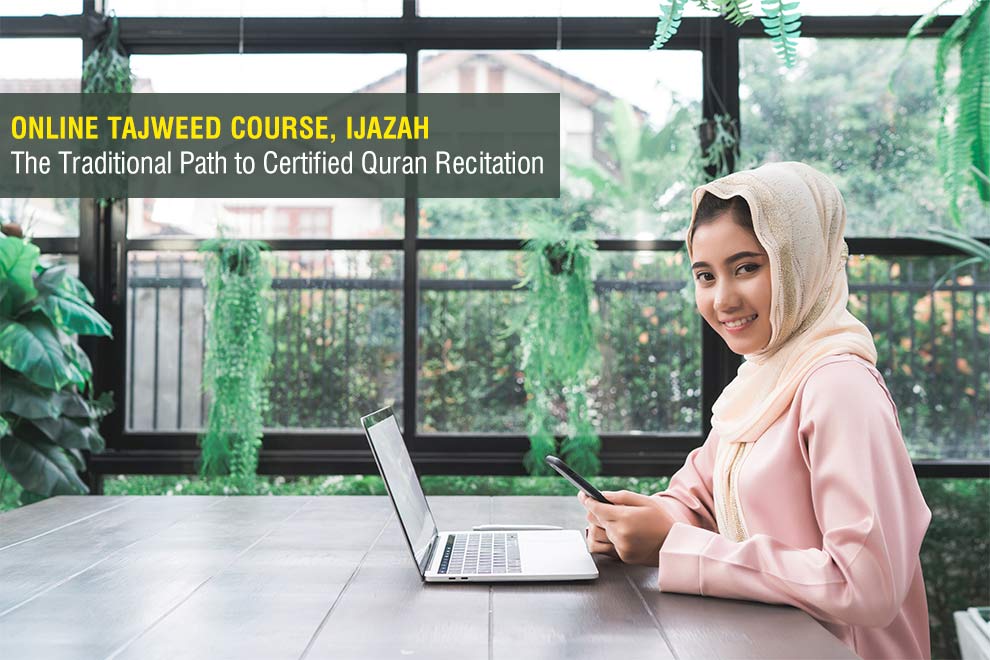
Traditionally, earning an Ijazah meant studying in person with a scholar, often requiring travel to established centers of Islamic learning. Today, verified online Tajweed Ijazah courses have made this credential accessible to students worldwide, without compromising the core requirement of live, teacher-supervised recitation. Reputable programs still maintain one-on-one sessions via video call, ensuring the authenticity of the traditional Ijazah process is preserved even in a virtual format.
For students exploring this path, it’s worth researching platforms that combine qualified, chain-certified instructors with structured curricula — such as the Tajweed Ijazah Course offered by Usmani Academy, which follows the traditional teacher-to-student certification model in an online setting.
Final Thoughts
In an age when self-study apps and quick-fix pronunciation guides are everywhere, the Ijazah system stands out as a reminder that some forms of knowledge are meant to be transmitted person-to-person, with accountability and authenticity built in. For students serious about mastering Quran recitation, pursuing a proper Tajweed Ijazah is not just an academic milestone — it is a continuation of a scholarly tradition stretching back to the earliest days of Islam.
Also Read: Best Project Management Certifications in 2026: Complete Career Guide